
Core Web Vitals are three Google metrics that measure how your website actually feels to a real visitor: how fast the main content loads, how quickly the page reacts when someone taps or clicks, and how steady everything stays while the page comes together. They matter because they influence both where you rank in Google and whether visitors stay long enough to become customers. When these numbers are good, your site feels quick and trustworthy. When they are poor, people feel the lag even if they cannot name it, and they leave.
If you run or manage a small business website, Core Web Vitals can sound like developer jargon that lives in a report you never open. This guide fixes that. We will explain what each of the three metrics measures, what a "good" score looks like, why they affect your rankings and your revenue, how they are measured, and the practical changes that move them in the right direction. No fluff, no acronym soup left unexplained.
What are Core Web Vitals?
Core Web Vitals are a small set of real-world performance signals that Google uses to describe the quality of a page's user experience. They are part of Google's broader "page experience" signals, and they feed into Search rankings. What makes them different from older speed scores is that they are built around what a real person experiences: not just how fast a server responds, but how fast the page becomes useful, how promptly it answers a click, and whether the content jumps around as it loads.
Google settled on three metrics because each one captures a different kind of frustration. One measures loading, one measures responsiveness, and one measures visual stability. Together they form a simple, honest picture of whether your site respects a visitor's time. Because they are tied to search visibility, they sit at the intersection of engineering and marketing, which is exactly where a lot of small business websites quietly lose ground.
The three metrics that make up Core Web Vitals
There are three metrics, each with a clear target. Google grades them at the 75th percentile of real visits, which is a fancy way of saying the experience has to be good for most of your visitors, not just the lucky ones on fast phones and fast connections.
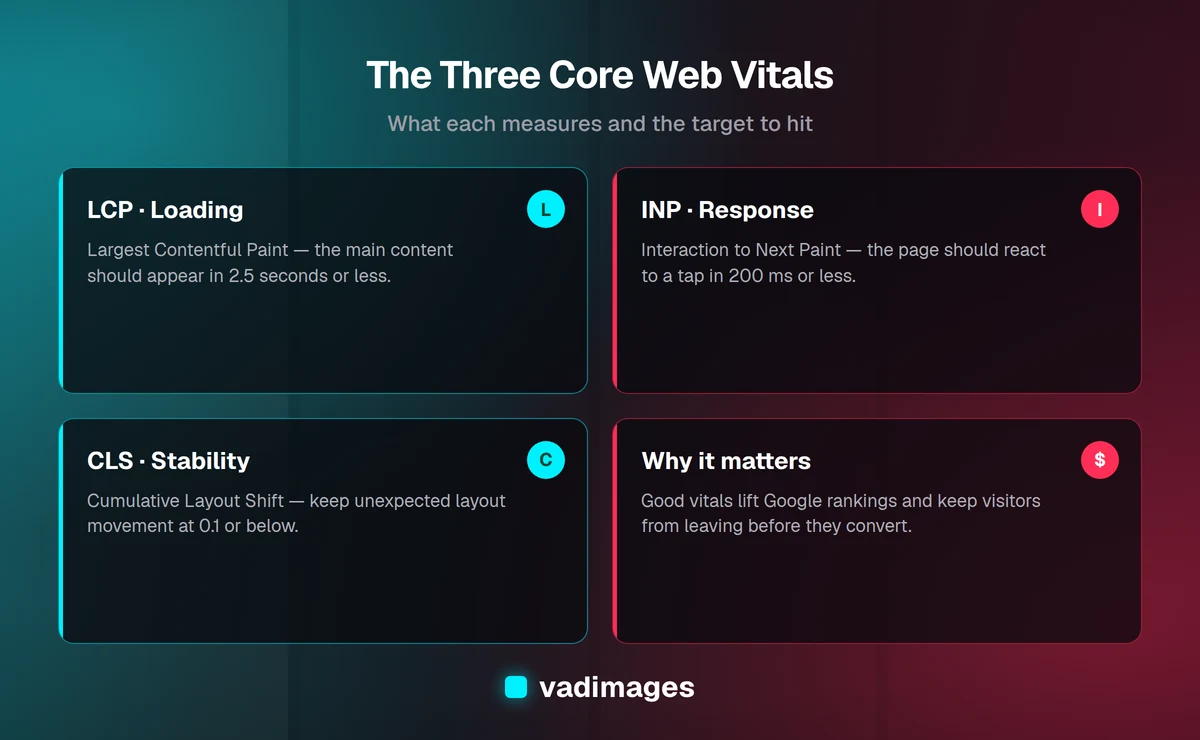
- Largest Contentful Paint (LCP) — loading. This measures how long it takes for the biggest, most important piece of content on the screen (usually a hero image, a headline, or a banner) to become visible. Aim for 2.5 seconds or less. Anything past 4 seconds is considered poor. LCP answers the visitor's first silent question: "Is this page actually going to load?"
- Interaction to Next Paint (INP) — responsiveness. This measures how quickly the page visibly reacts when someone interacts with it, tapping a button, opening a menu, or typing in a field. Aim for 200 milliseconds or less. INP replaced the older First Input Delay metric in 2024 because it captures the full experience of interacting with a page, not just the first click. A sluggish INP is that maddening moment where you tap and nothing happens, so you tap again.
- Cumulative Layout Shift (CLS) — visual stability. This measures how much the page unexpectedly moves around while it loads. Aim for a score of 0.1 or less. High CLS is why you go to tap a link and an ad or image loads in at the last second, shoving the button down and making you click the wrong thing. It feels cheap and it erodes trust.
Why Core Web Vitals matter for your business
There are two reasons to care, and they reinforce each other. The first is search visibility. Google uses Core Web Vitals as a ranking signal, so a faster, steadier site has an edge over a slower competitor with otherwise similar content. It is not the only factor (great content still wins), but when two pages are close, the better experience can be the tiebreaker that puts you above a rival on page one.
The second reason is the one that actually pays your bills: conversions. Every extra second of load time gives a visitor another reason to give up. People decide within moments whether a site feels fast and legitimate, and a slow or jumpy page quietly bleeds away the leads and sales you paid to attract. Your ad spend, your SEO work, and your social posts all funnel people to a page, and if that page feels sluggish, a share of them leave before they ever see your offer. Core Web Vitals are, in plain terms, a proxy for how much money your website is leaving on the table.
This is why we treat performance as a business metric, not a vanity score, in the custom software and websites we build. A fast site is not about impressing engineers. It is about respecting the visitor enough that they stick around and take the next step.
Field data vs. lab data: why the numbers sometimes disagree
Here is a distinction that trips up a lot of business owners. There are two ways to measure Core Web Vitals, and they can tell different stories about the same page.
Field data (also called real-user monitoring) comes from actual Chrome visitors over a rolling 28-day window. This is what Google uses for ranking, and it is the data that shows up in the Core Web Vitals report inside Google Search Console. It reflects your real audience on their real devices and networks, which is exactly why it is the version that counts.
Lab data comes from a controlled test that loads your page in a simulated environment, such as Google's PageSpeed Insights or the Lighthouse tool built into Chrome. Lab tests are fast, repeatable, and great for diagnosing problems, but they run on a single simulated device and connection, so they will not perfectly match what your real visitors experience. The practical rule: use lab tools to find and fix issues, and trust field data to tell you whether the fixes actually helped the people who matter.
What commonly drags each metric down
Poor scores almost always trace back to a short list of usual suspects. Once you know what to look for, most problems are recognizable.
- Slow LCP is usually caused by huge, uncompressed hero images, slow or overloaded hosting, render-blocking scripts and stylesheets, or a page that waits on too many third-party tools before it can show anything.
- Poor INP is usually caused by heavy JavaScript, especially bloated page builders, redundant plugins, and marketing or analytics tags that keep the browser busy and unable to respond to taps.
- High CLS is usually caused by images and ads without reserved space, fonts that swap and reflow the text, or banners and pop-ups that inject themselves after the page has already started rendering.
If your site is built on an off-the-shelf theme stacked with a dozen plugins, there is a good chance all three of these are working against you at once. That is not a moral failing, it is just what happens when a site grows by accretion instead of by design.
How to improve your Core Web Vitals
The good news is that the fixes are well understood, and you rarely need to do all of them to see real gains. In rough order of impact:
- Fix your images first. Compress them, serve modern formats like WebP, size them correctly for where they appear, and lazy-load anything below the fold. Oversized images are the single most common cause of a slow LCP, and this is often the highest-leverage change you can make.
- Get on solid hosting and a CDN. Cheap shared hosting adds latency to everything. A good host plus a content delivery network puts your pages physically closer to your visitors and cuts the time before anything appears.
- Trim the JavaScript. Audit your plugins and third-party scripts, remove what you do not use, defer what can wait, and be honest about which marketing tags actually earn their keep. This is usually where INP is won or lost.
- Reserve space for everything. Give images, embeds, and ad slots explicit dimensions so the layout does not jump, and load fonts in a way that avoids a visible reflow. These are the moves that tame CLS.
- Measure, change one thing, measure again. Use PageSpeed Insights to diagnose and Search Console to confirm the field data improved. Guessing is how teams burn weeks on changes that move nothing.
For a lot of small businesses, the honest answer is that a page bolted together from a heavy theme and endless plugins has a low ceiling, no matter how much you tune it. When that is the case, a purpose-built site pays for itself in speed and stability. That is the approach we take in how we work: build lean, measure real-user data, and optimize for outcomes rather than for a screenshot of a perfect score.
Where Core Web Vitals fit in the bigger picture
It is worth keeping perspective. Core Web Vitals are important, but they are not the whole game. A lightning-fast page with thin, unhelpful content will still lose to a slightly slower page that genuinely answers the visitor's question. Think of good vitals as table stakes: they remove friction so your content, your offer, and your credibility can do their job. They will not rescue a weak website, but they will stop a strong one from being undermined by an experience that feels broken.
Performance also compounds with everything else you invest in. It supports your services and solutions, it protects the traffic your SEO earns, and it applies across every kind of business we work with, from storefronts to booking systems to internal tools, as our case studies and industries pages show. Fast is not a feature you add at the end. It is a property of a site that was built with care from the start.
The bottom line
Core Web Vitals boil down to a simple promise to your visitors: the page will load quickly, respond when they touch it, and stay put while it does. Hit the targets (LCP at 2.5 seconds or less, INP at 200 milliseconds or less, and CLS at 0.1 or less) and you protect both your search rankings and the conversions your site was built to earn. Miss them, and you pay for it in visitors who leave before they ever see what you offer.
If your site feels slow, jumpy, or just a step behind your competitors, it is worth finding out exactly where the time is going and what it would take to fix it. Get in touch with Vadimages and we will give you a straight read on your Core Web Vitals and a plan to improve them, with transparent pricing and no jargon. We build for humans and optimize for growth, and fast is where that starts.