
Custom healthcare software development means building the patient portals, scheduling, intake, billing, and telehealth tools your practice actually needs — designed around your workflows and engineered for HIPAA-grade security. The right approach is rarely all-custom or all-off-the-shelf; it is a deliberate mix, chosen with a partner who understands clinical operations and compliance.
If you run or administer a medical, dental, behavioral health, or specialty practice, you have felt the friction: staff re-keying data between systems, patients calling to book because your website cannot, no-shows draining revenue, and an EHR that does not quite fit how you work. This guide explains what to build, what to buy, and how to choose a development partner who treats security and compliance as first-class requirements rather than an afterthought.
What does healthcare software development actually cover?
Healthcare software development is the practice of designing, building, integrating, and maintaining the digital tools a care organization uses to run its clinical and administrative operations. For a typical outpatient practice, that footprint usually includes a handful of connected capabilities:
- Patient portals — secure logins where patients view records, message the care team, complete forms, review results, and pay bills.
- Online scheduling — real-time booking, rescheduling, and automated reminders that cut no-shows and reduce phone volume.
- Intake automation — digital forms, insurance capture, e-signatures, and consent that flow directly into your systems instead of a clipboard and a scanner.
- EHR/EMR integration — connecting your electronic health or medical record system so data moves once, cleanly, without manual re-entry.
- Billing and revenue tools — eligibility checks, claims support, patient statements, and online payments.
- Telehealth — secure video visits, virtual waiting rooms, and documentation that ties back to the patient chart.
Underneath all of it sits the layer that matters most: security and HIPAA-aligned data handling. In healthcare, how you store, transmit, and control access to protected health information (PHI) is not a feature — it is the foundation everything else is built on.
Should a practice build custom software or buy off-the-shelf?
This is the first real decision, and the honest answer is: usually both. The goal is not to prove you can build everything from scratch. The goal is to spend your budget where custom work creates real advantage and to buy well-established tools everywhere else.
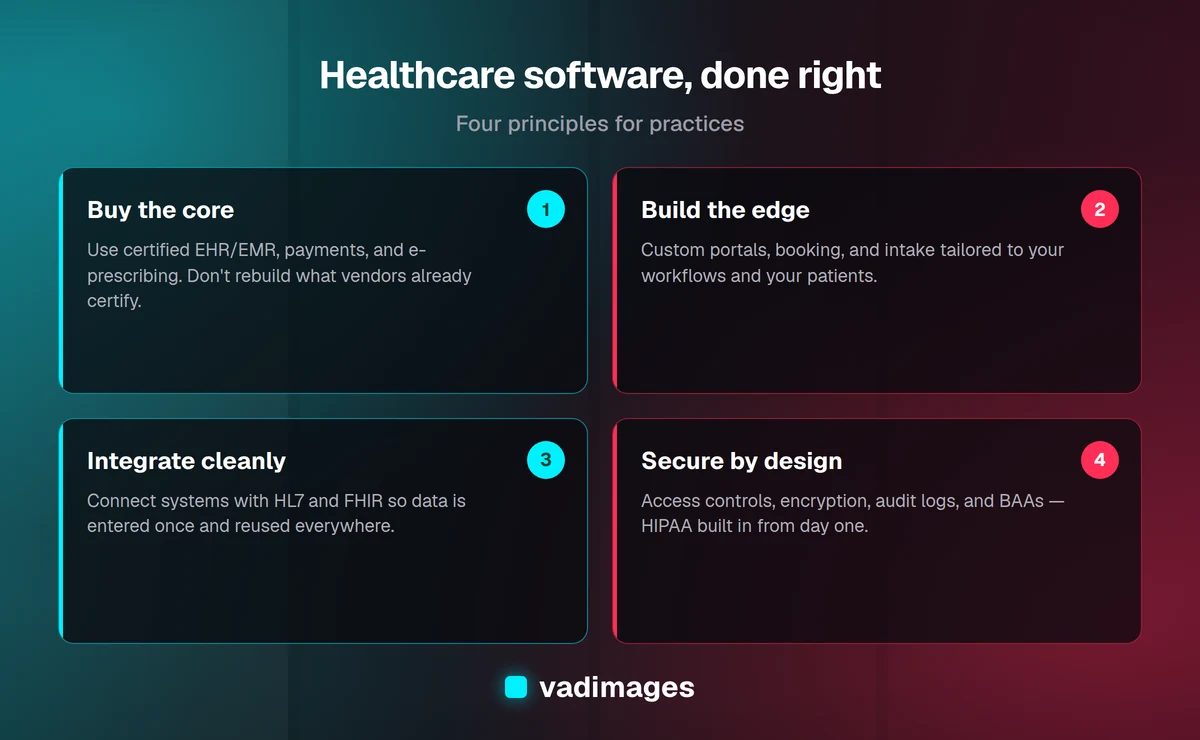
Buy off-the-shelf when the capability is standardized, heavily regulated, and not a source of differentiation. Your core EHR/EMR is the clearest example. Certified record systems represent enormous, ongoing compliance and engineering investment, and no practice should try to rebuild one. The same logic often applies to payment processing, e-prescribing, and lab connectivity, where certified vendors and networks already exist.
Build custom when the tool touches your specific workflow, your patient experience, or the seams between systems that vendors leave unaddressed. A few common examples:
- A patient portal or booking experience that matches your brand, specialties, and appointment types instead of a generic template.
- Intake and triage flows tailored to how your clinicians actually work.
- Integration middleware that stitches together an EHR, a scheduling tool, and a billing system that were never designed to talk to each other.
- Internal dashboards and reporting that reflect the metrics your leadership cares about.
A practical rule of thumb: if a capability is a commodity, buy it; if it is where you lose hours every week or where patients judge you, that is a candidate for custom development. Most healthy solutions are a well-chosen commercial core surrounded by custom integration and experience layers.
Why do EHR/EMR integrations matter so much?
Integration is where most practices feel the deepest pain and where good software development delivers the fastest return. When your portal, scheduler, intake forms, and billing all connect to a single source of truth, data is entered once and reused everywhere. When they do not, staff become human middleware — copying names, dates, and insurance details between screens, introducing errors and burning time.
Modern healthcare integration typically relies on interoperability standards such as HL7 and FHIR, along with the APIs your EHR vendor exposes. A capable development partner will map your data flows, confirm what your systems support, and build integrations that are reliable and auditable. Done well, integration reduces manual work, shortens the path from booking to billing, and gives you cleaner data to run the practice on.
What role does HIPAA compliance and security play?
Note: the following is general information, not legal advice. Work with qualified counsel and compliance professionals for guidance specific to your practice.
Any software that creates, receives, stores, or transmits PHI falls within the scope of HIPAA's Privacy and Security Rules. For a development project, that translates into concrete engineering and operational requirements that should be designed in from day one, not bolted on before launch:
- Access controls — unique user identities, role-based permissions, and least-privilege access so people see only what their job requires.
- Encryption — protecting PHI both in transit and at rest using current, industry-standard methods.
- Audit logging — recording who accessed what and when, so activity can be reviewed and anomalies investigated.
- Authentication — strong credentials and multi-factor authentication for staff and, where appropriate, patients.
- Business Associate Agreements (BAAs) — signed agreements with every vendor and hosting provider that touches PHI, including your cloud platform.
- Secure hosting — infrastructure configured for healthcare workloads, with a provider willing to sign a BAA and support your safeguards.
- Risk analysis and safeguards — an ongoing process of identifying risks to PHI and applying administrative, physical, and technical protections.
Security is not a one-time checkbox. It is a discipline that continues through maintenance, monitoring, patching, and incident response. When you evaluate a partner, ask how they handle each item above — not whether they have heard of HIPAA, but how compliance shows up in their architecture, their hosting choices, and their day-to-day process.
What should patient-facing tools like portals and telehealth get right?
Patients now expect the same convenience from their doctor's office that they get from every other service they use. That does not mean chasing trends; it means removing friction. A strong patient portal lets people accomplish real tasks — book, reschedule, complete intake, view results, message the team, and pay — without calling during business hours.
Good patient-facing software also respects accessibility and clarity. Older patients, patients with disabilities, and patients on slow connections all need to succeed. That means readable interfaces, mobile-friendly layouts, and flows that do not assume technical fluency. Telehealth adds its own requirements: a reliable, secure video experience, a clear pre-visit process, and documentation that ties back to the chart so a virtual visit is as complete as an in-person one.
The measure of success here is simple. Fewer phone calls for routine tasks, fewer no-shows, faster intake, and patients who feel taken care of before they ever walk in. Those outcomes are worth designing for deliberately.
How do you choose a development partner who understands compliance?
The technology matters, but the partner matters more. Many capable software teams have never handled PHI, and healthcare is an unforgiving place to learn on the job. When you evaluate firms, look past the portfolio and probe how they think about risk, integration, and the long term. Useful questions include:
- Have you built software that handles PHI, and how did you address HIPAA safeguards? Listen for specifics about access control, encryption, logging, and BAAs — not vague reassurance.
- Will you sign a Business Associate Agreement? A partner who touches PHI should expect this and be ready for it.
- How do you approach EHR/EMR integration? Look for familiarity with standards like
HL7andFHIRand a clear process for mapping data flows. - What happens after launch? Compliance and security require ongoing maintenance, monitoring, and updates. Understand who owns that and how it is priced.
- How do you handle discovery and scope? A serious partner invests in understanding your workflows before writing code, and is honest about what to build versus buy.
- Is your pricing transparent? You should understand what you are paying for and why, without surprises.
At Vadimages, we build custom software for organizations that cannot afford to get security wrong, and we are candid about where an off-the-shelf tool will serve you better than custom code. Our pricing starts at $5,000 and is transparent from the first conversation. You can see how we run engagements on our how we work page, and the kinds of systems we build on our custom software page.
What does a typical project look like and cost?
Every practice is different, but most engagements follow a recognizable arc. It starts with discovery — mapping your workflows, systems, and goals, and deciding together what to build versus buy. Then comes design and architecture, where the security model, integrations, and user experience are defined. Development proceeds in reviewable increments so you see progress and can adjust. Before launch, testing and security review confirm the system behaves correctly and protects PHI. After launch, maintenance keeps it secure, current, and reliable.
Costs scale with scope. A focused project — say, a custom booking and intake experience integrated with your existing EHR — sits at the lower end. A broader platform spanning portal, telehealth, billing, and multiple integrations represents a larger investment. Because the honest answer depends on your specific systems and goals, the most useful next step is a conversation, not a generic quote. Transparent pricing means we tell you what things cost and why, early.
Frequently asked questions
Do we need custom software if we already have an EHR? Often, yes — but as a complement, not a replacement. Your EHR is the record system; custom work usually lives around it, improving scheduling, intake, patient experience, and the integrations that make everything work as one.
Is custom healthcare software HIPAA compliant by default? No software is automatically compliant. Compliance depends on how the system is designed, hosted, operated, and maintained, and on your practice's policies. The right partner engineers safeguards in from the start, but compliance is an ongoing shared responsibility.
How long does a project take? A focused build can take a couple of months; a broader platform takes longer. Discovery gives you a realistic timeline before you commit to full development.
Can you integrate with our existing systems? Usually. It depends on the APIs and standards your systems support, which is one of the first things we confirm during discovery.
Is this legal advice on HIPAA? No. This article is general information. For compliance decisions specific to your practice, work with qualified legal and compliance professionals alongside your development team.
The bottom line
Good healthcare software development is not about building everything or buying everything — it is about making deliberate choices, integrating cleanly, and treating security and HIPAA compliance as foundational. Buy the certified core, build the workflow and experience layers that set you apart, and choose a partner who can speak fluently about both. Do that, and your software stops being a source of daily friction and starts quietly saving time, reducing errors, and improving how patients experience your practice.
If you are weighing a patient portal, scheduling, intake automation, an EHR integration, telehealth, or a broader custom build, we would be glad to talk it through — including where you should not build custom. Start a conversation on our contact page. We build for humans, optimize for growth.