
Most SaaS products do not fail because the code was bad. They fail because nobody wanted them badly enough to pay. The painful part is that founders usually learn this after spending six figures and a year of evenings on a build. Learning it in three weeks, for a few hundred dollars, is the entire point of validation.
This guide is the practical version of how to validate a SaaS idea before you build: what to test, in what order, what counts as a real signal, and when it is finally time to hire a team. It is written for US small-business founders and operators who have a product idea and a limited budget, not for venture-backed startups with runway to burn.
What validation actually means
Validation is not asking friends whether your idea sounds cool. Friends are polite, and politeness is not demand. Validation means collecting evidence that a specific group of people has a specific problem, that they already spend time or money trying to solve it, and that they will pay you to solve it better.
Notice the three claims inside that sentence. You are testing the problem, the current behavior, and the willingness to pay. An idea that passes only the first test is a hobby. An idea that passes all three is a business worth building.
Step 1: Write the idea as a falsifiable sentence
Before you talk to anyone, force the idea into one sentence you could be proven wrong about. Use this template: "[Specific customer] struggles with [specific problem] and currently handles it by [workaround]. We will replace that with [product] for [price]."
For example: "Independent HVAC contractors in the Pacific Northwest lose hours each week re-entering job details between their calendar and their invoices. They handle it with spreadsheets. We will replace that with a scheduling-to-invoice tool for a monthly subscription." If you cannot fill in the brackets, you are not ready to build. You are ready to research.
- Specific customer: a job title and industry, not "small businesses."
- Specific problem: something that costs time, money or stress today.
- Current workaround: spreadsheets, email, a competitor, or doing nothing.
- Price hypothesis: a number you can test, even if it is wrong.
Step 2: Talk to real customers, and ask about the past
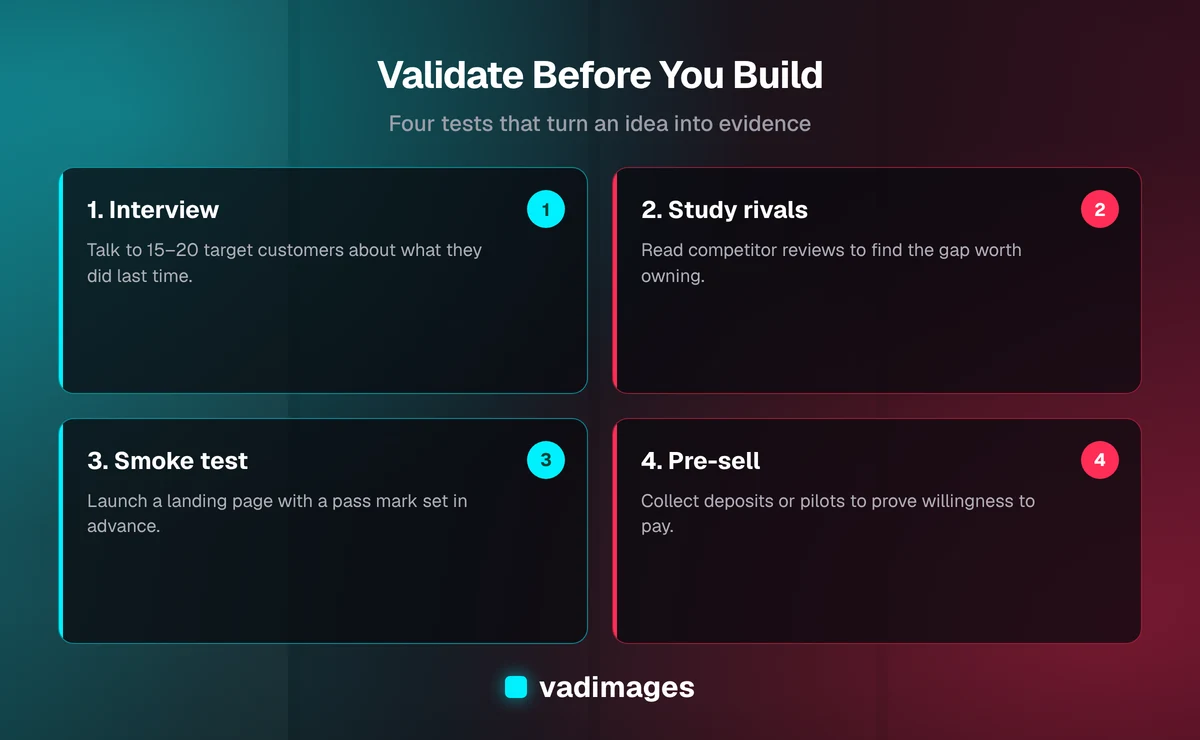
Aim for 15 to 20 conversations with people who match your customer sentence. Find them in industry forums, LinkedIn, local trade groups, and your own network's second-degree connections. Keep each call to 20 to 30 minutes.
The rule that matters most: ask about what people did, not what they would do. "Would you use a tool like this?" invites a polite yes. "Tell me about the last time this went wrong" invites a story, and stories contain real detail.
- Walk me through the last time you dealt with this problem.
- What did you try? What did it cost you in time or money?
- What tools or people do you use for this today, and what annoys you about them?
- If this disappeared tomorrow, what would change for you?
- Who else is involved in deciding to pay for something like this?
Listen for emotion, specifics, and existing spend. A person who says "it is annoying" is mildly interested. A person who says "I pay a bookkeeper $400 a month just to fix this" has handed you a price anchor.
Step 3: Study the competition, because competitors are good news
Founders often panic when they find competitors. Reverse that reaction. Existing products mean people already pay for a solution, which is the hardest thing to prove. Your job is to find the gap.
Read the reviews of the two or three closest competitors, especially the three-star ones. Look for repeated complaints: too complex, too expensive, missing an integration, built for enterprises rather than a five-person shop. Each repeated complaint is a candidate wedge for your positioning. If there are no competitors at all, be suspicious: either the market is tiny or the problem is not painful enough to pay for.
Step 4: Run a smoke test with a landing page
Once you have a sharp picture of the problem, build a one-page site that describes the product as if it exists. Include the headline benefit, three to four bullet points, an indicative price, and a single call to action such as "Join the early-access list" or "Book a 15-minute demo."
Then send targeted traffic to it. A small paid campaign, a post in the communities where your customers gather, or direct outreach to the people you interviewed all work. You are not measuring vanity traffic. You are measuring the percentage of the right visitors who take the next step.
Decide your pass mark before launching, not after. For example: "If at least 30 of the first 300 qualified visitors join the waitlist, we continue." Setting the bar in advance stops you from rationalizing a weak result. The exact numbers depend on your market, so treat any benchmark you read online, including this article's example, as a starting point rather than a guarantee.
Step 5: Test willingness to pay, not just interest
An email address costs a visitor nothing. Money, or a credible commitment of money, costs them something. Move from interest to commitment as quickly as you can.
- Pre-sales: offer a discounted founding-member price and collect payment or a deposit before the product exists.
- Letters of intent: for business customers, a short signed note saying they will pilot the product at an agreed price.
- Paid pilots: charge a small fee to deliver the outcome manually; the fee proves the problem is worth solving.
- Price conversations: ask interviewees to react to a real price and watch their face, not just their words.
If nobody will pay even a small deposit, that is not a failure of your pitch. It is information, and it just saved you a build budget.
Step 6: Deliver the outcome by hand first
The most underrated validation technique is the concierge MVP. Before writing software, deliver the result manually to five to ten paying customers. If your product will automatically generate weekly reports, produce those reports yourself in a spreadsheet and email them.
Manual delivery teaches you which steps actually matter to the customer, which features are noise, and how much time the work really takes. Those lessons turn directly into a tighter specification, and a tighter specification is the single biggest lever on development cost.
A related option is the "Wizard of Oz" prototype: customers see a polished interface, while you do the work behind the curtain. It lets you test the experience before you invest in the automation underneath.
Signals that mean go, adjust, or stop
After three to six weeks, review the evidence honestly against the bar you set at the start.
- Go: interviewees describe the problem unprompted, several already spend money on workarounds, your landing page cleared its pass mark, and at least a handful of people paid or signed a commitment.
- Adjust: the problem is real but your first customer segment, price or feature focus is off. Re-run steps 2 to 5 with the new angle.
- Stop: people are polite but nobody commits, the problem is rare, or the workaround is good enough. Stopping here is a win. You keep your budget for a better idea.
Common validation mistakes
- Asking leading questions. "Wouldn't it be great if..." produces agreement, not truth.
- Surveying the wrong people. Opinions from non-buyers are noise.
- Counting compliments as demand. Praise is free; payment is not.
- Building a full product to "test" it. That is not testing, it is gambling with a long fuse.
- Moving the goalposts. If the result misses the pass mark, change the idea, not the mark.
When it is time to build, and what to build first
Once the evidence says go, resist the urge to build everything on your list. Define the smallest version that delivers the one outcome your paying customers care about most. Everything else goes on a later roadmap. A focused first release is cheaper, ships faster, and gives you real usage data to steer the next investment.
This is where a good development partner earns their fee. A team that has seen many launches can tell you which features to defer, which integrations are worth the cost, and how to design the architecture so growth does not force a rewrite. Our own process starts with a short discovery phase for exactly that reason, and our custom software and solutions pages show what we build.
On cost, we are transparent: Vadimages projects start at $5,000+, and the final number depends on scope. The validation work above makes that number smaller and more predictable, because you arrive with real customer insight instead of guesses. See our pricing page for how we scope, or browse case studies and industries we serve for related examples.
A simple six-week validation plan
- Week 1: write the falsifiable sentence, list 30 target people, and book interviews.
- Weeks 1 to 2: complete 15 to 20 interviews and review competitor reviews.
- Week 3: publish the landing page and set your pass mark.
- Weeks 3 to 4: drive qualified traffic and follow up with everyone who signs up.
- Weeks 4 to 5: run pre-sales or paid pilots with the warmest leads.
- Week 6: decide to go, adjust, or stop, and write down why.
Final thoughts
Validation will not guarantee success, and no honest consultant will promise that it does. What it does is replace hope with evidence before you commit serious money. You learn who your customer is, what they will pay, and which features matter, and you learn it while mistakes are still cheap.
If your idea has passed these tests and you are ready to turn it into a real product, we would be glad to help you scope the smallest build that proves the business. Contact Vadimages for a free conversation about your SaaS idea and a transparent estimate.