
Few phrases make a small-business owner's eyes glaze over faster than "digital transformation." It sounds like something a consulting firm sells to a bank with ten thousand employees: a multi-year program, a steering committee, a slide deck full of arrows. But strip away the jargon and digital transformation for SMBs is something far more practical. It is the gradual work of replacing the spreadsheets, paper forms, copy-paste routines and disconnected tools that slow your team down with systems that fit how your business actually runs. Done well, digital transformation for an SMB is less a revolution and more a series of sensible upgrades, each one paying for itself before the next one starts.
The problem is that most advice on the subject is written for enterprises. It assumes a dedicated IT department, a large budget and the patience to wait two years for results. A twenty-person distributor in Portland or a growing home-services company in Vancouver, Washington has none of those luxuries. This article lays out a realistic roadmap instead: how to decide where to start, how to sequence the work, what it tends to cost, and how to avoid the expensive mistakes we see most often.
What digital transformation means for a small business
For an enterprise, digital transformation often means rethinking an entire business model. For a small or mid-sized business, it usually means something narrower and more useful: making the work you already do faster, more reliable and easier to scale. That might be moving quoting out of a shared spreadsheet into a proper tool, connecting your website to your CRM so leads stop falling through the cracks, giving field crews a mobile app instead of paper job sheets, or building a customer portal so clients stop emailing to ask where their order is.
A useful way to frame it is in three layers:
- Digitize: get information out of paper, inboxes and people's heads and into a system where it can be found, searched and shared.
- Connect: make your tools talk to each other so the same data is not typed in three places and nobody has to reconcile conflicting versions.
- Improve: once the data is clean and flowing, use it to automate routine decisions, spot trends and serve customers better than competitors who are still working by hand.
Most SMBs try to jump straight to the third layer, usually because a vendor promised AI-powered insights. But automation and analytics built on top of messy, disconnected data simply produce wrong answers faster. The realistic roadmap respects the order.
Why big-bang transformation fails small businesses
The most common failure pattern looks like this. A business decides it has outgrown its patchwork of tools, buys or commissions one large system meant to replace everything at once, and sets a launch date months away. The project grows as every department adds requirements. The launch slips. When it finally goes live, the team is asked to change every habit on the same Monday, adoption is shaky, and within a year people have quietly drifted back to their old spreadsheets.
Small businesses are especially vulnerable to this because they cannot absorb the disruption. There is no spare team to run the old process while the new one beds in. Cash flow does not tolerate a six-month gap between spending and seeing value. And the people who know how the business really works are the same people who are busiest serving customers.
The alternative is incremental transformation: pick one painful process, fix it properly, let the team adopt it, measure the result, and then move to the next. Each step is small enough to finish in weeks rather than quarters, and each one builds both the technical foundation and the team's confidence for the next.
Stage 1: Audit how work really flows
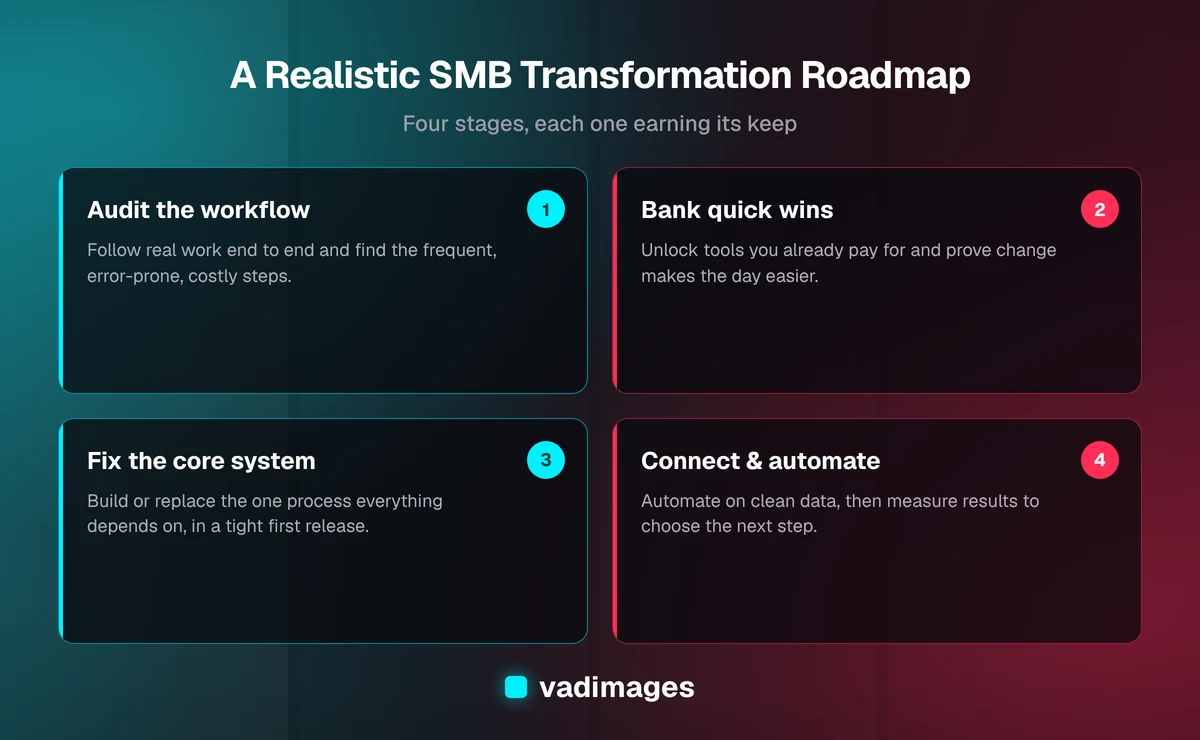
Every sensible roadmap begins with an honest look at how work moves through your business today, not how the org chart says it should. Pick a typical customer and follow them from first contact to final invoice. Where does information get re-typed? Where do things wait for one specific person? Where do errors creep in, and how are they caught? Which spreadsheets has the business quietly come to depend on, and who is the only person who understands them?
You do not need a consultant to start this. A whiteboard session with the people who do the work, a list of every tool and spreadsheet in use, and a rough estimate of the hours each manual step consumes per week will tell you a great deal. What you are looking for is a short list of processes that are frequent, error-prone and costly in staff time. Those are your candidates.
Then rank them by two simple questions: how much would fixing this save or earn, and how hard would it be? The sweet spot for your first move is a process with clear, visible pain and a contained scope.
Stage 2: Bank a few quick wins
Before committing to anything large, look for improvements you can make in days using tools you already pay for. Many SMBs use only a fraction of what their existing accounting, CRM or project-management software can do. Turning on built-in integrations, setting up proper user permissions, replacing an emailed form with an online one, or using an off-the-shelf automation tool to move data between two systems can remove a surprising amount of friction.
Quick wins matter for more than the hours they save. They prove to your team that change can make their day easier rather than harder, which is the single biggest predictor of whether later, larger steps get adopted. They also teach you where off-the-shelf tools stop being enough. When you find yourself stacking workarounds on workarounds, or paying for several subscriptions that each do a third of what you need, that is a signal you have reached the limits of the quick-win stage.
Stage 3: Build or replace the core system
Most businesses have one process that sits at the center of everything: quoting and job management for a contractor, order and inventory flow for a distributor, scheduling and client records for a service practice. When that core runs on spreadsheets and goodwill, every other improvement is limited. This is usually where real digital transformation for an SMB happens.
Here you face the classic choice between buying software and building it. Off-the-shelf platforms are the right answer when your process is standard and the product fits it closely. Custom software earns its place when your process is part of what makes you competitive, when you would otherwise need to bend your business to fit someone else's product, or when you are paying for and juggling several tools to approximate one workflow. Many businesses land on a hybrid: a custom core that handles the work that is unique to them, connected to standard tools for accounting, email and payments.
Whichever path you choose, scope the first release tightly. Replace the most painful part of the core process first, run it alongside the old method briefly if needed, and expand from there. You can see examples of how this plays out across sectors on our industries page and in our case studies.
Stage 4: Connect, automate and measure
Once the core system holds clean, reliable data, the third layer of transformation becomes possible. Now automation has something trustworthy to act on. Typical next steps include sending customers automatic status updates, generating invoices directly from completed jobs, flagging overdue tasks or low stock before they become problems, and giving owners a simple dashboard of the handful of numbers that actually drive the business.
This is also the stage where AI tools start to earn their keep for small businesses: drafting routine replies, summarizing notes, classifying incoming requests or pulling information out of documents. These capabilities are genuinely useful, but they depend completely on the groundwork. An AI assistant reading from a clean, well-structured system is helpful; one guessing across five disconnected spreadsheets is a liability.
Measure as you go. Pick two or three metrics tied to the original pain, such as hours spent on manual entry, time from inquiry to quote, or error rate on orders, and check them before and after each step. Measurement keeps the roadmap honest and tells you which investment to make next.
What a realistic budget and timeline look like
Small businesses rarely need, or can justify, a single large transformation budget. A more practical approach is to fund the roadmap step by step, with each phase sized so it can pay for itself within a reasonable horizon. Quick wins inside existing tools often cost little beyond staff time. A focused custom tool, such as an internal dashboard, a customer portal or a workflow app that replaces one critical spreadsheet, typically sits at the lower end of custom project pricing, which at Vadimages starts at $5,000. A core operational system that replaces several tools and serves multiple teams is a larger investment and is best delivered in milestones rather than as one lump sum.
On timelines, think in weeks per step, not years per program. A well-scoped first release of a core tool can often be in your team's hands within a couple of months, with further improvements arriving in regular increments after that. If a proposal asks you to wait many months before seeing anything working, treat that as a warning sign. Our pricing page explains how we structure fixed-scope projects and ongoing retainers so costs stay predictable.
Common mistakes to avoid
After many conversations with owners partway through their own transformation, the same pitfalls come up again and again:
- Starting with the tool instead of the problem. Buying a platform because a competitor uses it, then trying to find a use for it, rarely ends well. Start from the process and its pain.
- Leaving the team out. The people who do the work know where the real friction is. Involve them early and they become champions; surprise them and they become resisters.
- Ignoring data cleanup. Migrating years of duplicated, inconsistent records into a shiny new system just moves the mess. Budget time to clean data before or during the move.
- Trying to do everything at once. Breadth feels efficient on paper but spreads attention thin. Finish one step properly before starting the next.
- Forgetting ownership after launch. Systems need someone accountable for them. Decide in advance who maintains the tool, who handles user questions and how improvements get requested.
How to choose the right partner
Most SMBs will bring in outside help for at least part of the journey, typically for the core system build. The right partner behaves less like a vendor and more like an extension of your team. Look for someone who asks about your business before talking about technology, who proposes a small first step rather than a giant program, who shows you working software regularly rather than disappearing for months, and who is transparent about pricing and trade-offs, including when an off-the-shelf tool would serve you better than custom code.
At Vadimages, that is how we work. Every engagement starts with Discovery, where we map your current workflow and identify the highest-value step. From there we produce a scoped milestone plan, build with weekly demos so you see progress and can steer it, and then launch with ongoing support. You can read the details on our how we work page or browse the kinds of solutions we build for small and mid-sized businesses.
Your next step
Digital transformation for an SMB does not have to be a leap of faith. It is a roadmap of small, deliberate steps: understand how work really flows, bank a few quick wins, fix the core system that everything else depends on, and then connect, automate and measure. Each step should earn its keep before the next one begins, and at no point should your team feel like the business has been put on hold for a technology project.
If you are not sure where your first step should be, that is exactly what a discovery conversation is for. We work with businesses across the Portland and Southwest Washington area and throughout the US, and we will give you a straight answer about where to start, even if the answer is a tool you already own. Get in touch and let us map out a realistic roadmap together.