
If you run a business in Clark County, your website is probably doing more work than you give it credit for. It is the first thing a new customer checks after hearing your name, the place they confirm your hours and service area, and increasingly the source an AI assistant reads when someone asks it for a recommendation. So when owners start searching for web design in Vancouver, WA, they are rarely shopping for "a nicer look." They want a site that brings in calls, quote requests, bookings, or orders — and that does not fall apart the first time they need to change something.
This guide is written for that owner. It covers what good web design in Vancouver, WA actually includes, the local factors that are worth thinking about when your customers live on both sides of the Columbia River, what projects tend to cost, how to compare the different kinds of providers you will find, and what a sensible project looks like from first call to launch. It is written by a studio based here in Vancouver, so we will be upfront about our perspective — but the goal is to help you make a good decision whoever you end up hiring.
What "web design" should mean for a local business
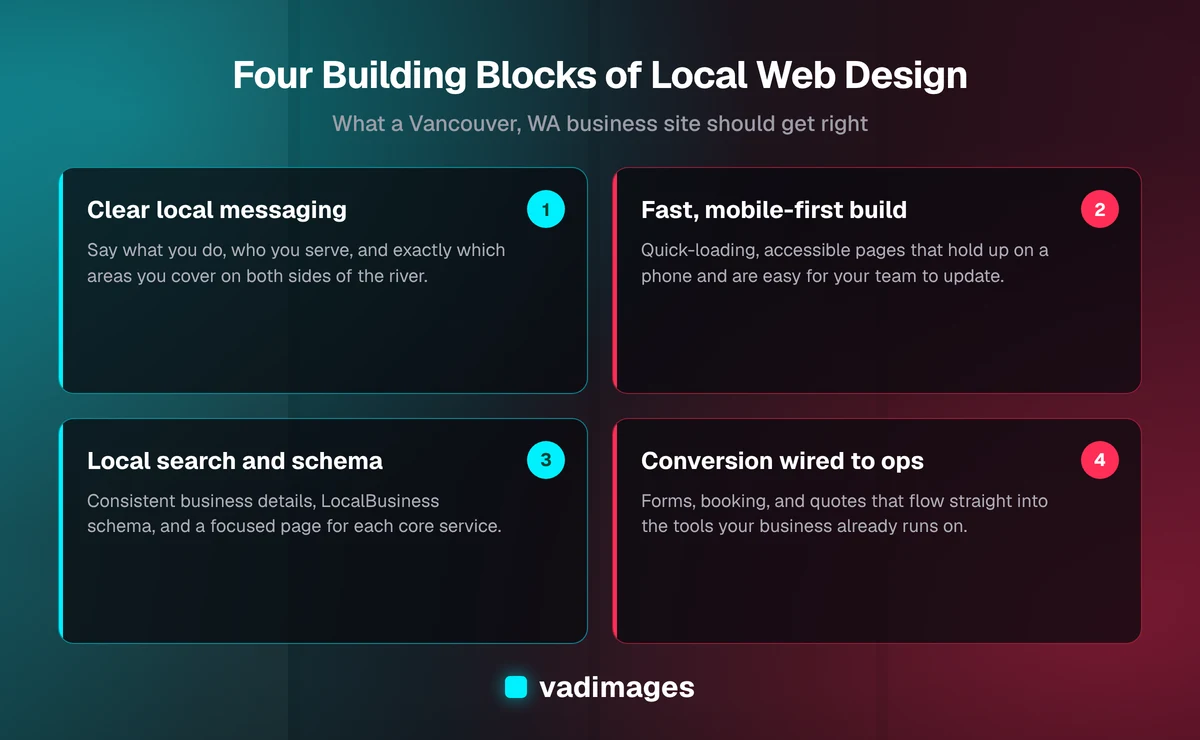
The phrase "web design" covers a huge range of work, from a one-page template to a full customer portal. That ambiguity is the source of most bad experiences: an owner asks for a website, gets a pretty homepage, and discovers six months later that it is slow, invisible in search, and impossible to update without calling someone. A modern business website is really four things working together:
- Design and messaging — a clear explanation of what you do, who you do it for, and why someone should choose you, presented in a layout that builds trust quickly.
- Engineering — fast, accessible, mobile-first pages built on a foundation that will not need replacing in two years.
- Findability — technical SEO, local search signals, and structured data so Google and AI assistants can understand and surface your business.
- Conversion and operations — forms, booking, quoting, or payments that route cleanly into the way your business actually runs, rather than landing in an inbox nobody checks.
A provider that is strong on only one of these will give you a site that is strong on only one of these. When you evaluate options, ask how each of the four is handled — and who on the team is responsible for it.
Why local context matters in Vancouver, WA
Vancouver sits in an unusual spot. It is its own city with its own neighborhoods, chambers, and customer base, and it is also part of the larger Portland metro area across the river. Many Clark County businesses serve customers in Vancouver, Camas, Washougal, Battle Ground, and Ridgefield while also taking jobs in Portland and its suburbs. That two-state reality shapes good web design in a few practical ways.
- Service-area clarity. If you serve both Southwest Washington and the Portland side, say so plainly and specifically. Customers — and search engines — should not have to guess whether you cross the bridge.
- Location pages done honestly. Dedicated pages for the areas you really serve can help, but only when each one contains genuinely useful, specific information. Thin, copy-pasted "city pages" tend to help nobody.
- Consistent business details. Your name, address, phone number, and hours should match across your website, your Google Business Profile, and directories. Inconsistencies confuse both people and machines.
- State-specific details where they apply. Washington and Oregon differ on things like sales tax and some licensing rules. If those differences affect your pricing, checkout, or service terms, your site should handle them clearly rather than leaving customers to find out at the end.
None of this requires a huge budget. It requires a designer who asks where your customers actually come from before drawing a single wireframe.
Local SEO basics every Vancouver business should cover
For most local businesses, the most valuable searches include a place: "near me," "Vancouver WA," "Clark County," or a neighborhood name. Showing up for those searches is partly about your website and partly about your wider presence. The website side of it is very manageable:
- Plain-text essentials. Put your services, service area, address or coverage area, phone number, and hours in real text on the page — not only inside images or embedded widgets.
- LocalBusiness schema. Structured data that labels your business name, address, phone, hours, and service area helps search engines and AI assistants read your details accurately.
- A page per core service. One page that tries to describe everything you do tends to rank for nothing in particular. Give each main service its own focused page.
- Real local proof. Photos of your own work, your own team, and project descriptions that mention the kinds of places you work are more convincing than stock imagery — to people and to algorithms.
- Speed on a phone. Many local searches happen on mobile, often in a hurry. Google's Core Web Vitals give you a useful yardstick: aim for the main content to appear within about two and a half seconds and for the page to respond quickly to taps.
Your Google Business Profile and reviews live outside your website, but your site should support them: link to your profile, make it easy for happy customers to leave a review, and keep the details identical everywhere.
What web design in Vancouver, WA typically costs
Pricing is where the market is most confusing, because the same word — "website" — can describe projects that differ in scope by a factor of ten or more. Rather than quote other providers' prices, here is how to think about the tiers you will encounter.
- DIY builders. Hosted site builders are inexpensive to start and fine for a very simple presence. The trade-offs are usually performance, flexibility, and the time you personally spend maintaining it.
- Template-based sites. A freelancer or small shop customizes a theme. This can be a good value for straightforward brochure sites, as long as someone is accountable for speed, security updates, and SEO basics.
- Custom-built business sites. Designed and engineered around your services, content, and conversion paths. This is where most of our work starts; our projects begin at $5,000+, with the final figure depending on page count, content, integrations, and features.
- Websites with software inside them. Online quoting, booking tied to your calendar, customer portals, inventory, or integrations with your CRM or accounting system. These are priced as software projects, scoped in milestones, and typically land well above a basic site.
Two questions cut through most pricing confusion. First: what exactly is included — copywriting, photography, SEO setup, analytics, training, hosting? Second: what happens after launch — who fixes things, how changes are billed, and whether you own the code and content outright. You can see how we structure fixed-scope and retainer work on our pricing page.
Choosing between a freelancer, an agency, and a studio
Search for web design in the Vancouver–Portland area and you will find solo freelancers, marketing agencies that offer websites alongside ads and social media, national platforms, and development studios that build both sites and custom software. Each can be the right fit; the mistake is picking one without knowing which problem you are solving.
- A freelancer can be excellent for a small, well-defined site, especially if you value a single point of contact. Ask how they handle coverage when they are unavailable and who maintains the site long term.
- A marketing agency makes sense when the website is one piece of a larger campaign and you want one team running ads, content, and design together. Ask who actually builds the site and how technical issues are handled.
- A software or development studio is the better fit when your site needs to do real work — integrate with your systems, take payments, automate intake, or grow into an application. Ask to see examples of similar builds, like our case studies.
Being local is a genuine advantage — easy in-person meetings, familiarity with the region, overlapping business hours — but it should be a tiebreaker, not the main criterion. Fit, process, and accountability matter more than a zip code.
Questions to ask before you hire anyone
A short list of questions will tell you a lot about any provider, including us:
- Who will I work with day to day, and who actually writes the code?
- How will I see progress? Regular demos beat a big reveal at the end.
- Do I own the domain, hosting accounts, code, and content? The answer should be yes, in writing.
- How do you handle SEO during a redesign? Listen for URL mapping and 301 redirects; skipping them is a common way to lose existing search traffic.
- How will the site perform on a phone? Ask how they test speed and accessibility, not just whether it "looks good on mobile."
- What does support look like after launch, and what does it cost?
- Can my team update content without breaking the design?
Clear, specific answers are a good sign. Vague ones — or answers that only talk about how the site will look — are worth probing.
How a well-run website project unfolds
A good project has a shape you can follow. Ours runs in four stages, and whichever provider you choose, you should expect something similar.
- Discovery. We learn how your business makes money, who your customers are, where they come from, and what your current site is or is not doing. This is also when we review analytics and search data if you have them.
- Scoping and milestone plan. We turn discovery into a written scope: pages, features, integrations, content responsibilities, timeline, and price — fixed-scope or retainer — so there are no surprises.
- Build with weekly demos. You see working pages every week, give feedback while it is cheap to act on, and are never waiting months to find out what you bought.
- Launch and support. Redirects, analytics, schema, performance checks, and training happen before and at launch, followed by ongoing support so the site keeps improving instead of slowly decaying.
You can read more about each stage on our how we work page.
When your website needs to be more than a website
Many Clark County businesses reach a point where the website is the easy part and the real friction lives behind it: quote requests copied by hand into a spreadsheet, bookings juggled across phone, email, and a calendar, customers emailing for status updates you have to look up manually. That is usually the moment to think beyond design.
A site built with that growth in mind can add an online quote builder, a booking flow tied to your real availability, a simple customer portal, or integrations that push leads straight into your CRM or job management tool. Planning for those possibilities at the start — even if you build them later — avoids paying twice. If that sounds familiar, our custom software and solutions pages show what that next step can look like, and our industries page covers the kinds of businesses we typically work with.
Getting started with a Vancouver web design partner
The best way to start is with clarity about the outcome. Before you talk to anyone, write down what you want the site to produce — more calls, more quote requests, fewer repetitive emails, better-qualified leads — and what frustrates you about the current one. Gather your logins, any analytics access, and a few sites you like and why. That alone will make every conversation sharper and every quote more comparable.
Vadimages is a custom software and web studio based in Vancouver, WA, working with businesses across Southwest Washington, the Portland area, and the wider US. We design and build fast, search-ready websites and the software behind them, with transparent pricing that starts at $5,000 and a process built on weekly demos rather than surprises. If you are weighing a new site or a rebuild and want a straight answer about what it would take, get in touch — we are happy to talk it through, in person or on a call.