
Sooner or later, every growing business that needs software runs into the same question: who should actually build it? You can hire a freelance developer, bring in an agency, or build an in-house team. Each option works well for some companies and badly for others, and the wrong choice tends to show up months later as missed deadlines, a half-finished product, or a system nobody left in the building understands. This guide compares freelancer vs agency vs in-house development in plain English — what each really costs, where each one shines, where each one breaks down, and how to choose for your own situation.
A quick note on bias: Vadimages is a software studio, so we obviously have a horse in this race. We have tried to write the comparison we would want to read as a business owner, including the cases where an agency is not the right answer.
The three options at a glance
A freelancer is an independent developer (or designer) you contract directly, usually by the hour or by the project. You get one person's skills, schedule, and judgment.
An agency or studio is a company that provides a team — typically some mix of project lead, designer, developers, and quality assurance — under a contract with defined scope, milestones, and responsibilities. You buy an outcome delivered by a group, with the agency managing who does what.
An in-house team means hiring developers as your own employees. You own the people, the process, and the knowledge, and you also own the recruiting, management, salaries, benefits, and turnover.
None of these is universally better. The right answer depends mostly on four things: how big and complex the work is, how long it will last, how central software is to your business, and how much technical leadership you already have.
Hiring a freelancer: flexible, affordable, and fragile
Freelancers are often the fastest and least expensive way to get a well-defined piece of work done. A good one brings deep skill in a specific area, communicates directly with you, and carries little overhead. For a small website update, a single integration, a prototype, or extra hands on a team that already has technical leadership, a freelancer can be an excellent choice.
The weaknesses come from the same source as the strengths: you are relying on one person.
- Single point of failure. If they get sick, take a full-time job, or simply get busy with a bigger client, your project stalls — and nobody else knows the code.
- Narrow skill coverage. Few individuals are equally strong at design, front end, back end, databases, security, hosting, and testing. Gaps in any of those show up later.
- You are the project manager. Someone has to define requirements, prioritize, review work, and make technical decisions. Without a technical lead on your side, that someone is you.
- Continuity and documentation vary widely. Some freelancers leave clean, documented code; others leave a working system only they can maintain.
Freelancers work best when the scope is small and clear, the work is not business-critical, or you already have someone in-house who can direct and review it.
Working with an agency: a team, a process, and a price tag
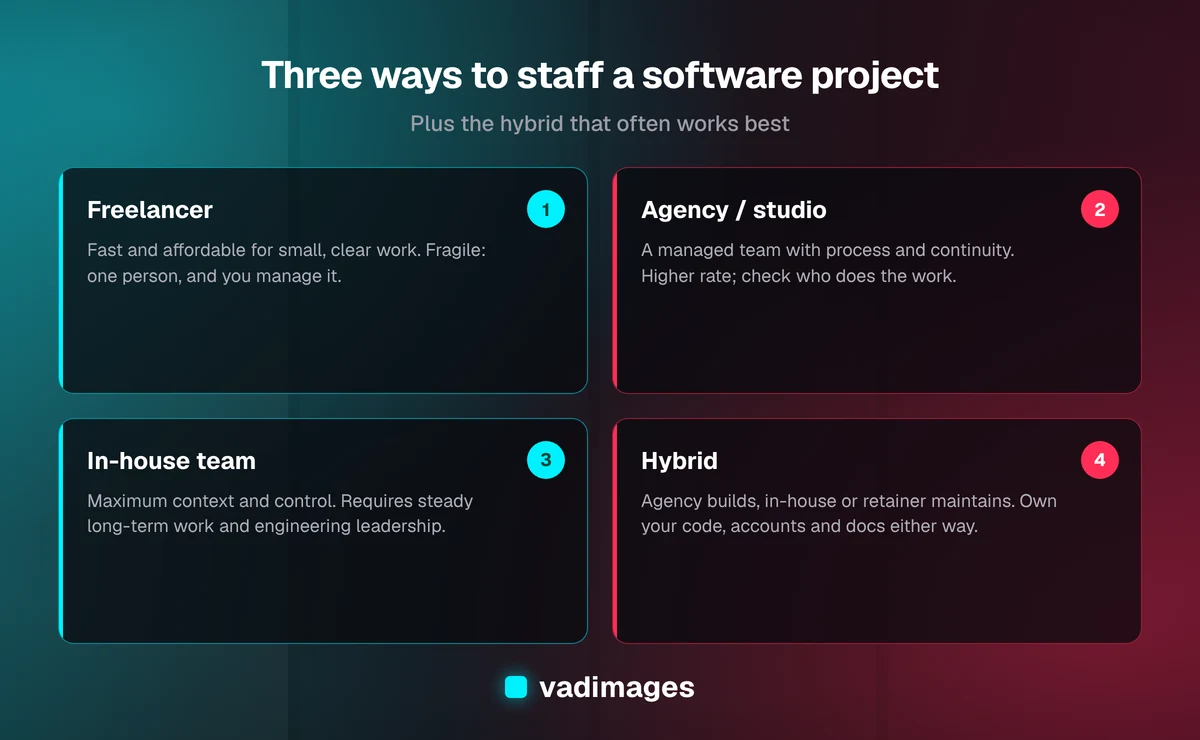
An agency gives you a complete, managed team without having to hire one. The main advantages are breadth and continuity: design, development, testing, and deployment are covered by people who have done this work together before, and the project does not depend on any single individual. A good agency also brings process — discovery, a written scope, milestones, regular demos, and a clear launch plan — which is exactly what many businesses lack when they first commission software.
The trade-offs are real too:
- Higher rates than a freelancer. You are paying for the team, the management, and the business behind it. Per hour, an agency costs more; per finished, working feature, the gap is often smaller than it looks.
- Less day-to-day control. You work through a project lead and a plan rather than directing individual developers.
- Quality varies enormously. Some agencies hand your project to junior staff or offshore subcontractors you never meet. It pays to ask exactly who will do the work.
- Ownership must be explicit. Make sure the contract gives you the code, the accounts, and the documentation, so you are never locked in.
Agencies tend to be the best fit for projects that are substantial but finite: a customer portal, an internal operations tool, a rebuild of a legacy system, or an app that needs design and engineering together. If you are evaluating agencies, our earlier piece on red flags when hiring a software agency is a useful checklist, and our how we work page shows the process we follow.
Building in-house: maximum control, maximum commitment
An in-house team gives you something neither of the other options can: people whose only job is your business. They build up deep context about your customers, data, and operations, they are available every day, and the knowledge stays inside the company. If software is your product, or the core of how you compete, you will almost certainly want an in-house team eventually.
The cost of that control is commitment. Hiring good developers takes time and money, and the true cost of an employee is well above their salary once you add benefits, payroll taxes, equipment, software, and management time. More importantly, a single developer is not a team. To build and run serious software you need a mix of skills, someone to lead technical decisions, and enough people that one resignation does not stop everything. For many small and mid-sized businesses, that is a much bigger investment than the software itself requires.
In-house is the right call when you have continuous, long-term development work, software is strategically central, and you are ready to manage engineers — or to hire someone who can.
Comparing the true cost
Hourly rates are the most visible number and the least useful one. A better way to compare freelancer vs agency vs in-house is to ask what it costs to get a working, maintained system into production — and to keep it there.
- Freelancer: lowest rate and lowest overhead, but add your own time spent managing, plus the risk cost of delays, rework, or a hand-off if they disappear.
- Agency: higher rate, but project management, design, testing, and deployment are included, and the cost is usually tied to a defined scope or a predictable retainer. At Vadimages, projects start at $5,000 and are quoted as fixed-scope builds or monthly retainers — see our pricing page for how that works.
- In-house: salaries and benefits every month whether or not there is a project, plus recruiting, onboarding, tools, and management. Cost-effective when the workload is steady and long-term; expensive when it is lumpy.
Also count the costs that never appear on an invoice: the time a project sits stalled, the opportunity lost when a launch slips, and the price of rescuing a codebase nobody can maintain. Those are often larger than the difference in rates.
Risk, quality, and continuity
Beyond cost, three questions separate a good choice from a regrettable one.
What happens if a key person leaves? With a freelancer, the project often stops. With an in-house team of one or two, the same. A team-based agency or a larger in-house group absorbs departures more easily — as long as the code is documented and lives in repositories you own.
Who checks the work? Code review, testing, and security practices are what keep small problems from becoming outages. Agencies and established in-house teams usually have these built in; with a solo freelancer, it depends entirely on the individual.
Who supports it after launch? Software needs updates, security patches, and small improvements for as long as you use it. Decide before you start who will handle that, and how quickly they will respond when something breaks.
Hybrid models that often work best
The choice is rarely all-or-nothing. Some of the most effective setups we see combine options:
- Agency builds, in-house maintains. An agency delivers the first version with good documentation, then hands over to an in-house developer — or stays on a light support retainer.
- In-house lead, outside capacity. One technical person on staff owns direction and quality, while freelancers or an agency add capacity for specific projects.
- Agency as the long-term team. For businesses that need ongoing development but not enough to justify a full team, a retainer with a studio provides continuity without the overhead of hiring.
- Freelancer for the edges. Specialists handle self-contained pieces — a design refresh, a specific integration — around a core system owned by a team.
How to choose: freelancer vs agency vs in-house
If you want a simple rule of thumb, start with these questions:
- Is the work small, clear, and non-critical? A vetted freelancer is often the efficient answer.
- Is it a substantial project with a beginning and an end, and do you lack in-house technical leadership? An agency or studio is usually the safest route to a finished, working system.
- Is software your product, with years of continuous work ahead, and can you lead engineers? Invest in an in-house team, possibly with outside help to get started.
- Somewhere in between? Consider a hybrid: an agency to build, then a retainer or an in-house hire to run it.
Whichever route you choose, protect yourself the same way: own your code, accounts, and documentation; insist on regular demos of working software; agree on scope and milestones in writing; and plan for support after launch before the build begins.
Where Vadimages fits
Vadimages is a custom software studio in Vancouver, WA, working with businesses across Portland, Southwest Washington, and the rest of the US. We are a good fit when you need a real team to design, build, and support a custom software system — a portal, internal tool, integration, or modernization — but do not want to build and manage an engineering department to get it. Every engagement follows the same path: discovery, a scoped milestone plan, a build with weekly demos, and launch plus ongoing support. You own the code and everything around it. You can see the kinds of projects we take on in our case studies.
And if, after talking it through, a freelancer or an in-house hire is the better answer for you, we will say so. Get in touch to talk about your project and which model makes the most sense.