
When a business decides it needs custom software, the instinct is to start building as soon as possible. The problem feels urgent, the budget is approved, and every week without the new system is another week of spreadsheets and workarounds. But the projects that go smoothly, land on budget and actually get used almost always share one thing: a proper software discovery phase before a single line of code is written. Discovery is where you find out what you really need, what you can safely leave out, and what it will honestly take to deliver. Skipping it does not save time; it just moves the hard questions to the most expensive point in the project.
This article explains what a software discovery phase involves, why it matters so much for small and mid-sized businesses, what you should expect to walk away with, and how to tell a useful discovery process from an expensive formality.
What a software discovery phase actually is
A software discovery phase is a short, structured period at the start of a project dedicated to understanding the problem before committing to a solution. It brings together the people who run the business, the people who will use the software day to day, and the people who will build it. Together they answer a handful of foundational questions: What problem are we solving? For whom? How does the work happen today? What does success look like? What are the constraints on budget, timeline, existing tools and data? And what is the smallest useful version we could launch first?
Discovery is not a lengthy requirements document that nobody reads, and it is not a sales meeting dressed up as analysis. For most small-business projects it is measured in days or a couple of weeks, not months. Its job is to turn a vague idea, such as "we need a portal" or "we need to get off spreadsheets", into a clear, shared picture that both sides can plan and price against with confidence.
Why great software starts before code
It is a long-standing and widely accepted principle in software engineering that problems get more expensive to fix the later they are found. A misunderstanding caught in a whiteboard conversation costs a few minutes to correct. The same misunderstanding caught after the screens are designed costs a redesign. Caught after launch, it can mean rebuilding features, migrating data again and retraining staff.
Most failed or overrun software projects do not fail because the developers could not write the code. They fail because the team built the wrong thing, or the right thing in the wrong order, or something that technically works but does not fit how people actually do their jobs. Those are all problems of understanding, and discovery is where understanding gets built. It is also where you surface the awkward details early: the exception that happens once a month but matters enormously, the legacy system that has to keep running, the report the owner checks every Friday that nobody mentioned.
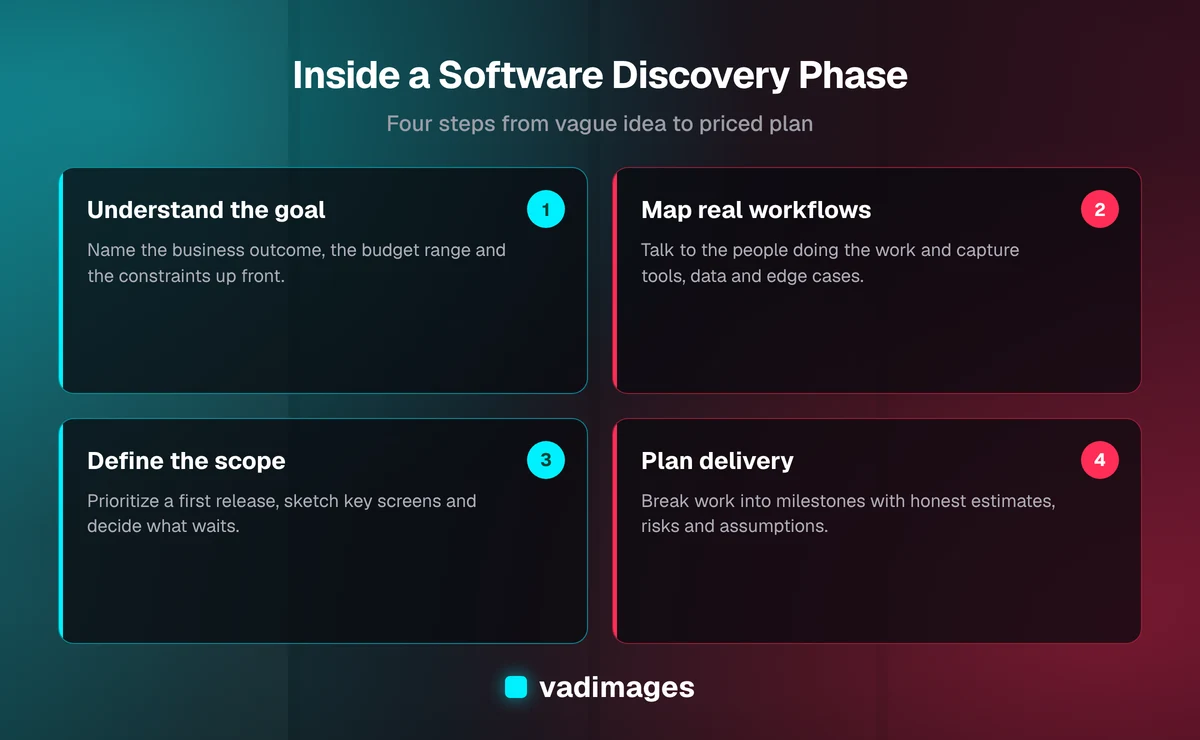
Step 1: Understand the business goal
Good discovery starts with the business, not the technology. Before talking about features, it is worth getting precise about the outcome you want. Are you trying to cut the hours your team spends on manual data entry? Respond to customer inquiries faster? Reduce ordering errors? Give clients self-service access so your staff can stop answering status emails? Each of those goals points toward a different solution, and naming the goal clearly gives every later decision something to be measured against.
This is also where constraints come out into the open: the budget range you are comfortable with, any hard deadlines such as a seasonal rush or a contract renewal, compliance requirements that apply to your industry, and the tools you are committed to keeping. None of these are reasons to avoid a project; they are the boundaries that make a sensible plan possible.
Step 2: Map how work really happens
The next step is to understand the current process in detail, ideally by talking to the people who do it. Owners and managers often describe how work is supposed to flow; front-line staff describe how it actually flows, workarounds and all. Both views matter, and the gap between them is usually where the most valuable insights live.
Useful discovery activities at this stage include:
- Stakeholder interviews with owners, managers and the people who will use the system daily.
- Walking through real examples, such as following an actual order, job or client record from start to finish.
- Reviewing existing tools and data: the spreadsheets, forms, software subscriptions and reports the business relies on today, and the quality of the data inside them.
- Identifying integrations with accounting, payments, email, CRM or any other systems the new software has to talk to.
- Listing the edge cases: refunds, rush orders, partial shipments, cancellations and the other exceptions that real operations are full of.
The output is usually a simple workflow map showing who does what, in which order, with which information. It does not need to be elaborate. It needs to be accurate.
Step 3: Define scope and priorities
With the goal and the workflow understood, the team can start shaping the solution. This is where discovery earns its keep, because the most valuable thing it produces is often a decision about what not to build yet. Almost every project starts with a wish list longer than the budget. A good discovery process sorts that list into what is essential for a first release, what can follow in a later phase, and what turns out not to be needed at all once the real workflow is understood.
Typical outputs at this stage include user roles and permissions, a prioritized feature list, rough wireframes or clickable sketches of the key screens, a data model describing the main records the system will hold, and notes on technical approach, including whether parts of the problem are better served by an existing product than by custom software. Seeing even rough screens is often the moment when stakeholders realize what they actually want, which is far cheaper to learn now than during the build.
Step 4: Plan delivery and estimate honestly
The final step turns understanding into a plan. With a defined scope, a development team can break the work into milestones, estimate each one with real confidence, and identify the risks most likely to affect cost or timeline. Risky or uncertain pieces, such as an unfamiliar third-party integration or messy legacy data, can be flagged early and sometimes tested with a small proof of concept before the main build begins.
This is what makes fixed-scope pricing possible. Without discovery, any quote for custom software is either padded heavily to cover the unknowns or optimistic in a way that leads to change requests later. With discovery, both sides know what is being built and what it will cost. At Vadimages, projects start at $5,000 and are priced either as fixed-scope milestones or as an ongoing retainer, and discovery is what lets us choose the right model for each client. You can read more on our pricing page.
What you should walk away with
A worthwhile software discovery phase leaves you with tangible, useful deliverables, ideally ones you own and could take to another developer if you chose to. At a minimum, expect:
- A clear problem statement and success criteria that everyone has agreed on.
- A workflow map of the current process and how the new system will change it.
- A prioritized scope for the first release, with later phases noted separately.
- Wireframes or screen sketches for the most important parts of the system.
- A milestone plan with estimates, risks and assumptions written down.
- A technical recommendation, including integrations and any parts better handled by existing tools.
Just as important is what you should not walk away with: a vague promise, a single big number with no breakdown, or a hundred-page document that restates what you already said in the first meeting.
Signs a discovery process is done well, or badly
Not every discovery phase is equally useful. A few signals help you tell the difference. Good discovery involves the people who actually use the current process, not just leadership. It produces visual artifacts such as workflow maps and screen sketches rather than only text. It challenges your assumptions respectfully and is willing to recommend a smaller first step, or even an off-the-shelf tool, when that is the better answer. And it ends with a plan specific enough that you could check the final product against it.
Warning signs include a discovery that is really just a series of sales calls, one that never talks to front-line staff, one that stretches on for months without converging, or one whose output is so generic it could describe any project. If you finish discovery and still cannot explain in a sentence what will be built first and why, something went wrong.
How Vadimages runs discovery
Discovery is the first step of every engagement we take on. Our process runs Discovery, then a scoped milestone plan, then the build with weekly demos so you can see and steer progress, and finally launch and ongoing support. During discovery we talk to the people who do the work, map the workflow, sketch the key screens and agree on what the first release needs to accomplish. We are candid when part of the problem is better solved with a tool you already have, because a smaller, well-aimed project serves you better than a large, unfocused one.
We work with businesses throughout the Portland and Southwest Washington area and across the US, in a range of industries. You can see the full process on our how we work page, browse the kinds of solutions we build, or look at our case studies for examples of where discovery led.
Great software really does start before code. If you have a project in mind, or just a problem you suspect software could solve, the best first step is a conversation about it. Get in touch and we will help you figure out what to build, what to leave out and what it will honestly take.