
Software agencies price projects by estimating the work required to reach a defined outcome, then choosing a pricing model — usually fixed-price or time-and-materials — that fits how well that outcome is understood. At Vadimages, we start with a discovery step, price from what the work actually involves, and always begin at $5,000+ so the engagement has enough room to deliver something real.
If you have ever asked a software agency “how much will this cost?” and received a vague shrug or a number that felt pulled from thin air, you are not alone. Pricing custom software is genuinely harder than pricing a product off a shelf, because you are buying something that does not exist yet. But “harder” is not the same as “mysterious.” Below is an honest look at how software agencies price projects, what actually drives the number, and how we approach it at Vadimages.
Why is software pricing so hard to pin down?
A custom software project is not a fixed object with a barcode. It is a set of outcomes you want, translated into code, design, infrastructure, and testing. Two projects that sound identical in a single sentence — “we need a customer portal” — can differ by a factor of ten once you look at the details: how many user types, what integrations, what compliance requirements, how much existing data has to be migrated, and how polished the experience needs to be.
That is why a responsible agency resists quoting a firm price from a one-line description. The number depends on scope, and scope depends on questions that have not been answered yet. When someone gives you an instant quote for complex work, they are either padding heavily to protect themselves or setting up a change-order conversation for later. Neither is transparent. The honest answer early on is a range, and a plan to narrow that range quickly.
What actually drives the number?
When you strip away the jargon, software pricing comes down to a handful of concrete cost drivers. Understanding them helps you see why one project costs $8,000 and a similar-sounding one costs $80,000.
- Scope and feature count. Every screen, workflow, user role, and edge case is work. More features means more design, more code, and more testing.
- Integrations. Connecting to payment processors, CRMs, accounting systems, or third-party APIs adds effort, and each integration carries its own quirks and failure modes.
- Data and migration. Moving years of records out of an old system, cleaning them, and mapping them into a new structure is often underestimated and frequently significant.
- Design and polish. A functional internal tool and a customer-facing product held to a high visual standard are different budgets, even with the same features.
- Complexity and risk. Real-time features, heavy calculations, security and compliance requirements (HIPAA, PCI, SOC 2), and unusual performance demands all raise the effort and the risk.
- Infrastructure and scale. An app for 50 internal users is engineered differently from one expected to serve 50,000 customers.
- Ongoing needs. Maintenance, hosting, support, and future changes are part of total cost of ownership, even if they sit outside the initial build.
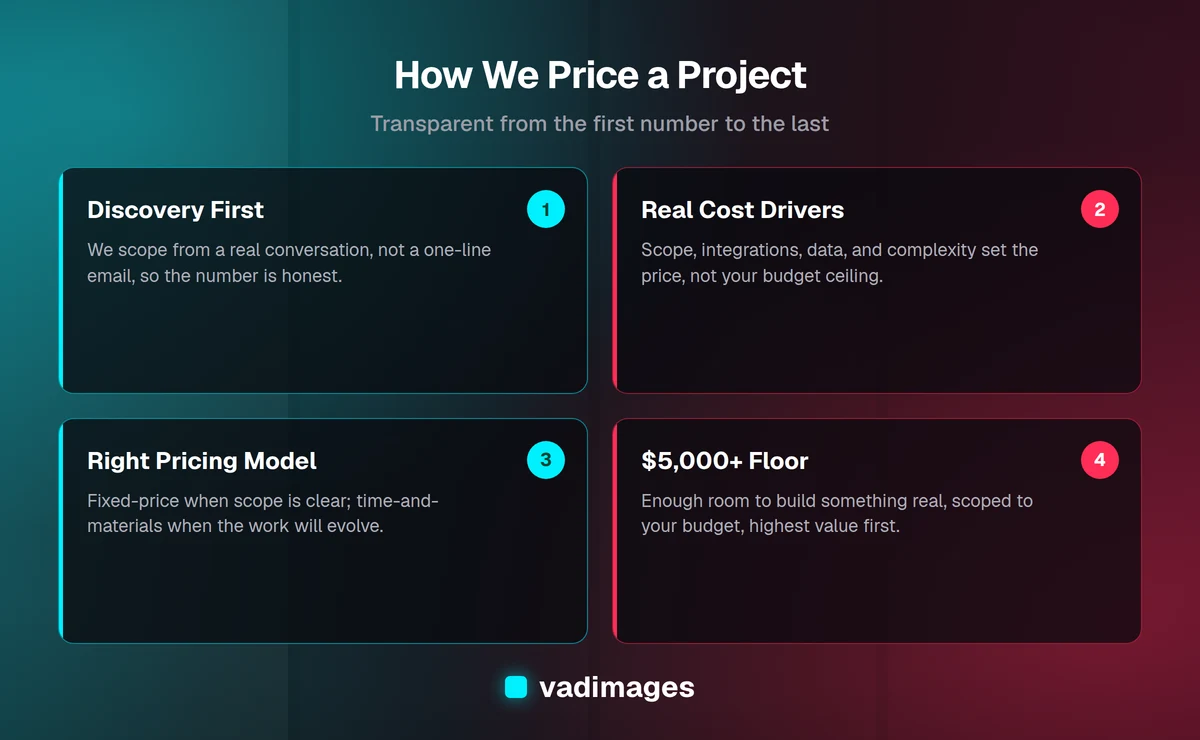
Notice what is not on this list: how much the agency thinks you can afford. Value-based pricing has its place, but the foundation of an honest estimate is the work itself, not a guess about your budget ceiling.
Fixed-price vs. time-and-materials: which is better?
These are the two pricing models you will encounter most often, and neither is universally “better.” They fit different situations, and the right choice depends mostly on how well the work is understood before it starts.
Fixed-price means you agree on a defined scope and a single number for it. It works best when the requirements are clear, stable, and well documented — a redesign with a known feature set, a defined integration, a specific deliverable. The advantage is budget certainty: you know exactly what you are committing to. The trade-off is rigidity. Because the agency carries the risk of underestimating, fixed-price bids usually include a risk buffer, and anything outside the agreed scope becomes a change order. If your requirements are still evolving, a fixed price tends to push both sides into rigid, sometimes adversarial, conversations about what “counts.”
Time-and-materials (T&M) means you pay for the actual hours worked at an agreed rate, usually with an estimated range and a cap or checkpoint structure. It works best when the scope is expected to evolve, when you want to steer priorities as you learn, or when the project is large enough that no one can responsibly fix every detail up front. The advantage is flexibility and transparency — you see where the hours go and can redirect them. The trade-off is that you carry more of the uncertainty, so it requires trust and good communication.
Many real projects use a blend: a fixed price for a well-defined first phase, then T&M for the more exploratory work that follows. What matters is not the label but whether the model matches how much is genuinely known — and whether the agency is honest with you about that.
Why does Vadimages start with discovery?
We do not send a real number until we understand the work, and we cannot understand the work from a single email. That is why serious estimates start with a discovery step: a focused conversation (and, for larger projects, a short paid discovery engagement) where we dig into what you are actually trying to accomplish, who the users are, what systems it has to talk to, and what “done” looks like.
Discovery-first estimating does two things. First, it replaces guesswork with information, which lets us give you a number we can stand behind instead of a padded worst case. Second, it often surfaces a cheaper or faster path than the one you walked in with — a simpler workflow, an existing tool that covers part of the need, or a phase-one version that delivers most of the value for a fraction of the cost. Discovery pays for itself when it prevents you from building the wrong thing well.
For small, well-understood projects, discovery might be a single call. For larger ones, a paid discovery phase produces a written scope, a recommended architecture, and a realistic budget — a deliverable you own and could take to any developer, even if you chose not to build with us.
Why do you start from $5,000 and up?
Transparent pricing means naming a floor, so here it is: our projects start at $5,000. That is not an arbitrary gate — it reflects what it actually takes to design, build, test, and ship something real, even something small, to a professional standard.
Below that threshold, the honest truth is that you are usually better served by an off-the-shelf tool, a template, or a no-code solution, and we will happily tell you so. Custom software earns its cost when your needs are specific enough that generic tools force painful compromises. When that is the case, a $5,000+ engagement gives us enough room to do discovery, build the highest-value piece properly, and hand you something you can actually use — rather than a rushed fragment that creates more problems than it solves.
Starting from a clear floor also protects you. It filters out the false economy of a cheap quote that balloons through change orders, and it sets the expectation that we are building a durable asset, not a disposable one.
What if I have a fixed budget?
Most SMB owners do, and that is completely workable. A budget is not a limitation we resent — it is one of the most useful constraints you can give us, because it lets us design to it.
When you tell us the budget, we scope to it rather than pretending it does not exist. That means we prioritize ruthlessly: we identify the features that carry the most value and build those first, and we defer or drop the ones that sound nice but do not move the needle. This is the “highest-value-first” approach, and it is the opposite of the trap where a project spends its whole budget on foundations and edge cases before delivering anything a user can touch.
The practical result is that even a modest budget can produce a working, valuable first version. You get something in front of real users early, you learn from it, and you fund the next phase from a position of knowledge instead of speculation. If the full vision costs more than the current budget, we will say so plainly and show you a sequence that gets you there over time — not a single quote that quietly assumes you will find more money later.
How does the estimate turn into a real project?
Once discovery gives us a shared understanding, the estimate becomes a plan. Here is roughly how the number turns into working software.
- Scope and proposal. We write down what we are building, in plain language, along with the pricing model, the estimate or fixed price, and the assumptions behind it. You should be able to read it and recognize your own project.
- Phasing. We break the work into phases, with the highest-value functionality first. You approve a phase before it starts, so you are never committing the whole budget on faith.
- Build and check-ins. We work in short cycles with regular demos. You see progress, not just invoices, and you can adjust priorities as real software takes shape.
- Testing and launch. We test as we go and before release, so “done” means working, not just written.
- Support and next steps. After launch we talk about maintenance, hosting, and the next phase — with the same transparency about cost.
Throughout, the goal is no surprises. If something changes — a new requirement, an integration that turns out to be harder than expected — we raise it early, explain the cost impact, and let you decide. That is what transparent pricing looks like in practice: not just an honest first number, but honest conversations all the way through.
What should I ask an agency before hiring them?
Whether or not you work with us, a few questions will tell you quickly whether an agency prices honestly.
- “How did you arrive at this number?” A good answer references scope and specific drivers, not a vague gut feel.
- “What is included, and what would be a change order?” Clarity here prevents most billing disputes later.
- “Fixed-price or time-and-materials, and why for my project?” The reasoning matters more than the label.
- “What happens if we run over?” You want a process for that conversation, not a surprise invoice.
- “What could we cut to fit a smaller budget?” An honest partner can always answer this.
If the answers are specific, calm, and willing to say “it depends, and here is what it depends on,” you are probably dealing with someone who will price you fairly.
Frequently asked questions
Can you give me a price over the phone? We can give you an honest range and tell you what would move it up or down, but a firm number comes after a short discovery step. Anyone who commits to an exact price for complex custom work sight unseen is guessing — and building the guess into your invoice.
Is a fixed price safer than time-and-materials? Not automatically. Fixed price gives budget certainty but bakes in a risk buffer and can turn every change into a negotiation. T&M is more flexible and transparent but asks you to share the uncertainty. The safer choice is the one that matches how well your requirements are understood — which is exactly what discovery clarifies.
Do you charge for discovery? For small projects, an initial conversation is free. For larger ones, we run a paid discovery phase and give you a written scope, architecture, and realistic budget that you own outright — useful even if you decide not to build with us.
Why is your minimum $5,000? Because that is what it takes to deliver real, professional, custom software — even a small piece of it — with proper discovery, building, and testing. Below that, an off-the-shelf tool usually serves you better, and we will tell you so.
What if my budget is smaller than the full project? We scope to your budget and build the highest-value features first, so you get a working first version rather than an unfinished whole. Then you can fund later phases from what you learn.
Will the price change after we start? Only if the scope changes, and never quietly. New requirements or newly discovered complexity get raised early, with the cost impact explained, so the decision is always yours.
The bottom line
Honest software pricing is not a magic number — it is a process. It starts with discovery, rests on real cost drivers rather than guesswork, uses whichever pricing model fits how well the work is understood, and stays transparent through every change along the way. At Vadimages we start from $5,000+, scope to your budget, and build the highest-value work first, so you always know what you are paying for and why. We build for humans and optimize for growth, and that includes being straight with you about cost.
Want a real number for your project? See how we structure engagements on our pricing page, or get in touch and we will start with a straightforward conversation about what you are trying to build.