
Sooner or later, every growing company hits the same fork in the road. A process is straining, a spreadsheet has quietly become a liability, or a new opportunity needs software that does not exist yet — and someone has to answer a deceptively simple question: do we build it, buy it, or partner to get it done? The answer shapes your budget, your timeline, and how much of your business you truly control for years afterward. Yet most teams make the call on instinct, or on whichever option the loudest person in the room happens to prefer.
This is the framework we use at Vadimages to help US small and mid-sized businesses make that decision with their eyes open. It is not a pitch for custom software — plenty of problems are better solved by a tool you can buy this afternoon. It is a way to match each need to the right path, sidestep the expensive mistakes, and know why you chose what you chose. Read it before your next big software decision, because the wrong call here is one of the costliest a growing company can make.
Three paths, not two
The classic phrasing is "build versus buy," but that framing quietly hides the option most SMBs should consider first. There are really three:
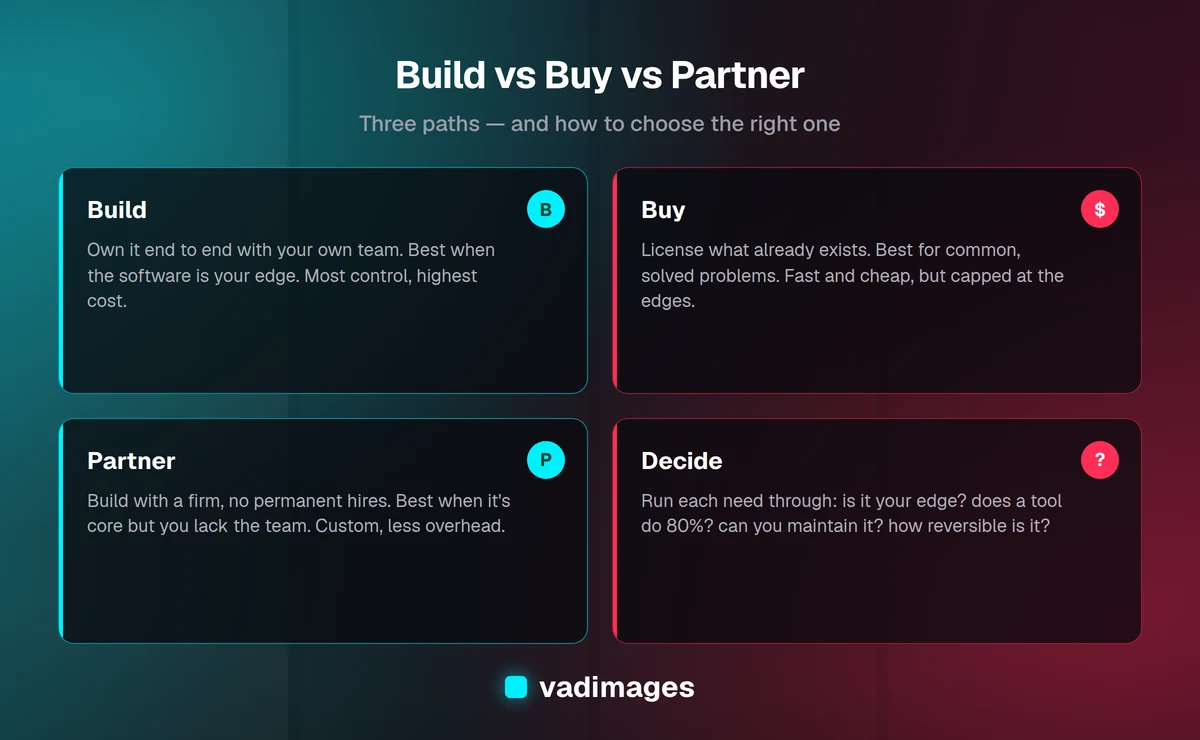
- Build — you create the software yourself, with an in-house team, owning every line of code and every decision. Maximum control, maximum cost, maximum responsibility.
- Buy — you license an existing product (usually SaaS) that already solves a common problem. Fast to start and low upfront cost, but you live inside someone else's roadmap.
- Partner — you bring in an external firm to design and build software with you, tailored to your business, without hiring and managing a permanent engineering department. Custom outcomes without the standing overhead.
Most decisions get framed as build-or-buy because "partner" is invisible to teams who have never done it. But for a company that needs something specific and does not have — or does not want — a full engineering org, partnering is frequently the path that delivers a build-quality result on a buy-quality budget. Naming all three options honestly is the first move in the framework.
When building it yourself makes sense
Building in-house is the right answer when the software is your competitive advantage — when the way you do this one specific thing is the reason customers choose you, and no product on the market can replicate it. If you are a logistics company whose routing engine is your edge, or a software company whose core platform is the product itself, you do not want that living in a tool your competitors can also license. Owning it outright is the whole point.
The catch is that building is never just the first version. A team you hire to build also has to maintain, secure, support, and evolve what they made — indefinitely. The sticker price of version one is usually the smallest number in the whole equation. Salaries, benefits, management, turnover, and the slow accrual of technical debt make in-house building the most expensive path by a wide margin. It is worth every dollar when the software is genuinely core to your business, and rarely worth it when it is not. Our guide to custom software development walks through what that kind of ownership actually entails.
When buying off-the-shelf wins
Buying is the smart default for any problem that is common, well-understood, and not unique to you. Email, accounting, payroll, CRM, help-desk ticketing, scheduling — thousands of companies have the same need, so a mature product already exists that does it well for a predictable monthly fee. Building your own version of a solved problem is one of the most reliable ways to waste money in software, and it is a mistake even sophisticated teams make.
The limit shows up at the edges. Off-the-shelf tools are built for the average customer, so the closer your process gets to something unusual, the more you feel the walls. You end up bending your business to fit the software, stitching several tools together with manual work, or paying for features you will never touch. Buying is excellent right up until the thing you need is precisely the thing the product does not do — and no amount of configuration closes that gap. When you find yourself running a spreadsheet alongside the tool to handle what it cannot, you have found the ceiling.
The partner path most SMBs overlook
Partnering is the middle path, and for growing businesses it is often the best-kept secret of the three. You get software built specifically for how you work — the custom outcome — but you rent the expertise instead of hiring it. A good development partner brings a team that has solved similar problems many times over, a repeatable process, and the ability to spin up and wind down as the work requires. You do not carry the salaries between projects, and you do not have to become a software company just to get software that fits.
Partnering shines when a need is core enough that off-the-shelf will not do, but not so central that you want a permanent team owning it forever — which describes a large share of real SMB software. It also lowers risk: a seasoned partner will tell you when buying is the smarter move, scope the work in stages, and hand you something you genuinely own at the end. The way we structure this is spelled out in how we work, and the range of problems it fits sits under our solutions. Done well, partnering gives you build-grade results without build-grade overhead.
The framework: five questions
When a real decision lands on your desk, run it through these five questions in order. Together they point clearly toward build, buy, or partner far more often than gut instinct does.
- Is this our edge? If the software is a reason customers pick you, lean toward build or partner and keep control. If it is plumbing every business needs, lean toward buy.
- Does something already do 80% of it? If a mature product covers the vast majority of your need out of the box, buy it and stop. Chasing the last 20% with a custom build is usually a bad trade.
- Do we have the team — for years, not weeks? Building means owning maintenance forever. If you cannot staff that permanently, partnering gets you the custom result without the standing payroll.
- How fast do we need it, and how reversible is the choice? Buying is fastest and easiest to walk away from. Building is slowest and stickiest. Weigh speed against lock-in honestly.
- What is the real total cost? Compare five-year totals, not launch-day prices — licenses and per-seat fees for buy, salaries and maintenance for build, a scoped project plus lighter upkeep for partner.
How AI is shifting the math
AI has moved the lines between these three paths over the last couple of years, and it is worth factoring in. Building is cheaper and faster than it used to be, because modern tooling and AI-assisted development compress the timeline for a capable team — so some things that were once "too expensive to build" now clear the bar. At the same time, off-the-shelf products are racing to bolt AI features on, which means buying can get you capabilities that would have demanded a custom build a year ago. And partners increasingly deliver AI-enabled features as part of a normal project rather than a moonshot. The practical effect is simple: re-run the framework more often, because a need that sat firmly in "buy" or firmly in "too costly to build" last year may land somewhere new today.
The mistakes that cost the most
A few anti-patterns show up again and again. Building what you could have bought — reinventing a solved, commodity problem because it felt "easy" — burns budget and attention that belonged on your actual edge. Buying your way around your differentiator is the mirror mistake: forcing the one thing that makes you special into a generic tool, and slowly becoming as undifferentiated as the software you run. Underestimating the tail catches nearly everyone — treating software as a one-time purchase when it is a living system that needs care for as long as you use it.
The subtlest error is deciding once and never revisiting. The right answer changes as you grow. A tool you bought at ten people may cap you at fifty; a system you built at fifty may be worth handing to a partner to modernize at two hundred. The framework is not a one-time gate — it is a question you re-ask each time the ground shifts, which is why it pays to keep an eye on the systems your industry depends on and whether they still fit.
Most winners blend all three
In practice, healthy companies rarely pick one path for everything. They buy the commodity layer — accounting, email, payroll — because there is no advantage in owning it. They build or partner on the handful of workflows that are genuinely theirs. And they connect the two so the custom core and the bought tools share data instead of fighting each other. The goal is not ideological purity about custom software; it is putting each dollar where it earns the most.
That blend is also why the decision benefits from an outside read. A partner who has seen dozens of these calls can tell you, honestly, which of your needs are commodity and which are core — and will happily point you to a product to buy when that is the right answer, because a good partner would rather earn your trust than sell you a build you did not need. You can see how we have helped other teams make this call in our case studies.
Making the call with real numbers
Once you know which path a need belongs on, put numbers to it. For buying, add up per-seat licenses across the team over three to five years, plus the cost of the manual work the tool cannot absorb. For building, count salaries and benefits for the people who will build and maintain it, plus the opportunity cost of what that team is not doing instead. For partnering, scope the project into stages so you can see cost against value at each step, with lighter ongoing upkeep afterward. Custom work with us starts at $5,000 and up depending on scope, and we keep the estimate transparent from the first conversation — you can see our approach on the pricing page.
Build, buy, and partner are not rival philosophies — they are three tools, and the whole skill is matching each need to the right one. If you are staring at that fork right now and want a straight answer about which path fits your situation, get in touch. We will tell you honestly where custom makes sense, where an off-the-shelf tool is the better buy, and where partnering gets you the most for your money — even when the answer is not the one that sends work our way.