
Two terms have started showing up in every AI sales pitch aimed at small businesses: chatbot and AI agent. They get thrown around as if they mean the same thing, and the vendors selling them are not always in a hurry to explain the difference. That is a problem, because the two are not interchangeable, and confusing them is an expensive mistake to make.
If you buy a chatbot expecting it to run your operations, you will be disappointed. If you commission an AI agent to answer a handful of frequently asked questions, you will overpay for something you did not need. The gap between the two is measured in tens of thousands of dollars, months of build time, and a very different level of risk.
So here is the plain-English version, written for the person who has to sign off on the budget rather than the person writing the code. What each one actually is, where each one earns its keep, and how to tell — before you spend a dollar — which one your business needs.
What a chatbot actually is
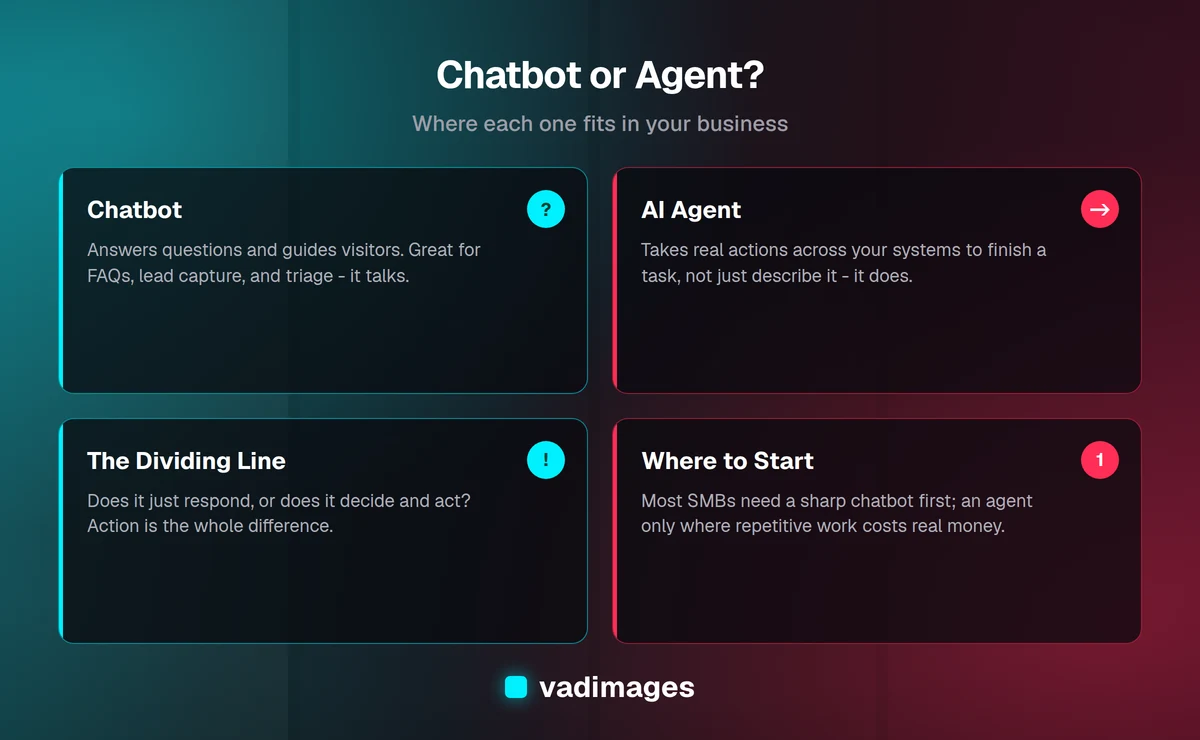
A chatbot is a program that talks. You type or say something, it responds. That is the whole job. The good ones are genuinely useful: they answer questions, point people to the right page, collect a lead, book an appointment, or hand the conversation off to a human when they hit the edge of what they know.
Older chatbots followed rigid scripts — press 1 for sales, press 2 for support — and everyone hated them because they broke the moment you asked something slightly off-script. Modern chatbots built on large language models are far better. They understand plain questions, remember what you said three messages ago, and reply in natural sentences instead of menu trees.
But notice what is happening under the hood: the chatbot is producing words. It might tell you your order shipped, but it did not go into your shipping system and check. It might say "I have booked that for you," but unless someone wired it up to actually do so, it is describing an action rather than taking one. A chatbot is a conversation. Everything it accomplishes, it accomplishes by talking to you or by handing structured information to a human who then does the real work.
For a lot of small businesses, that is exactly enough. If most of your customer contact is questions with knowable answers, a sharp chatbot on your website can quietly handle a large share of it.
What an AI agent actually is
An AI agent is a program that acts. Give it a goal instead of a question, and it works out the steps, uses the tools it has been given, and carries the task through to a finished result — often across several of your systems, without a person driving each step.
The difference is not just vocabulary. A chatbot answers "how do I reset a customer's password?" An agent resets the password. A chatbot explains your refund policy; an agent checks the order, confirms it qualifies, issues the refund in your payment system, updates the record, and emails the customer. It plans, it decides, and it does — then it reports back on what it did.
To pull that off, an agent needs three things a plain chatbot does not. It needs tools: connections into your real systems, such as your CRM, your database, your calendar, or your accounting software. It needs the ability to make decisions and chain several steps together rather than replying once and stopping. And it needs guardrails, because a program that can take real actions can also take the wrong ones — refunding an order that should not be refunded, emailing the wrong list, deleting a record it should have kept.
That is why agents are more powerful and more demanding to build. You are no longer wiring up a system that talks. You are wiring up a system that reaches into your business and changes things. This is squarely custom software territory, not a plug-in you drop onto your homepage in an afternoon.
The difference in one sentence
If you remember nothing else, remember this: a chatbot responds, an agent acts. One produces answers; the other produces outcomes.
Everything else follows from that. Because a chatbot only talks, the worst it can usually do is give a wrong answer — annoying, but recoverable. Because an agent takes real actions in real systems, a mistake has real consequences, which is why agents demand tighter permissions, more testing, and clearer boundaries around what they are and are not allowed to touch.
It also explains the price gap. A chatbot is a front door: relatively contained, relatively quick to ship. An agent is plumbing that runs through the whole house, and plumbing that can turn the water on and off. More connections, more edge cases, more that can go wrong — and more value when it goes right.
Where a chatbot is the right call
A chatbot is often the smarter first move, and not just because it is cheaper. Plenty of real business problems are, at heart, "customers keep asking the same questions and we keep answering them by hand." That is a talking problem, and talking is what chatbots are for.
A chatbot tends to be the right fit when:
- Most of your inbound messages are questions with knowable answers — hours, pricing, availability, "do you serve my area," "where is my order."
- You want to capture and qualify leads around the clock instead of losing the ones who show up at 11pm.
- You need to triage: sort the routine questions from the ones that genuinely need a human, so your team only handles what matters.
- You want to guide visitors to the right place on your site — the right solution, the right industry page, the right contact form.
In these cases an agent would be overkill. You do not need something that reaches into five systems and takes actions; you need something that answers well, escalates cleanly, and never sleeps. Done properly, a chatbot like that pays for itself in saved hours and captured leads well before it needs to do anything more ambitious.
Where you actually need an agent
You have crossed into agent territory when the goal is not "answer the customer" but "get the work done." The tell is repetitive, rules-based work that currently eats staff hours and involves moving information between systems.
An agent starts to make sense when:
- A task follows clear, repeatable rules — the kind of thing you could write down as a checklist — but a person still does it by hand dozens of times a day.
- The work spans several systems: pull an order here, check inventory there, update the record, send the confirmation.
- Speed or volume matters — the work needs to happen instantly, overnight, or at a scale your team cannot match without hiring.
- The cost of the manual version is real and measurable, which means the return on automating it is easy to justify.
Common examples for small and mid-sized businesses: processing routine orders or refunds end to end, onboarding a new client across your CRM and billing tools, reconciling invoices, generating and sending recurring reports, or handling the first pass of a support ticket by actually looking up the account rather than just talking about it. In each case the value is not a better conversation. It is hours of repetitive work that stop landing on a human's desk.
The cost and complexity gap
This is where the choice becomes a budget decision. A focused, well-built chatbot is a contained project. An AI agent is a piece of operational software that touches your live systems, so it carries the weight of any serious build: integrations, permissions, testing, and a plan for what happens when something goes wrong.
At Vadimages, custom builds start at $5,000, and where a given project lands inside or above that depends far more on how many systems it touches and how much it is trusted to do than on whether you call it a chatbot or an agent. A chatbot that only answers questions from your own content sits at the simpler end. An agent that takes real actions across your CRM, your payment processor, and your database sits higher, because there is more to connect, more to safeguard, and more to test before it touches anything real.
The honest guidance we give clients: do not pay for an agent to solve a chatbot-sized problem, and do not try to stretch a chatbot to do an agent's job. We lay the real ranges out before any work starts — you can see how we think about it on our pricing page and in our case studies.
How to decide which one you need
You can usually settle this with three honest questions about the problem you are trying to solve:
- Do I need better answers, or completed work? If the pain is "people keep asking us things," that is a chatbot. If the pain is "people keep doing the same task by hand," that is an agent.
- Does it need to reach into my systems? If the job can be done with information you already publish, a chatbot is plenty. If it has to read from and write to your live tools, you are looking at an agent.
- What is the cost of a mistake? A wrong answer is cheap to fix. A wrong action — a bad refund, a deleted record — is not, and that raises the bar for testing, guardrails, and budget.
Most small businesses we work with are best served by starting with a sharp chatbot for the front door, then adding agent capabilities later, in the one or two places where repetitive work is clearly costing real money. You do not have to choose forever on day one.
Where Vadimages fits
We build both, and we are candid about which one a given problem actually calls for — because we would rather ship you the right tool than the expensive one. For a lot of clients that means a chatbot first, proven and paying off, with the door left open to agent-style automation once the highest-value manual task is obvious.
If you are weighing this decision and want a straight answer rather than a sales pitch, tell us what your team keeps doing by hand and what your customers keep asking. We will tell you honestly whether it is a chatbot problem, an agent problem, or a bit of both — and roughly what it would take to solve. Start the conversation on our contact page.