
If your business touches patient data in any way — a clinic booking tool, a therapy practice portal, a billing dashboard, an app that syncs with a hospital — then HIPAA compliant software is not a nice-to-have you bolt on later. It is a set of design decisions you make before the first line of code, and getting them wrong is expensive in a way that ordinary bugs never are. A missed feature costs you a sprint. A HIPAA violation can cost tens of thousands of dollars per record and, just as damaging, the trust of the providers who referred their patients to you.
The good news is that building for HIPAA is far less mysterious than the acronym-heavy guides make it sound. This is a plain-English walk through what the law actually requires of software, who has to comply, the safeguards that matter most in practice, and where small teams tend to go wrong. No fear-mongering, and no pretending a single tool or checkbox makes you "HIPAA certified" — because, as you will see, no such certification exists.
What HIPAA actually asks of your software
HIPAA — the Health Insurance Portability and Accountability Act — is a US law from 1996, and the part that matters for software is the Security Rule. It governs how electronic protected health information (ePHI) is stored, transmitted, and accessed. ePHI is any health information tied to an individual: a diagnosis, a treatment note, an appointment tied to a name, even a patient's email address inside a medical context. If your application creates, receives, stores, or moves that kind of data, the Security Rule applies to it.
Here is the part that trips people up: HIPAA is deliberately not a list of specific technologies. It does not say "use AES-256" or "log in with this exact method." Instead it defines safeguards across three categories — administrative, physical, and technical — and expects you to implement them in a way that is reasonable and appropriate for your size and risk. That flexibility is a gift and a trap. A gift because a five-person practice is not held to the same operational scale as a hospital network. A trap because "reasonable and appropriate" is decided after the fact, often by an investigator, if something goes wrong.
One more myth worth killing early: there is no government body that stamps your app as "HIPAA compliant." Any vendor selling you a "HIPAA certified" platform is describing their own assessment, not an official seal. Compliance is a state you maintain, not a badge you earn once. That reframing changes how you build — you are designing a system that can demonstrate compliance on any given day, not passing a one-time test.
Who actually has to comply
HIPAA splits the world into two groups. Covered entities are the front-line healthcare organizations: providers who bill electronically, health plans, and clearinghouses. Business associates are the vendors and contractors who handle PHI on a covered entity's behalf — and this is the category most software companies fall into without realizing it. If you build a scheduling app that a dermatology clinic uses, you are almost certainly a business associate. So is your hosting provider, your email service if it carries PHI, and any analytics tool that can see patient data.
This matters because responsibility flows down the chain through a contract called a Business Associate Agreement (BAA), which we cover below. The short version: if patient data passes through your software, you are on the hook for protecting it, and "we're just the vendor" is not a defense. Understanding exactly where your product sits in that chain is the first thing we map out on any healthcare project, and it shapes everything from the database design to which industries features we prioritize.
The technical safeguards that matter most
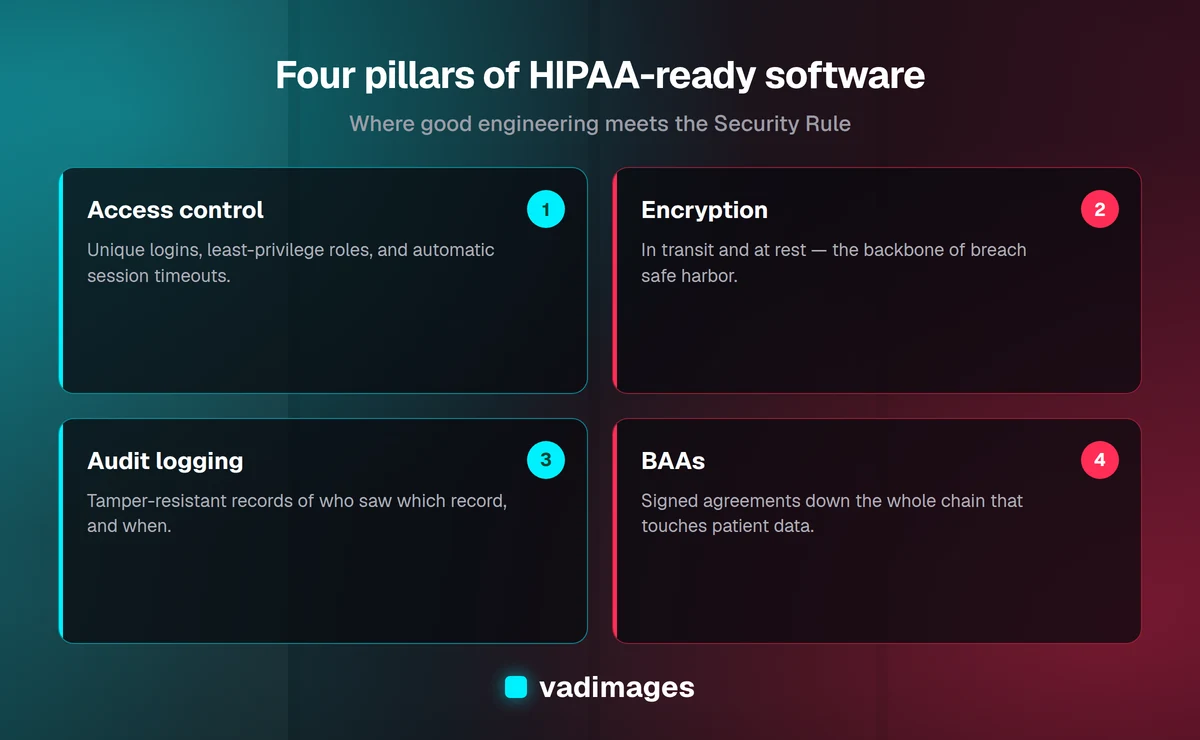
When people picture HIPAA software, they picture the technical safeguards — and rightly, because this is where good engineering does the heavy lifting. The Security Rule names a handful of technical requirements, and in practice they translate into four things you can point to and verify:
- Access control. Every user gets a unique identity — no shared logins, ever. People see only the data their role requires, sessions time out automatically, and there is a defined way to grant emergency access without leaving a hole. The principle is simple: the fewer people who can see a given record, the smaller your risk surface.
- Encryption, in transit and at rest. Data moving between the browser and your server is encrypted (TLS), and data sitting in your database and backups is encrypted too. Encryption is technically an "addressable" specification rather than a hard mandate, but skipping it is nearly indefensible — and properly encrypted data that is lost or stolen may not even trigger a breach notification, which is a powerful reason to do it well.
- Audit logging. The system records who accessed which record and when, and those logs are tamper-resistant and actually reviewed. If you cannot answer "who looked at this patient's file last Tuesday," you cannot demonstrate compliance, full stop.
- Integrity and authentication. The system can prove that data has not been improperly altered, and it reliably confirms that users are who they claim to be — which in modern builds means multi-factor authentication as the default, not an option buried in settings.
None of these are exotic. They are standard practice in any well-built custom software project. The difference with healthcare is that they are non-negotiable and must be documented, not just implemented. We design them in from the schema up, because retrofitting access control and audit trails onto a system that was not built for them is one of the most painful and costly rebuilds a company can face.
The safeguards that aren't about code
Here is where many technical teams stumble: they treat HIPAA as an engineering problem, when roughly two-thirds of the Security Rule is about people and process. The administrative safeguards are things like running a formal risk assessment, assigning someone to own security, training staff, and having a written incident-response plan for the day something goes wrong. The physical safeguards cover the boring-but-critical: who can physically reach the servers (your cloud provider handles most of this), how workstations are secured, and how old drives are wiped before disposal.
The reason this matters to a software decision is that the best-encrypted application in the world does not make you compliant on its own. A HIPAA-ready product gives you the tools to run good process — the audit logs, the access reports, the configurable timeouts — but your organization still has to use them. When we scope a healthcare build, we are explicit about this line: here is what the software guarantees, and here is what your team owns. Pretending the software covers everything is how businesses get a nasty surprise during an audit.
Where small teams get HIPAA wrong
Over the years the same avoidable mistakes show up again and again. Knowing them upfront saves a lot of money:
- Letting PHI leak into places it shouldn't be. Patient data ending up in application logs, error-tracking tools, analytics platforms, or a spreadsheet someone exported "just to check something" is one of the most common exposures — and each of those third-party tools needs its own BAA or needs to never see PHI at all.
- Using consumer tools for clinical data. Standard Gmail, a generic form builder, or an off-the-shelf chat widget are not built for PHI. The moment patient information flows through them without a signed BAA, you have a gap.
- Treating compliance as a launch-day event. Compliance drifts. New features, new integrations, and new staff all reopen risks you thought were closed. Without periodic reviews, a compliant launch becomes a non-compliant product within a year.
- Skipping the risk assessment. It is required, it is the first thing an investigator asks for, and it is the single most-overlooked step. A documented risk assessment is not bureaucratic busywork — it is the map that tells you where to spend your security budget.
Business Associate Agreements and your cloud stack
A Business Associate Agreement is the contract that makes the whole chain work. Whenever PHI passes from one party to another — from the clinic to your app, from your app to your hosting provider — a BAA has to be in place spelling out how each side protects the data and what happens if there is a breach. No BAA, no legal basis to handle the data.
The practical upside is that the major cloud platforms make this straightforward. Amazon Web Services, Google Cloud, and Microsoft Azure will all sign a BAA and publish lists of their "HIPAA-eligible" services. That word eligible is doing real work: signing the BAA does not automatically make everything compliant — you still have to build only on the covered services and configure them correctly. This is exactly the kind of decision we handle in the architecture phase of a project, so you are not discovering six months in that a convenient service you built around was never covered by your agreement. It is a core part of how we approach solutions for regulated clients, and we walk through the trade-offs openly in how we work.
How we build HIPAA-ready software at Vadimages
Our approach is not to sprinkle security on at the end but to make it the frame of the project. That means a data-flow map before we build anything, so we know exactly where PHI lives and travels. It means unique identities, role-based access, encryption everywhere, and audit logging designed in from the first schema, not bolted on. It means choosing HIPAA-eligible infrastructure and getting the BAAs signed before code ships. And it means handing you documentation you can actually show an auditor — not a vague promise that "it's secure."
We are also honest about the boundary of our role. We build software that is engineered to support your compliance and give you the reporting and controls to maintain it; the administrative side — your policies, your training, your legal review — stays with you, and we will tell you plainly when a question belongs with your attorney or compliance officer rather than your development team. That clarity is worth more than any reassurance, and it is why healthcare clients tend to stay with us across projects. You can see the shape of that work in our case studies.
What it costs and how to start
A common worry is that "HIPAA compliant" is code for "ten times the price." It is not. Good security overlaps heavily with good engineering, so a well-scoped healthcare build costs more than a throwaway marketing site but is very much in reach for a small or mid-sized business. Our custom projects start at $5,000, and healthcare work sits above that baseline because of the extra design, documentation, and infrastructure it genuinely requires — we quote it transparently rather than hiding it in a vague retainer, and you can see our ranges on the pricing page.
If you are weighing a new patient-facing tool, a portal, or an integration that will touch health data, the cheapest moment to get HIPAA right is before you build. A short conversation about your data flows and where your product sits in the compliance chain will save you far more than it costs. When you are ready, get in touch and we will map it out with you.
This article is general information from a software development team, not legal advice. HIPAA compliance is ultimately a legal and organizational responsibility — for decisions specific to your business, work with a qualified healthcare attorney or compliance professional alongside your development partner.