
Ask ten business owners how custom software gets built and you will get ten vague answers — usually some version of "you tell developers what you want, they disappear for a few months, and something comes back." That mental model is where most software disappointments begin. Custom software is not a black box you drop a wish into; it is a process with distinct phases, each with its own goal, its own decisions, and its own moment where your input matters most.
This is a plain-English tour of that process — the software development lifecycle — the same one we use at Vadimages to build systems for US small and mid-sized businesses. Knowing how the work actually unfolds is not just curiosity: it tells you what to expect, when your involvement counts, and how to spot a project heading off the rails before it costs you. Whether you are about to commission your first custom build or trying to understand why your last one went sideways, understanding the lifecycle is the single best way to get software that works — and to avoid paying for one that does not.
What the lifecycle actually is
The software development lifecycle is simply the sequence of stages a piece of custom software moves through, from the first conversation to the day you retire it. Different firms use different names and draw the boxes differently, but under the labels the work is the same: understand the problem, plan the solution, build it, prove it works, put it in front of real users, and keep it healthy as your needs change. Skipping or rushing any one of these is where budgets blow up and timelines slip.
It helps to think of it less as an assembly line and more as a series of gates. At each gate you learn something, make a decision, and commit to the next stretch of work with better information than you had before. A well-run project makes those gates visible to you — you always know which phase you are in and what has to be true to move on. The way a firm structures these phases tells you a lot about how the whole engagement will go, which is why we lay ours out plainly in how we work.
Phase one: discovery
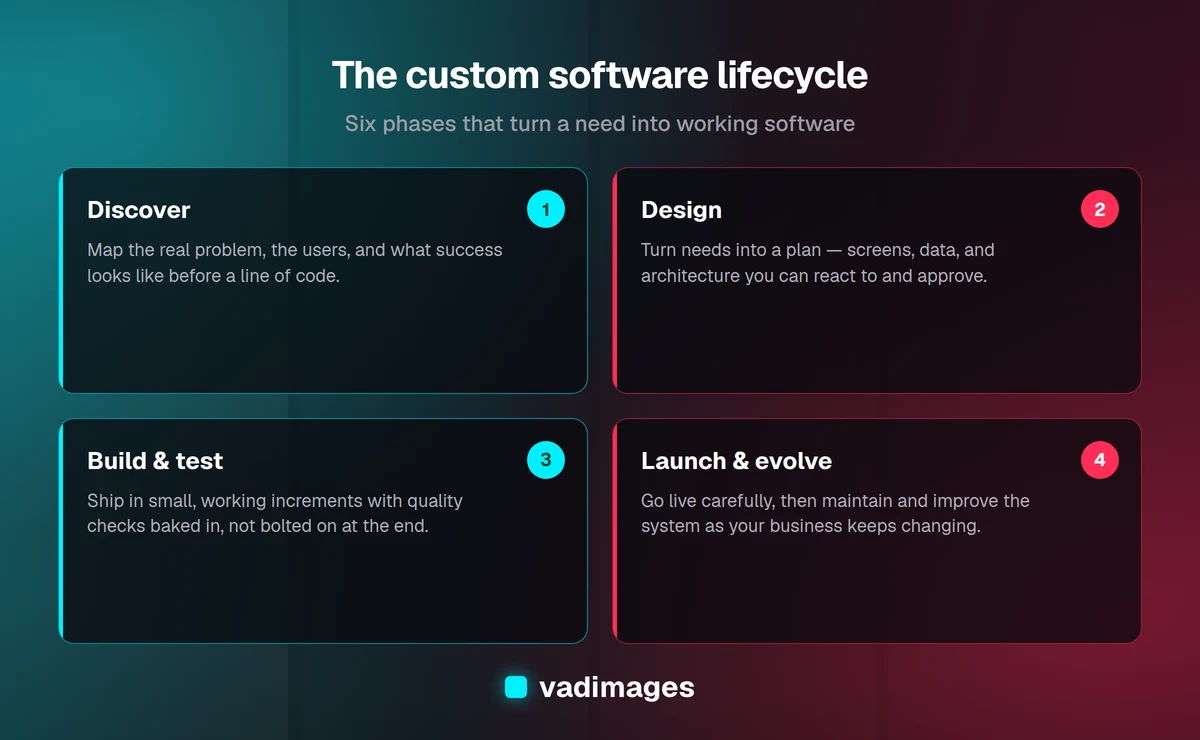
Everything good starts here, and most failures trace back to here being skipped. Discovery is the work of figuring out what actually needs to be built — not what someone assumed, or the first solution that came to mind, but the real problem underneath. A good discovery phase asks uncomfortable questions: Who will use this every day? What are they doing now, and where does it hurt? What would success look like in numbers? And what happens if you do nothing at all?
The output of discovery is not code — it is clarity. By the end you should have a shared, written understanding of the problem, the people it affects, the must-haves versus the nice-to-haves, and a rough sense of scope and cost. This is also where a good partner will occasionally tell you that custom software is the wrong answer, and that an off-the-shelf tool would serve you better. That honesty is a feature, not a flaw. If you want to see the shape of problems custom work is genuinely suited to, our custom software overview is a useful starting point.
Phase two: design and planning
With the problem understood, design turns it into a concrete plan. This happens on two levels at once. There is the design you can see — the screens, the flows, the way a user moves from opening the app to getting something done — often sketched as wireframes or clickable prototypes so you can react to something real before it is expensive to change. And there is the design you cannot see — the architecture, the data model, the decisions about how the pieces fit together and how the system will hold up as it grows.
This phase is where changing your mind is cheap, so it is where you should push hardest. Moving a button on a prototype takes minutes; moving it after the feature is built takes days. A strong design phase also breaks the work into a sequence — what gets built first, what can wait — so the project delivers value early instead of making you wait months for a single big reveal. The demands of your particular field shape these choices too, which is why we pay close attention to the industries we build for.
Phase three: development
This is the phase everyone pictures when they think of software — people writing code — but the way it happens matters more than the fact that it happens. Good modern development is iterative. Instead of vanishing for six months and returning with a finished product, the team builds in short cycles, delivering small, working slices of the software regularly. You see progress you can click on every couple of weeks, not a status report that says "70% done" with nothing to show for it.
That rhythm exists for your protection as much as the team's. Frequent, visible increments mean course corrections happen while they are still small, feedback shapes the product as it forms, and there are no half-year surprises. It also keeps the relationship honest: you are never asked to trust that unseen work is going well, because you can see it. If a firm cannot show you working software at regular intervals, treat that as a warning sign no matter how reassuring the written updates sound.
Phase four: testing and quality assurance
Testing is not a single step at the end — in a healthy project it runs alongside development the whole way. Every feature gets checked against what it was supposed to do, edge cases get probed, and automated tests are written so that fixing one thing does not quietly break another. There is manual testing, where a person uses the software the way a real customer would, and automated testing, where the code checks itself every time something changes.
The reason to care about this as a non-technical buyer is simple: the cost of a bug rises sharply the later it is caught. A problem found during development is cheap to fix; the same problem found by your customers after launch is expensive, embarrassing, and erodes trust. When you evaluate a partner, ask how they handle quality — the answer separates teams that build software that lasts from teams that ship and pray. You can see the difference reliability makes in our case studies.
Phase five: launch and deployment
Launch is the moment the software goes from a project to a live system your business depends on — and doing it well is a discipline of its own. A careful launch is rarely a single dramatic switch-flip. More often it is staged: released to a small group first, watched closely, then rolled out more widely as confidence grows. Data from old systems has to be migrated cleanly, the people who will use it need to be trained, and there has to be a plan for the inevitable hiccups of the first few days.
The goal is a launch that feels almost anticlimactic, because everything that could have gone wrong was caught before it reached everyone. That calm is not luck — it is the payoff of the phases that came before. Getting this stretch right is where the difference between a smooth transition and a painful one is decided, and it is a big part of why a repeatable process matters more than raw coding talent alone. The full range of what that process delivers sits under our solutions.
Phase six: maintenance and evolution
Here is the phase almost everyone forgets when they budget — and it is the longest one by far. The day software launches is not the finish line; it is the start of its working life. Operating systems update, security threats evolve, browsers change, your business grows, and the thing that fit you perfectly at launch needs adjusting to keep fitting. Software is a living system, not a monument, and it needs care for as long as you rely on it.
Maintenance covers a lot: fixing issues that surface in real use, keeping dependencies and security patches current, and steadily adding improvements as you learn what your users actually want. The mistake that costs the most is treating software as a one-time purchase and letting it quietly rot. Budgeting for the whole life of the system — not just its birth — is the mark of a buyer who has done this before, and it is why we talk about total cost openly on our pricing page.
Why it is a loop, not a line
Laid out in phases, the lifecycle looks like a straight march from start to finish. In reality the best projects treat it as a loop. What you learn from real users after launch feeds a new round of discovery; a new feature runs through its own small design-build-test-release cycle; the system grows in deliberate increments rather than one enormous push. The phases do not disappear — they repeat at a smaller scale, over and over, for as long as the software is useful.
This is why the relationship with whoever builds your software matters as much as the initial build. You are not buying a finished object; you are starting an ongoing process of shaping software around a business that keeps changing. The firms that serve SMBs well are the ones set up for that long arc, not just the launch-day sprint.
What your role looks like
You do not need to understand code to be a great client — but the lifecycle only works if you show up for the moments that need you. Those moments are concentrated: in discovery, where your knowledge of the business is irreplaceable; in design, where your feedback on prototypes is cheap and powerful; and at each development checkpoint, where a few minutes of your reaction keeps the product on track. A partner who genuinely wants your input at those gates is a partner building the right thing; one who only surfaces at the start and the end is a partner building something you may not recognize.
The best outcomes come from treating it as a collaboration with clear, well-spaced touchpoints — enough involvement to steer, not so much that you are managing engineers day to day. A good firm makes that easy, telling you exactly when a decision is needed and what it hinges on, so your time goes where it actually moves the project.
How long it takes and what it costs
The honest answer is that it depends on scope — but the lifecycle gives you a better way to think about it than a single lump-sum number. A small, well-defined tool might move through the phases in a matter of weeks; a substantial system that reshapes how a company operates unfolds over months, with value delivered in stages along the way rather than all at the end. Custom work with us starts at $5,000 and scales with the size of the problem, and because we break projects into phases you can see cost against value at each gate instead of writing one big check into the dark.
That staged approach is deliberate. It lets you start smaller, prove the value, and expand with confidence — and it keeps the estimate transparent from the first conversation. We would rather you understand exactly what each phase buys you than be surprised by an invoice, which is why we keep the numbers plain and the scope visible throughout the engagement.
The takeaway
Custom software is not magic, and it is not a gamble — it is a process, and processes can be understood, planned, and judged. When you know the lifecycle, you know what good looks like at every stage: discovery that asks hard questions, design you can react to, development you can see, testing that runs throughout, a launch that feels calm, and maintenance that keeps the system alive. A firm that runs those phases well and makes them visible to you is a firm worth trusting with something this important.
If you are weighing a custom build and want to understand how the whole process would work for your specific situation, get in touch. We will walk you through what each phase would look like, where your involvement would matter most, and what it would realistically take to turn your idea into software you can rely on — no jargon, and no surprises.