
Most small-business owners think about SEO as words: the right keywords, a steady stream of blog posts, a title tag that mentions what they sell. That work matters — but it sits on top of something quieter and much easier to ignore. Technical SEO is the plumbing underneath your website: the parts that decide whether search engines, and now AI assistants, can even reach your pages, read them cleanly, and trust them enough to put them in front of someone looking for exactly what you do.
When the plumbing leaks, nothing above it works. You can publish the best article in your industry and watch it never rank because one stray line in a config file quietly told Google not to index it. You can launch a beautiful redesign that triples your load time and loses the customers who never wait for a slow page to appear. This is a plain-English technical SEO checklist for 2026 — what to check, why each item matters, and how to tell whether a problem is a five-minute fix or a sign your site needs real engineering help.
What technical SEO actually covers
It helps to separate SEO into three layers. Content SEO is what you say — the topics, keywords, and answers on your pages. Off-page SEO is what others say about you — links, reviews, and mentions across the web. Technical SEO is everything about how your site is built and served: how fast it loads, whether search engines can crawl it, how your pages are structured, and whether the signals a machine relies on are present and correct. Content and links get most of the attention because they are visible. Technical issues get ignored because they are invisible right up until they cost you traffic.
The good news for a small or mid-sized business is that technical SEO is finite. Unlike content, which is an endless project, the technical foundation is a checklist you can actually finish, then maintain. Get it right once and you remove a whole category of reasons your marketing might silently fail. Here is what belongs on that checklist heading into 2026.
Start with crawlability and indexing
Before Google can rank a page, it has to do two things: crawl it (fetch the page) and index it (store it as a candidate to show in results). If either step fails, nothing else on this list matters. This is the single most common place we find serious problems when a business asks why their traffic is flat despite months of content work.
Walk through these fundamentals:
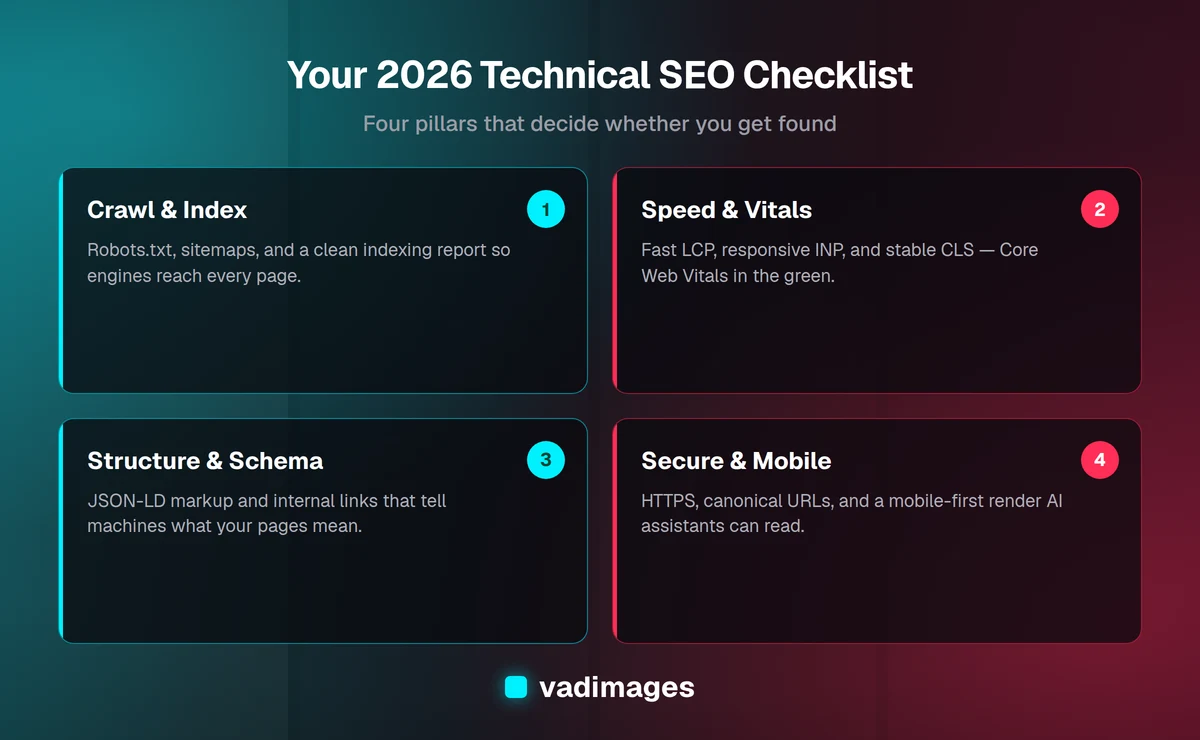
- Your robots.txt file should allow search engines to reach the pages you want ranked. A surprising number of sites accidentally block their own blog, product pages, or entire staging directories that got pushed live.
- An XML sitemap should list your real, canonical URLs and be submitted in Google Search Console. It is a map you hand the crawler so it does not have to guess.
- Check for stray noindex tags. These tell search engines to skip a page entirely, and they love to linger on templates after a site is built or migrated.
- Use the Pages (Indexing) report in Google Search Console to see which URLs are indexed and, more importantly, which are excluded and why. That report is the closest thing you have to an X-ray of how Google sees your site.
If your indexing report shows dozens of important pages excluded as "crawled — currently not indexed" or "discovered — not indexed," that is a signal worth taking seriously. It often points to thin content, duplication, or crawl-budget problems that a proper audit can untangle.
Core Web Vitals and page speed
Speed is no longer a nice-to-have. Google measures real-world performance through Core Web Vitals, a small set of metrics that approximate how a page actually feels to a visitor. In 2026 the three that matter are:
- Largest Contentful Paint (LCP) — how long until the main content appears. Aim for 2.5 seconds or less.
- Interaction to Next Paint (INP) — how quickly the page responds when someone taps or clicks. This replaced the older First Input Delay metric in 2024. Aim for 200 milliseconds or less.
- Cumulative Layout Shift (CLS) — how much the layout jumps around as things load. Aim for 0.1 or less.
These are not vanity numbers. A page that loads in one second versus five seconds is the difference between a visitor who reads your offer and one who hits the back button before your headline even renders. For small businesses, the usual culprits are oversized images, bloated page builders stacking a dozen scripts, and cheap hosting. The fixes range from trivial — compress your images, enable caching — to structural, where the honest answer is that a site built on a heavy template will never be fast and needs to be rebuilt on a modern, performance-first foundation.
Mobile-first and clean rendering
Google now indexes the mobile version of your site as the primary one. If your desktop site is rich and your mobile site strips out content, headings, or structured data to look tidy on a phone, you are effectively hiding that material from Google. Everything that matters for ranking needs to be present in the mobile experience, not just the desktop one.
There is a related, less obvious trap: rendering. Many modern sites build their pages with JavaScript in the browser. Search engines can process JavaScript, but it is slower and less reliable than plain HTML, and it introduces one more place where content can quietly go missing from what gets indexed. If your site is a single-page app or leans heavily on client-side rendering, confirm that your key content and links appear in the initial HTML — or use server-side rendering so crawlers and AI systems get the full page on the first request. This is exactly the kind of decision that is cheap to make correctly at build time and expensive to retrofit later, which is why we bake it into how we approach building sites and applications from the start.
Structured data and schema markup
Structured data — usually written as JSON-LD schema markup — is a standardized way of labeling what your content means. Instead of leaving a search engine to infer that a block of text is a product, a review, an FAQ, or a local business with an address and hours, you tell it explicitly in a language it fully understands.
The payoff is twofold. First, well-formed schema can earn rich results in Google — star ratings, FAQ dropdowns, business details — that make your listing larger and more clickable than a plain blue link. Second, and increasingly important in 2026, structured data helps machines that are not traditional search engines understand your site. AI assistants that summarize and recommend businesses lean heavily on clearly labeled, well-organized information. For a local company, LocalBusiness, Organization, and FAQPage schema are among the highest-value items you can add. Getting the entities consistent across your site — same business name, address, and details everywhere — is part of the same job.
Security, canonical URLs, and duplicates
A few foundational items round out the technical core. Your entire site should run on HTTPS; it has been a baseline expectation for years, and a mix of secure and insecure pages creates warnings that erode trust. Every page should have a single canonical URL, so that the same content reachable at multiple addresses — with and without a trailing slash, with tracking parameters, on both www and non-www — is consolidated into one version rather than competing against itself.
Duplicate content is the quiet tax here. When several near-identical pages exist, search engines have to choose which to rank, and they often choose none of them. Clean canonicalization, sensible redirects for pages you have moved or retired, and a habit of not publishing thin variations of the same page keep your authority focused where you want it. When you migrate or redesign a site, mapping old URLs to new ones with proper 301 redirects is the step most often skipped — and the one that most often tanks traffic overnight.
Architecture and internal linking
How your pages connect to one another is both a usability and a ranking signal. A flat, logical structure — where important pages are reachable in a few clicks from the homepage and grouped into clear sections — helps visitors and crawlers alike. Internal links pass authority between pages and tell search engines which of your pages are most important and how they relate. A strong internal linking habit, where new articles link to your core service and industry pages and your case studies reinforce your service pages, quietly compounds over time. Orphan pages — ones nothing links to — are the opposite: easy to publish, hard for anyone to find.
Technical SEO for AI search
The newest layer of the checklist is making your site legible to AI systems, sometimes called generative engine optimization or GEO. The encouraging part is that most of it overlaps with good traditional technical SEO. Content that is served as clean HTML, structured with clear headings, labeled with schema, fast to load, and free of crawl blocks is exactly what an AI assistant can ingest and cite. If you have done the work above, you are most of the way there.
A few 2026-specific habits help. Make sure your most important facts — what you do, where you operate, how to contact you, what things cost — are stated plainly in text rather than trapped in images or scripts. Keep an up-to-date sitemap so new content is discovered quickly. And be deliberate about whether you allow AI crawlers to access your site, a policy choice that lives in the same robots configuration you already maintain. The businesses that show up in AI answers tomorrow are, for the most part, the ones whose technical foundation is solid today.
Turning the checklist into a routine
Technical SEO is not a one-time cleanup; it is a foundation you set and then protect. Every redesign, every new page builder plugin, every content migration is a chance to reintroduce a problem you already solved. The practical rhythm for a small business is straightforward: fix the foundation once, then run a light quarterly check of your indexing report, Core Web Vitals, and any pages that have slipped, so small issues get caught before they become traffic losses.
If you work through this list and find more red than green — pages that will not index, Core Web Vitals in the danger zone, no schema, a JavaScript-heavy site that renders unpredictably — that usually means the problem is structural rather than cosmetic, and no amount of new content will fix it. That is the point where it makes sense to bring in help. At Vadimages we build and rebuild business websites and applications on a fast, crawlable, machine-readable foundation, with technical SEO handled as part of the engineering rather than bolted on afterward. Our project pricing is transparent and starts at $5,000, and you can see how we scope and price work on our pricing page or in our process overview. If you would like a straight answer about what is holding your site back, get in touch and we will take a look.