
If you run a plumbing company, an HVAC shop, a law practice, or almost any local service business, you have probably noticed a block of listings sitting above the regular ads at the top of Google: a few businesses with photos, star ratings, a verification badge, and a button to call or message. Those are Google Local Services Ads, and they work differently from almost everything else Google sells. Instead of paying for clicks, you pay for leads — a phone call, a message, or a booking request from a real prospect in your service area.
That pay-per-lead model makes Local Services Ads attractive to small businesses that have been burned by click-based advertising. But it also comes with its own rules, its own ranking factors, and its own operational demands. This guide explains how Google Local Services Ads work, who they suit, how they compare to standard Google Ads, and what needs to be in place on your side — phones, follow-up, tracking — for the leads to turn into revenue.
What Google Local Services Ads actually are
Local Services Ads (often shortened to LSA) are a Google advertising product built specifically for businesses that provide services in a defined geographic area. When someone searches for something like "emergency plumber near me" or "estate planning attorney," Google can show a short list of verified local providers at the very top of the page, frequently above the traditional text ads and the map results.
Each listing is generated from a profile rather than written ad copy. It typically shows your business name, your rating and review count, your hours, your service area, and a badge indicating that Google has verified the business. A searcher can tap to call you directly, send a message, or in some categories request a booking — all without visiting your website.
Availability depends on your category and location. Google has steadily expanded the program across home services such as plumbing, electrical, HVAC, roofing, cleaning, and pest control, and into professional services such as legal, real estate, and financial planning. Whether your specific service is eligible in your city is something you confirm when you sign up.
How the pay-per-lead model works
With standard search ads, you pay each time someone clicks, whether they ever contact you or not. With Local Services Ads, you are charged when a prospect contacts you through the ad — typically a phone call that connects, a message, or a booking request. Viewing your listing or your profile is not a lead.
A few mechanics are worth understanding up front:
- You set a budget. You decide roughly how much you want to spend over a period, and Google limits how many leads you receive accordingly. You can also choose a bidding approach, from letting Google maximize leads within your budget to setting your own target per lead, depending on what is available for your category.
- Lead costs vary by category and market. A lead for a high-value legal matter in a large metro is priced very differently from a lead for house cleaning in a smaller town. Google shows estimates during setup, and these change over time.
- You can dispute invalid leads. If a lead is clearly not a real prospect — a spam call, a job outside your service area, a service you said you do not offer — you can request a credit. Google reviews these requests, and its policies on what qualifies have shifted over the years, so keep good records.
- You choose your services and area. You specify which job types you want leads for and which zip codes or areas you serve, so you are not paying for work you do not want.
Verification and the trust badge
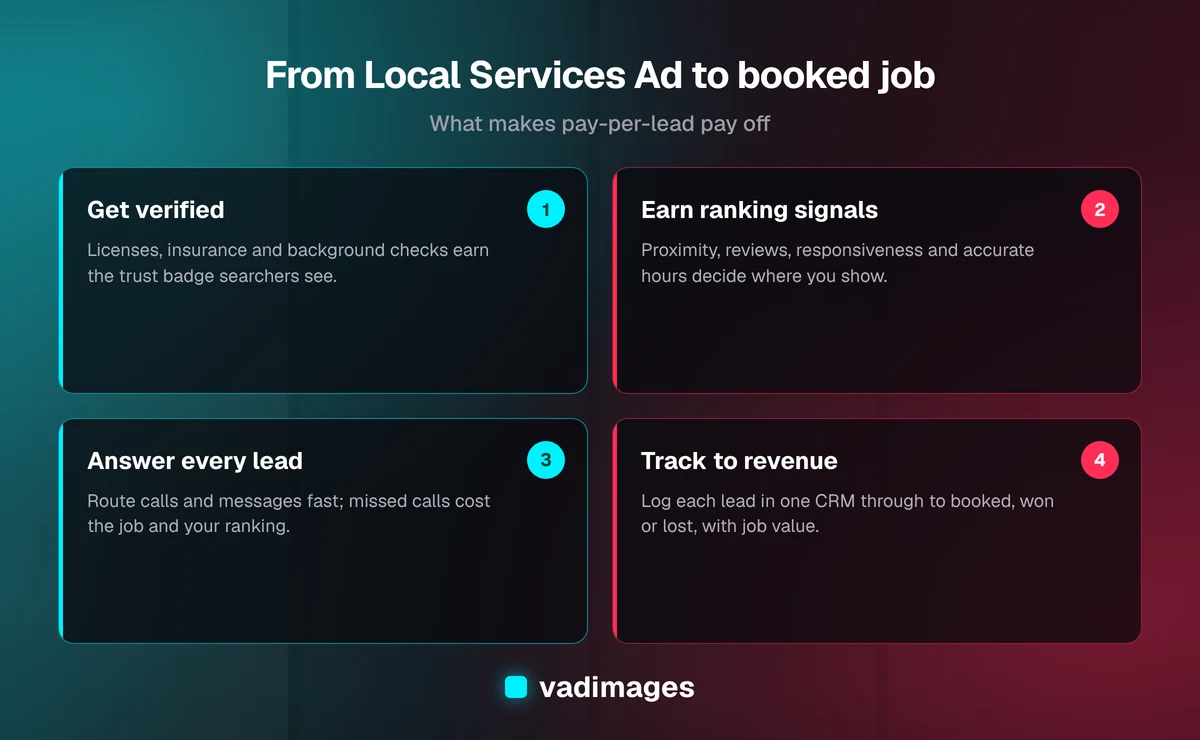
Before your ads can run, Google verifies your business. Depending on your category and location, that process can include business registration, professional licensing, insurance, and background checks on the owner and sometimes on field staff. Google has used different badge names over the life of the program, but the idea is consistent: the badge tells searchers that Google has screened the business before showing it.
Verification takes time and paperwork, sometimes several weeks, and it is the main reason some businesses start and never finish. Treat it as a project. Gather your license numbers, insurance certificates, and business documents before you begin, and make sure the business name, address, and phone number match exactly across your Google Business Profile, your website, and your licensing records. Mismatches are a common cause of delays.
The badge itself is a real asset. For a homeowner deciding who to let into their house, or a family choosing a lawyer, a visible signal of verification can tip the decision before anyone reads your website.
What decides where you rank
Local Services Ads are not a pure auction. Paying more can help, but Google weighs several signals about the quality of the business and how likely the searcher is to have a good experience. The factors Google itself points to include:
- Proximity — how close you are to the searcher, or whether they fall inside your service area.
- Reviews — your rating and the number of reviews you have. A steady flow of genuine reviews matters.
- Responsiveness — how reliably you answer calls and reply to messages. Missed calls and slow replies count against you.
- Business hours — you can only appear when you are marked as open, so hours that reflect when you truly answer the phone help.
- Complaints and policy issues — serious or repeated complaints can reduce or suspend your visibility.
Notice how much of this is operational rather than marketing. Responsiveness and reviews are outcomes of how your business runs day to day. The companies that do best with LSA are usually the ones with disciplined intake, not the ones with the biggest budgets.
Local Services Ads vs. regular Google Ads
It is tempting to frame this as either-or, but the two products do different jobs. Here is the practical difference:
- Billing: LSA charges per lead; standard search ads charge per click.
- Control: Search ads give you detailed control over keywords, ad copy, landing pages, and bidding. LSA gives you much less — Google decides which searches trigger your listing based on the services you select.
- Destination: Search ads usually send people to your website. LSA typically connects them straight to your phone or inbox, so your website plays a supporting role rather than a starring one.
- Setup effort: Search ads can launch quickly but take ongoing expertise to manage well. LSA takes longer to launch because of verification, then needs less day-to-day tuning and more operational follow-through.
Many local service businesses run both: Local Services Ads to capture high-intent "call someone now" searches, and search campaigns to reach people researching options, to promote specific high-margin services, or to cover service types LSA does not support.
Is pay-per-lead right for your business?
Local Services Ads tend to work well when a few conditions are true. Your service is eligible in your area. Your average job value is high enough that the cost of a lead is comfortably covered by the jobs you win. You can answer the phone during your listed hours — or have someone who can. And you have, or can build, a healthy base of reviews.
They tend to disappoint when calls go to voicemail, when messages sit unanswered for hours, when the business cannot handle the volume, or when the team has no way of knowing which leads became jobs. In those situations, it is easy to conclude that "LSA doesn't work" when the real issue is what happens after the phone rings.
The systems behind a profitable lead
A lead is not revenue. It is an opportunity that expires quickly. Someone who searched for an emergency electrician will usually call the next listing if you do not answer. That makes the systems behind your ads at least as important as the ads themselves:
- Fast response. Route LSA calls and messages to whoever can actually pick up, with clear coverage for after-hours if you advertise those hours. Automated text-back on missed calls can save leads that would otherwise be lost.
- Lead capture in one place. Leads arriving through LSA, your website, your Google Business Profile, and referrals should land in the same CRM or job-management system, not in a dozen inboxes and voicemail boxes.
- Outcome tracking. Record whether each lead was booked, quoted, won, or lost, and the job value. Without that loop, you cannot tell whether your cost per lead is a bargain or a drain.
- Review requests. Since reviews influence ranking, a simple automated request after each completed job keeps your profile growing.
- A credible website. Even when the ad bypasses your site, many prospects check it before they call back or sign a contract. Clear services, service areas, and contact details reinforce the trust the badge started.
This is where a lot of small businesses get stuck. The ad platform is straightforward; stitching together call routing, intake forms, a CRM, job scheduling, and reporting is not. It is the kind of workflow and integration work we do regularly, often connecting tools a business already uses so that every lead is captured, followed up, and tied to a result.
Getting started without wasting budget
If you decide to try Google Local Services Ads, a careful launch saves money and frustration:
- Confirm your category is eligible in your area and gather verification documents before you start.
- Make your Google Business Profile, website, and license records consistent down to the business name and phone number.
- Select only the job types and service areas you actually want, and set hours that match when you really answer.
- Start with a modest budget, then review lead quality weekly and dispute leads that clearly do not qualify.
- Track every lead through to a booked or lost job so you can judge return on spend in dollars, not just lead counts.
After a couple of months you will know far more than any estimate can tell you: what a lead really costs in your market, how many turn into jobs, and whether the channel deserves more budget.
Turning leads into a reliable pipeline
Local Services Ads give local service businesses something rare in online advertising: a model where you pay for contact from real prospects rather than for attention that may never convert. The businesses that get the most from them treat the ad as the front door of a system — verified profile, strong reviews, fast answers, and clean tracking from first call to finished job.
At Vadimages we help service businesses in the Portland and Southwest Washington area and across the US build the websites, intake flows, CRM integrations, and reporting that turn paid leads into booked work. You can see the kinds of problems we solve in our industry work and case studies, and how we run projects — discovery, a milestone plan, build with weekly demos, then launch and support — on our process page. Projects start at $5,000, with details on our pricing page. If your ads are generating calls but not enough jobs, get in touch and we will help you find where leads are slipping away.