
Hiring a software agency is one of the larger bets a small business makes, and it is usually made with the least information. You are buying something you cannot see yet, from people you have known for a few weeks, on the strength of a proposal and a good conversation. When it goes well, you get a tool that quietly runs part of your business for years. When it goes badly, you get a half-finished system, a drained budget, and the job of starting over with someone else.
The good news is that most bad engagements give off warning signs long before the contract is signed. The problems that sink a project — vague scope, a partner who overpromises, code you do not actually own — are visible in how an agency sells, quotes, and answers questions during the courtship. You just have to know what you are looking at.
Here are the red flags worth taking seriously when you are choosing who builds your software, written for the person signing off on the budget rather than the one writing the code. None of them is automatically disqualifying on its own, but two or three together should make you slow down.
A price with no explanation behind it
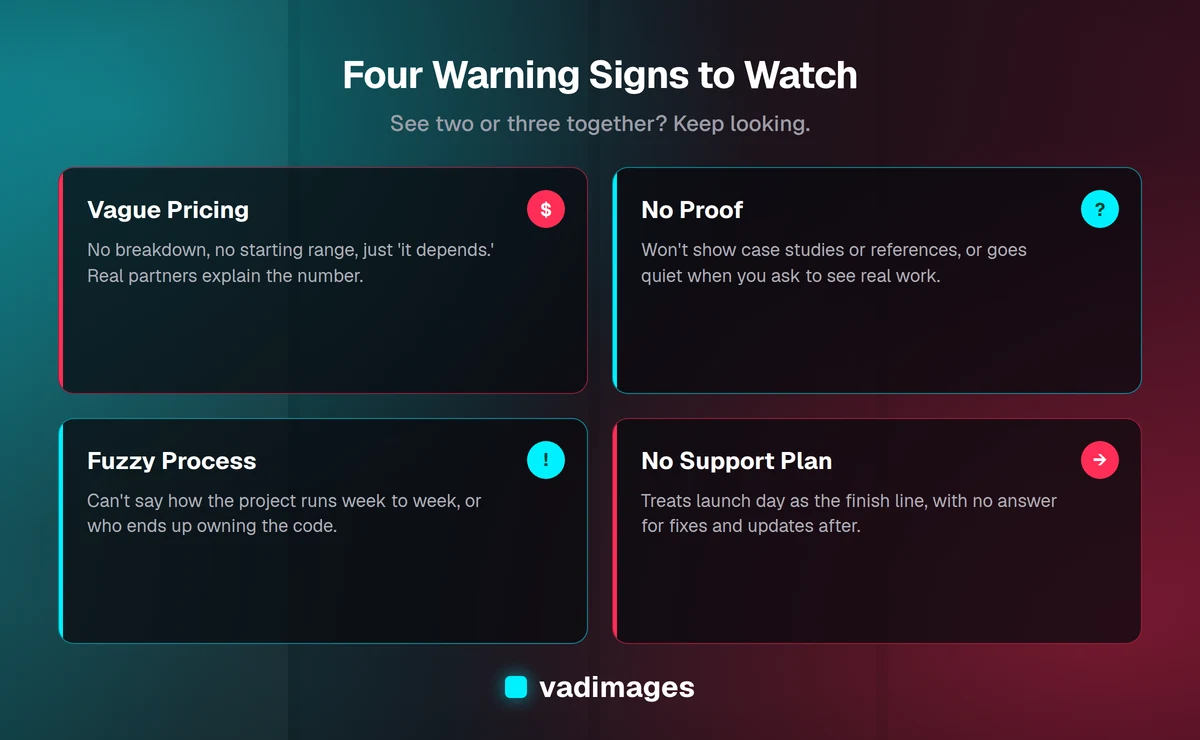
The single most common red flag is a number that arrives with no reasoning attached. Either the quote is suspiciously low — a full custom application for a few hundred dollars — or it is a large figure with no breakdown of what it covers. Both are warnings. A price that is too good to be true usually means the agency has not understood the work, and the real cost will surface later as change orders. A large, opaque number means they either cannot or will not show you where the money goes.
A trustworthy agency can tell you why a project costs what it does: the features that drive the number, the parts that are expensive, and the parts you could cut to hit a tighter budget. Custom software is a real investment — serious projects generally start around $5,000 and climb from there with complexity — and any partner worth hiring will talk about that openly rather than dodging it. If you cannot get a straight answer about money before you have paid anything, assume the answers do not get clearer once you have. Look for a firm that publishes or walks you through its pricing instead of guarding it.
They will not show you real work
Every agency has a polished website and a page of logos. What separates the real ones is whether they can point to specific projects and explain what they built, what problem it solved, and what happened after launch. Be wary of a shop that talks in generalities — "we do web, mobile, AI, everything" — but goes quiet when you ask to see something concrete or to speak with a past client.
Ask for case studies and references, and actually follow up on them. A confident partner will happily connect you with a client who can describe what it was like to work together, including the rough patches. Silence, stalling, or a sudden pivot to "we protect our clients' privacy" for every single request is a sign there may not be much finished work to show.
There is no clear process
Good software is built in a rhythm: discovery, a plan, regular check-ins, working software you can see before it is finished. When you ask an agency how a project actually runs week to week and get a hand-wave in return, that is a problem. "We will just start coding and figure it out" sounds agile and flexible. In practice it means you will not know where the project stands until the money runs out.
Ask them to walk you through what the first month looks like, how often you will see progress, and how they handle changes when — not if — the plan shifts. You want a partner who can describe how they work in plain terms: who you will talk to, what you will review, and how decisions get made. A vague answer here almost always turns into surprises later.
They say yes to everything
It feels great when a vendor loves every idea you have. It should not. An experienced agency has built enough software to know that some features are traps — expensive to build, rarely used, and a drag on everything else. A partner who never pushes back, never says "that part is not worth it yet," and never asks a hard question about your business is either not listening or not experienced enough to know better.
The best early sign of a strong partner is a good discovery conversation: they ask about your customers, your current workflow, and what you have already tried, and they are willing to talk you out of scope you do not need. That instinct saves you money. Enthusiasm with no discernment costs you money.
You cannot tell who will actually do the work
A classic bait-and-switch: you meet a sharp, senior team during the sales process, sign the contract, and then find your project handed to junior developers or an offshore subcontractor you never met. The work quietly changes hands, quality slips, and communication gets harder across time zones and layers.
There is nothing wrong with a distributed team or a lean shop — plenty of excellent agencies are small or remote. The red flag is a lack of transparency about it. Ask directly who will write your code, who your day-to-day contact is, and whether that changes after the contract is signed. You are entitled to a clear answer, and the answer should match the people who showed up to win your business.
Ownership and access are left murky
This one is easy to overlook and painful to discover late. When the project is done, who owns the code? Whose name is on the domain, the hosting account, the app store listing, the analytics? If the answers are fuzzy — or if the agency keeps everything on accounts you do not control — you do not really own your software. You are renting it, and the rent can go up.
Before you sign, get it in writing that you own the source code and all the accounts your business depends on. A reputable partner builds this in by default, hands over the keys, and has no problem with you moving to another provider someday. An agency that resists is protecting its leverage over you, not your investment. This is worth confirming in plain language in the contract, alongside how the finished custom software will be delivered and documented.
Communication is already slow
Pay attention to how an agency treats you before you are a paying client, because that is the best behavior you will ever see from them. If emails go unanswered for days, if calls get rescheduled repeatedly, or if you feel like you are chasing them for basic information during the sales process, take it seriously. Responsiveness rarely improves once the deal is closed and you are one of many active projects.
The reverse is also true: a partner who is organized, prompt, and clear while courting you is showing you how the working relationship will feel. Communication is not a soft nicety on a software project — it is the thing that keeps a build on track when something unexpected comes up, and something always comes up.
There is no plan for after launch
Software is not a painting you hang on the wall and forget. It needs updates, security patches, and fixes when something breaks or your business changes. An agency that treats launch day as the finish line — with no conversation about maintenance, support, or who you call at 9 a.m. when a customer reports a bug — is setting you up to be stranded.
Ask what happens after go-live. Is there a support arrangement? How are fixes handled, and what do they cost? A partner who wants a long relationship will have a clear answer, because keeping your software healthy is part of the job. One who is only interested in the build is one you will be searching for a replacement for within a year.
What good looks like
Flip every red flag over and you have your checklist for a partner worth hiring. The signals to look for are:
- Transparent pricing — they explain what drives the cost and give you a real starting range instead of dodging the question.
- Proof you can check — specific projects, honest references, and work they can describe in detail.
- A process you understand — a clear plan, regular check-ins, and working software you see along the way.
- Honest pushback — a discovery conversation where they help you cut scope you do not need.
- Clear ownership — the code and accounts are yours, in writing.
- A support plan — a real answer for what happens after launch.
None of this requires you to become technical. It requires you to ask direct questions and to notice how they get answered. The right agency will welcome the scrutiny, because it is how they win the clients who stay. At Vadimages, we work with small and mid-sized businesses across a range of industries and build software solutions around exactly these principles — clear pricing, a process you can follow, and code you own. If you are weighing a project and want a straight answer before you commit, get in touch and we will tell you plainly what it would take.