
Something has shifted in how small and mid-sized businesses across the Pacific Northwest think about software. A few years ago, the default answer to almost any operational problem was to buy another subscription. Need to track jobs? There's an app for that. Need to manage inventory, schedule crews, or invoice clients? Buy the tool, pay per seat, and make your business fit the software. Today, more and more owners in Vancouver, Portland, and the wider region are asking a different question: instead of bending our business to fit a tool built for someone else, what would it take to build the tool around how we actually work?
That question is behind a real trend. PNW businesses that would once have never considered custom software are now treating it as a serious investment — on par with hiring a key employee or buying a piece of equipment. This isn't about chasing technology for its own sake. It's about owners doing the math and realizing that the stack of monthly subscriptions they've assembled is expensive, disconnected, and quietly holding the business back.
The Pacific Northwest is quietly becoming a custom-software region
When people picture custom software, they tend to picture Silicon Valley — venture money, hoodie founders, apps built to be sold to millions. That's not what's happening here, and that's exactly the point. The businesses investing in custom software across the PNW are landscapers, clinics, manufacturers, logistics firms, professional-services offices, and regional retailers. They aren't building the next unicorn. They're building the one system that finally makes their day-to-day run without friction.
The region has always had a practical, build-it-yourself streak. The same instinct that makes a Vancouver contractor fabricate a custom jig rather than buy a mediocre one is now showing up in how they treat their operations. If the off-the-shelf option is clumsy, overpriced, or missing the one feature that matters, building the right thing starts to look reasonable — especially once you realize the price of a real custom tool is no longer out of reach for a business doing a few million in revenue.
What's pushing PNW businesses off the shelf
Almost every custom-software conversation we have starts with a specific frustration, not a grand vision. When you line those frustrations up, the same handful appear again and again:
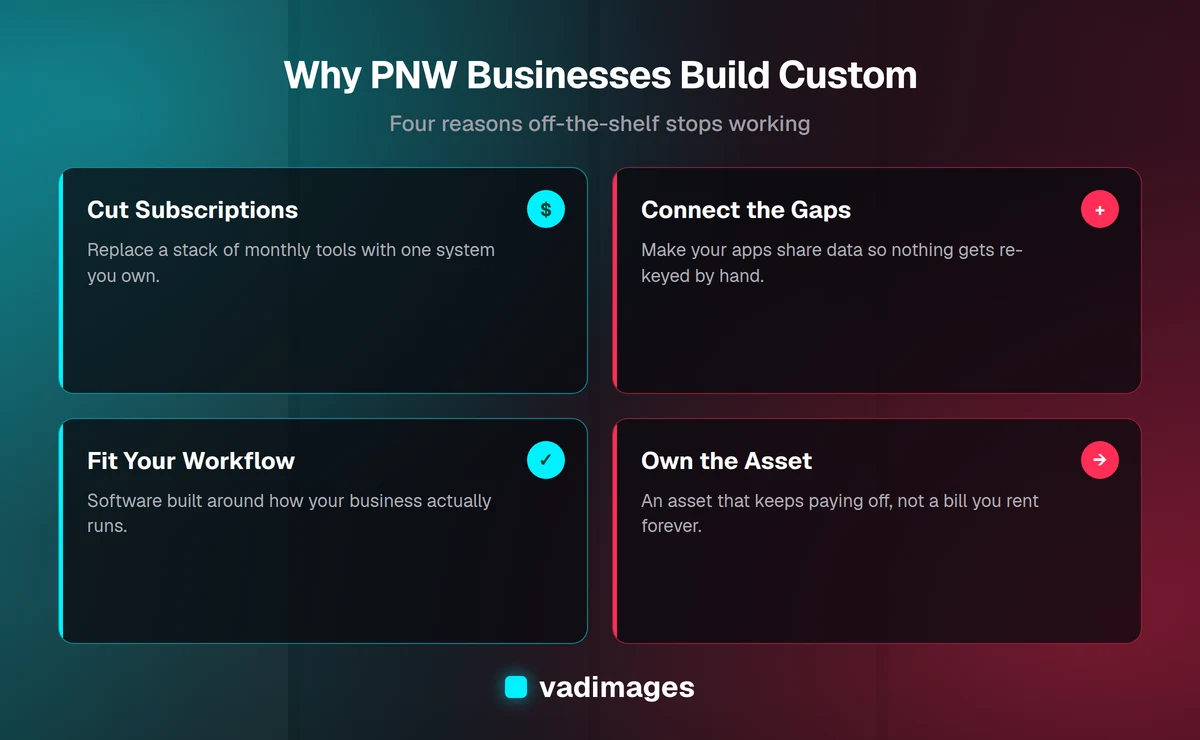
- Subscription fatigue. A typical small business is now paying for a dozen or more separate tools, each with its own login, its own monthly bill, and its own idea of how the work should be done. The total is often larger than owners realize until they add it up.
- Tools that don't talk to each other. The scheduling app doesn't know what the accounting app knows, so someone re-keys the same data three times. Every handoff is a chance for something to fall through.
- Paying for features you'll never use while missing the one you need. Generic software is built for the average of thousands of companies. The 20% you actually need is buried under 80% of clutter, and the workflow unique to your business simply isn't there.
- Spreadsheets doing a job they were never meant to do. The real operating system of a lot of PNW businesses is a fragile web of shared spreadsheets that only one person fully understands. It works until it doesn't.
- Growth exposing the cracks. A process that was fine at ten employees becomes a bottleneck at forty. Manual steps that were tolerable start costing real money and real customers.
None of these is a technology problem on its own. Together, they add up to a business that spends too much of its energy fighting its own tools instead of serving customers. Custom software is attractive because it targets the specific friction rather than adding one more generic layer on top.
The Vancouver–Portland corridor has its own rhythm
The Vancouver, Washington and Portland, Oregon corridor is one of the more interesting places in the country to run a business, and that shapes what local companies need from their software. Many operate on both sides of the Columbia River — a supplier in Portland, a warehouse in Vancouver, customers spread across both metro areas. That creates practical complications that generic tools rarely handle well.
Washington has no state income tax; Oregon has no sales tax. A business selling and operating across the river has to get tax handling, reporting, and record-keeping right in two different regimes at once — the kind of rule that a boxed product treats as an edge case but that a local company lives with every single day. Custom software can bake those realities in so the right thing happens automatically, instead of relying on a staff member to remember which rule applies where.
There's also a cultural fit. PNW business owners tend to value straight talk, durable work, and partners who are actually reachable. Working with a team that understands the local market — and can sit down at the same table — beats routing a critical system through an offshore vendor twelve time zones away. That preference for a genuine working relationship is part of why regional demand for custom builds keeps growing.
What PNW businesses are actually building
The projects that deliver the best return are rarely flashy. They're the unglamorous systems that remove a recurring headache and quietly pay for themselves. Across the region, the common patterns look like this:
- Operations hubs that replace a tangle of spreadsheets and apps with one place to see jobs, crews, materials, and status in real time.
- Customer and client portals where people can book, upload, approve, pay, and check status themselves — cutting the phone-and-email back-and-forth that eats a team's day.
- Workflow automation that takes a manual, multi-step process — quote to invoice, intake to scheduling, order to fulfillment — and runs it with a fraction of the clicks.
- Integrations that finally connect the accounting system, the CRM, and the field tools so data flows once instead of being re-entered by hand.
- Industry-specific tools built around the exact rules of a trade — the way a clinic, a manufacturer, or a logistics firm truly operates rather than a vendor's generic template.
If you want to see how this plays out in practice, our case studies walk through the kinds of problems these builds solve and the outcomes they produce. The through-line is always the same: the software earns its keep by giving people their time back.
It's an investment, not an expense
The mindset shift that's driving this trend is the move from thinking of software as a cost to thinking of it as an asset. A subscription is a bill you pay forever for something you never own. A custom system is something you own outright — an asset that keeps working, keeps saving hours, and can be extended as the business changes.
The return usually shows up in three places. First, hours saved: automating a task that used to take a person ten hours a week is, in effect, buying back a quarter of someone's time to spend on higher-value work. Second, mistakes avoided: every manual re-entry and every missed handoff carries a cost, and removing them protects both revenue and reputation. Third, capacity unlocked: a business that can take on more work without adding proportional overhead is a business that can actually grow its margins. When owners run those numbers honestly, a well-scoped custom build often pays for itself faster than they expect.
What custom software actually costs here
The biggest myth that keeps PNW businesses from even asking about custom software is that it must cost a fortune. It's true that a large enterprise platform can run into the hundreds of thousands. But that's not what most local businesses need, and it's not where a good partner starts.
At Vadimages, focused custom projects start at around $5,000, and we're transparent about pricing from the first conversation. A tightly scoped tool that automates one painful workflow or replaces one fragile spreadsheet lands at the lower end. A more involved operations hub or a system that ties several parts of the business together costs more, because it does more. What you should never get is a number with no explanation behind it. You can see how we think about scope and budget on our pricing page, and the sequence we follow — from first conversation to launch — on how we work.
The healthier way to frame the question isn't "how much does custom software cost?" It's "what is this problem costing us right now, and what would it be worth to make it go away?" Once the problem has a price tag, the investment decision gets a lot clearer.
How to tell if you're ready
Custom software isn't the right move for every business or every problem. It earns its place when the pain is specific and recurring. A few signs that it's worth a conversation:
- You're paying for several tools that overlap, and still doing manual work to bridge the gaps between them.
- A critical part of your operation runs on a spreadsheet only one person truly understands.
- Your team spends real hours each week on repetitive copy-paste, data entry, or status-chasing.
- You've outgrown an off-the-shelf tool and keep hitting a wall it simply won't let you past.
- Growth is being throttled by process, not by demand.
If two or three of those sound familiar, the value is probably there. If none do, a good partner will tell you so — the right answer is sometimes to tune what you already have rather than build something new. Exploring your solutions and the industries we work in is a good way to see whether your situation fits the pattern.
Choosing a partner who works the way you do
If the trend has a lesson, it's that the software matters less than the partnership behind it. A custom system is only as good as the team that scoped it, built it, and stands behind it after launch. That's why so many PNW owners prefer working with a local partner who explains things in plain language, quotes transparently, and treats their business like it matters — because to a regional firm, it does.
The businesses getting the most out of this shift aren't the ones with the biggest budgets. They're the ones who started with a single, well-defined problem, worked with a partner who was honest about scope and cost, and built something that fit. If you're a Vancouver, Portland, or wider Pacific Northwest business wondering whether your stack of subscriptions and spreadsheets is finally holding you back, that's exactly the conversation worth having. Get in touch and we'll help you figure out whether custom software is the right investment — and if it is, what a sensible first step looks like.