
If you have to choose one first, choose the channel that matches your timeline: Google Ads when you need customers this quarter, SEO and GEO when you can invest for the next year and want durable, compounding traffic. Most healthy businesses eventually run both, but where you start should be driven by budget, timeline, and how mature your website already is.
What is the real difference between Google Ads and SEO?
The google ads vs seo debate gets framed as paid versus free, which is misleading. Both cost money. The difference is in how you pay and what you own at the end.
Google Ads (paid search) is a rented spot at the top of the results page. You bid on keywords, and when someone searches, an auction decides whether your ad shows and what you pay per click. Turn the budget off and the traffic stops the same day. It is a faucet: instant flow, but only while the money runs.
SEO (search engine optimization) is the work of earning rankings in the organic, unpaid results through content, technical health, and authority. You are not buying clicks; you are building an asset. Increasingly this includes GEO (generative engine optimization) — making sure your business is quoted and cited inside AI answers from tools like ChatGPT, Google's AI Overviews, and Perplexity. SEO and GEO are slower to pay off, but the traffic keeps arriving after you stop actively working on it.
One rents attention. The other builds equity. Neither is inherently smarter — they solve different problems on different timelines.
How fast does each channel actually produce results?
This is usually the deciding factor, so let's be honest about it.
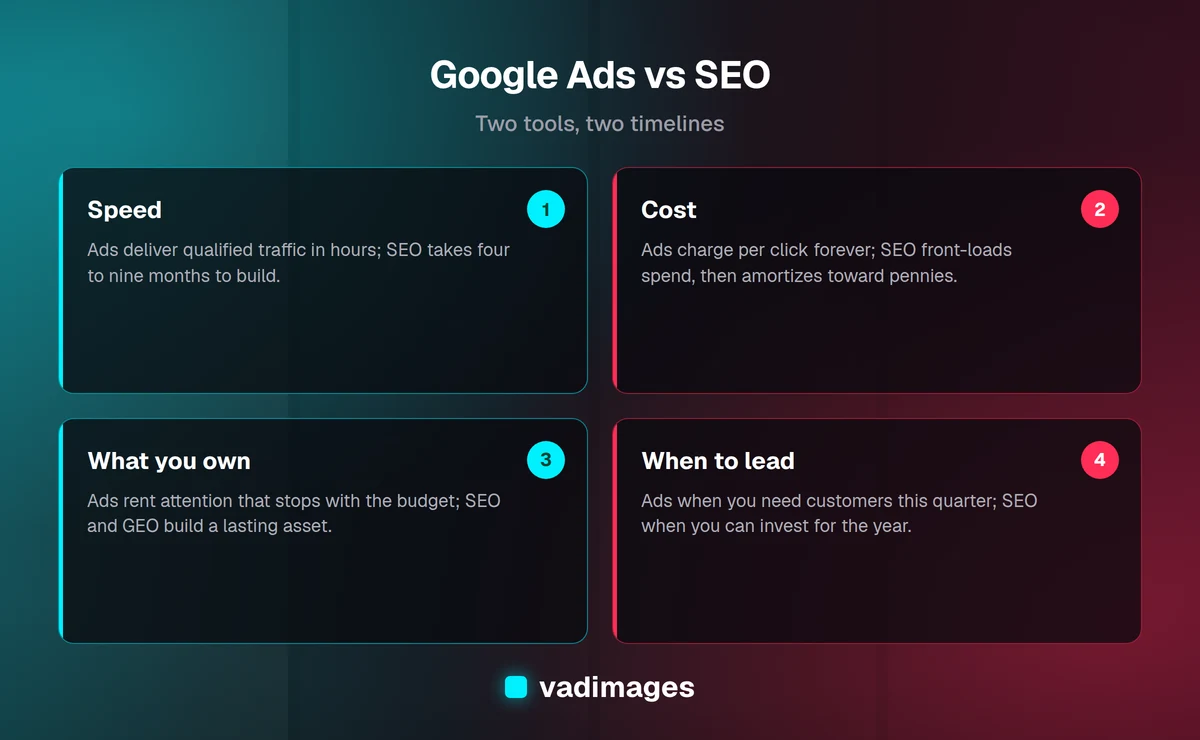
Google Ads is fast. A well-structured campaign can send qualified visitors to your site within hours of approval. You can test headlines, landing pages, and offers in days, and you get clean data on which keywords convert. For a business that needs pipeline now — a new location opening, a seasonal push, a product launch — nothing else compares for speed.
SEO is slow, then it isn't. For a new or thin website, meaningful organic traffic typically takes four to nine months to build, sometimes longer in competitive markets. Google has to crawl your pages, judge their quality, and watch how users respond before it trusts you with rankings. But once you rank, that position keeps working. A page that took three months to rank can drive leads for years with light maintenance.
The mental model that helps: Google Ads buys you time, SEO buys you compounding. Ads get customers in the door while your organic presence is still being built.
What does each one really cost?
Cost structure is where a lot of owners get surprised, so here is the plain version.
With Google Ads, you pay per click, every click, forever. In competitive US service industries, clicks can run anywhere from a couple of dollars to $50 or more, and only a fraction of clicks become leads. Your cost per acquisition is a moving target that rises as competitors bid up the same keywords. The spend never becomes an asset — stop paying and you are back to zero visibility. Budgets typically need to be a few thousand dollars a month to gather enough data to optimize well.
With SEO, you pay for work up front — content, technical fixes, and links — and the cost per visitor drops over time as traffic grows against a fixed investment. A page that cost $600 to produce might attract thousands of visitors over its life, pushing the effective cost per click toward pennies. The catch is that the money goes out before the traffic comes in, which requires patience and a longer runway.
A useful way to compare them: Google Ads has a high, permanent variable cost. SEO has a higher upfront cost that amortizes toward near-zero. Over a two-to-three-year horizon, organic search almost always wins on cost per lead. Over the first ninety days, paid search almost always wins.
When does Google Ads make the most sense?
Lead with paid search when one or more of these is true:
- You need revenue this quarter. Payroll, a launch, or a growth target won't wait nine months.
- Your margins support the click cost. High-value services — legal, dental, home services, B2B software — can absorb a $40 click because one closed deal is worth thousands.
- You're testing a market or offer. Ads give you fast, honest data on which messages and keywords convert before you commit months of SEO work to them.
- You're in a seasonal or event-driven window. Tax season, holidays, or a time-boxed promotion reward instant visibility.
- Your website is brand new. With no domain authority yet, ads are often the only way to appear on page one while SEO matures.
The honest caveat: if your landing pages are weak or your follow-up is slow, ads will expensively expose those gaps. Paid traffic amplifies whatever conversion system you already have — good or bad.
When does SEO and GEO make the most sense?
Lead with organic when:
- You can invest ahead of return. You have six to twelve months of runway and want to stop renting every visitor.
- Your customers research before they buy. If people compare options, read reviews, and ask AI assistants for recommendations, you need to be present in those unpaid, high-trust moments.
- Click costs in your industry are brutal. When paid clicks routinely run $30 to $80, organic rankings become dramatically cheaper per lead over time.
- You want to build a defensible moat. Competitors can outbid you tomorrow, but they can't buy your way out of a year of accumulated content and authority.
- You care about AI visibility. GEO is quickly becoming its own reason to invest — being cited in AI answers is the new version of ranking first, and it rewards the same fundamentals: clear, trustworthy, well-structured content.
SEO is the choice of businesses that think in years, not weeks. It rewards patience with an asset that gets cheaper and stronger the longer you own it. If you want a deeper look at how organic and generative search fit together, our SEO and GEO services page breaks down the approach.
How do Google Ads and SEO work together?
Framing them as rivals is the most common mistake. In practice they make each other better.
Ads feed SEO with data. Paid campaigns tell you within weeks which keywords actually convert into customers, not just which ones get clicks. That intelligence lets you prioritize your SEO content around proven money keywords instead of guessing.
SEO lowers your ad costs. Google rewards relevant, high-quality landing pages with better Quality Scores, which means lower cost per click. The same page improvements that help you rank organically make your paid traffic cheaper.
Owning both slots builds trust. When your business appears in the ad spot and the top organic result, you take more of the page, look more established, and win more clicks than either placement alone.
Ads cover the gap while SEO matures. The smartest sequence for many businesses is to run ads for immediate leads, invest in SEO and GEO in parallel, and then dial paid spend down on the keywords where you've earned strong organic rankings — reallocating that budget to terms you don't yet own. Over time, paid becomes a scalpel instead of a life-support machine.
Retargeting ties it together: someone finds you through an organic article, and a low-cost retargeting ad brings them back when they're ready to buy. The channels compound instead of competing.
Where should I start, based on my situation?
Here is a practical decision guide by business stage and constraint.
- New business, tight budget, need leads now: Start with a small, tightly focused Google Ads campaign on your highest-intent keywords. Keep the geography and keyword list narrow so a modest budget goes far. Begin foundational SEO (site structure, core service pages) in the background.
- Established business, healthy margins, no organic presence: Run both from day one. Use ads for immediate pipeline and fund a serious SEO/GEO program to stop the long-term bleed of paying for every click.
- Steady business, patient budget, high click costs: Lead with SEO and GEO. Use a lean ads budget only on your two or three most valuable "ready to buy" keywords while organic builds.
- You already rank well organically: Shift toward ads for expansion — new services, new markets, and competitor keywords you don't rank for yet — and use retargeting to convert your existing organic traffic.
- You have no website worth sending traffic to: Fix that first. Neither channel performs when the destination doesn't convert. A fast, clear, trustworthy site is the prerequisite for both.
If you're unsure which bucket you fall into, that's a fifteen-minute conversation, not a guess. The right split depends on numbers specific to your business — your margins, your close rate, and your click costs.
Frequently asked questions
Is SEO cheaper than Google Ads? Over the long run, almost always. SEO front-loads the cost and then amortizes it as traffic grows, while Google Ads charges for every click indefinitely. In the first three months, though, ads are usually the cheaper way to actually get customers, because SEO hasn't matured yet.
Can I do both on a small budget? Yes, if you keep each focused. Run ads on a narrow set of high-intent keywords rather than spreading thin, and concentrate SEO on a few pages that match proven buyer intent. Trying to compete broadly on a small budget is where money gets wasted.
How long until SEO pays off? For most small and midsize businesses, expect four to nine months to see meaningful organic traffic, with results compounding after that. Newer domains and more competitive industries sit at the longer end.
Does GEO replace traditional SEO? No — it extends it. The content quality, clarity, and authority that earn organic rankings are the same signals that get you cited in AI answers. Do the fundamentals well and you benefit in both places at once.
If I can only afford one, which should it be? If you need customers within the next 90 days, choose Google Ads. If you can wait and want to stop renting every visitor, choose SEO. The tie-breaker is your runway, not your preference.
The bottom line
Google Ads and SEO are not competitors — they're tools for different jobs. Ads buy speed and certainty; SEO and GEO build a durable, compounding asset that gets cheaper over time. Start with paid search when you need results this quarter, start with organic when you can invest for the year ahead, and run both once you can — using each to strengthen the other. The wrong move is treating it as a permanent either/or decision. The right move is sequencing the two around your real budget, timeline, and business stage.
Not sure which mix fits your numbers? We'll give you an honest recommendation based on your margins and market — no hype, no lock-in. Talk to Vadimages about your search strategy.