
On May 20, 2026, the Federal Motor Carrier Safety Administration removed twelve more electronic logging devices from its list of registered ELDs — including 888 ELD, DRAGON ELD, ACTION ELD, COBRA ELD, and both versions of FIRST ELD. Motor carriers running any of those devices must replace them with a registered ELD before July 20, 2026, or their drivers will be placed out of service at roadside inspections. It is the latest move in the most aggressive year of ELD enforcement since the mandate took effect, and any fleet that treats its logging device as “set and forget” infrastructure is now carrying real operational risk.
A record enforcement year for ELDs
FMCSA revoked 38 devices in all of 2025 — itself an increase of more than 80 percent over 2024. In 2026 the agency has already gone well past that pace: nine devices were removed on February 12, fourteen more on March 4 (most of them tied to a single provider, Gorilla Fleet Safety), HERO ELD followed on April 2, Safe ELD and MYLOGS ELD on May 7, and now twelve more on May 20. That puts 2026 revocations above forty devices before the year is even half over.
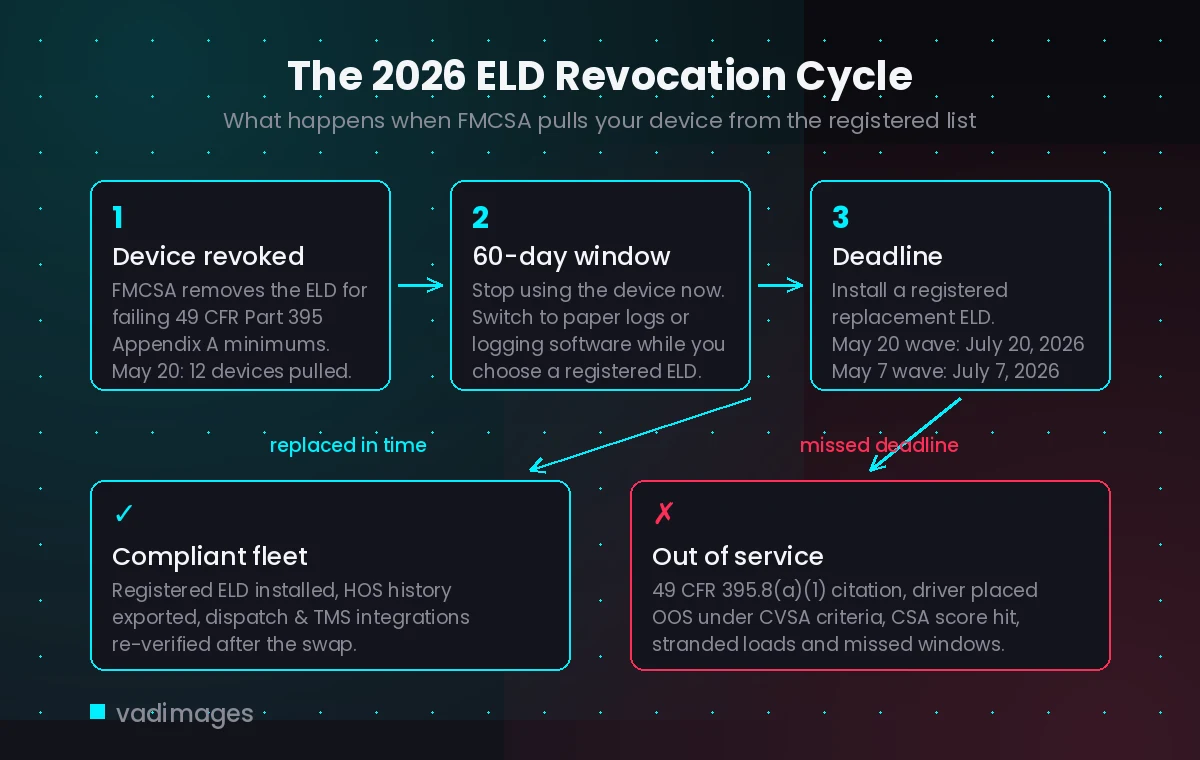
The agency is not being subtle about its intent. “Meeting federal requirements isn’t optional,” FMCSA Administrator Derek D. Barrs said when announcing the March removals. “If a device falls short, it will be removed. We enforce the standard fairly and firmly because safety depends on it.” Every revocation cites the same cause: failure to meet the minimum technical requirements in Appendix A to Subpart B of 49 CFR Part 395 — the specification that governs how an ELD must record, retain, and transfer hours-of-service data.
The May 20 action and the July 20 deadline
Carriers using any of the twelve newly revoked devices are required to take two steps. First, discontinue the revoked ELD immediately and revert to paper logs or logging software to keep recording hours-of-service data. Second, install a compliant replacement from FMCSA’s registered ELD list before July 20, 2026. Drivers found using a revoked device on or after that date will be cited under 49 CFR 395.8(a)(1) — “no record of duty status” — and placed out of service under the CVSA Out-of-Service Criteria. Fleets affected by the May 7 action face an even closer deadline of July 7.
The grace periods for earlier waves have already expired. Since April 14, drivers still running the nine devices revoked in February have been placed out of service on the spot; the same has applied since May 4 to the fourteen devices removed in March. In other words, this is not a theoretical future risk — inspectors are actively ordering trucks off the road today.
Why this matters beyond the citation
An out-of-service order is never just a citation. The load on that truck stops moving, the delivery window is missed, and a recovery driver or tow may be needed before the freight moves again. The violation lands on the carrier’s CSA profile, which feeds the scorecards brokers and shippers use when deciding who gets the next load — and which insurers review at renewal. For small and mid-size fleets running on thin margins, a handful of preventable out-of-service events can quietly price them out of their best lanes.
FMCSA does allow revoked vendors to return to the registered list if they fix the identified deficiencies, but the agency itself urges carriers not to wait on that outcome. A vendor that failed the technical specification once is a vendor whose reinstatement timeline you cannot control.
How to audit your exposure this week
Even if none of your devices appear in the May notices, the pace of revocations makes a standing process worth building. A practical checklist:
- Inventory every ELD in the fleet by name, model number, and ELD identifier — not just vendor brand, since several providers sell the same hardware under multiple names.
- Check that inventory against FMCSA’s registered ELD list and the revocation notices, and subscribe to the agency’s email alerts so the next wave doesn’t surprise you.
- If a device is affected, export your hours-of-service history before switching — you must retain six months of records, and a revoked vendor may not stay around to help you retrieve them.
- Plan the replacement like a real migration: driver training, cab installation windows, and updates to every system that consumes ELD data.
- Verify that dispatch, TMS, and payroll integrations still work after the swap — HOS feeds frequently break when the telematics vendor changes.
How Vadimages helps
For logistics and transportation clients, the recurring lesson of 2026 is that fleet software should never be hard-wired to a single telematics vendor. Vadimages builds custom dispatch, route-optimization, and fleet-tracking systems with an integration layer that treats the ELD as a swappable data source: when a vendor is revoked, you change the connector, not the platform. We also build compliance dashboards that match your device inventory against FMCSA’s registered list and alert dispatchers the day a device in your fleet appears in a revocation notice — alongside HOS data pipelines that keep driver-hours visibility intact through a vendor migration. If your dispatch or tracking stack depends on a single ELD vendor’s app, now is the time to decouple it.
Bottom line
FMCSA has revoked more ELDs in five months of 2026 than in any full prior year, and enforcement on the earlier waves has already begun. If your fleet runs any device removed on May 20, you have until July 20 to replace it; if you are affected by the May 7 action, July 7. Audit your device inventory now, plan the migration deliberately, and make sure your software stack can survive an ELD swap without losing dispatch visibility.
This article is for general information only and is not legal or compliance advice.