
The software development trends to watch in 2027 are practical, not sci-fi: AI-assisted development, optimizing for AI search (GEO), composable and API-first architecture, vertical SaaS, no-code and custom hybrids, security and privacy by default, and automation woven through everyday operations. For a small or midsize business owner, the question isn't whether these trends are real; it's which ones move revenue, reduce risk, or cut cost in your specific business. This guide explains each trend in plain terms and what it means for you as an owner or manager, not just for engineers.
A quick note on how to read this: no single trend below is a silver bullet, and you don't need to chase all of them. The value comes from picking the two or three that map to a real problem you already have and applying them deliberately.
AI-assisted development is now the baseline, not the edge
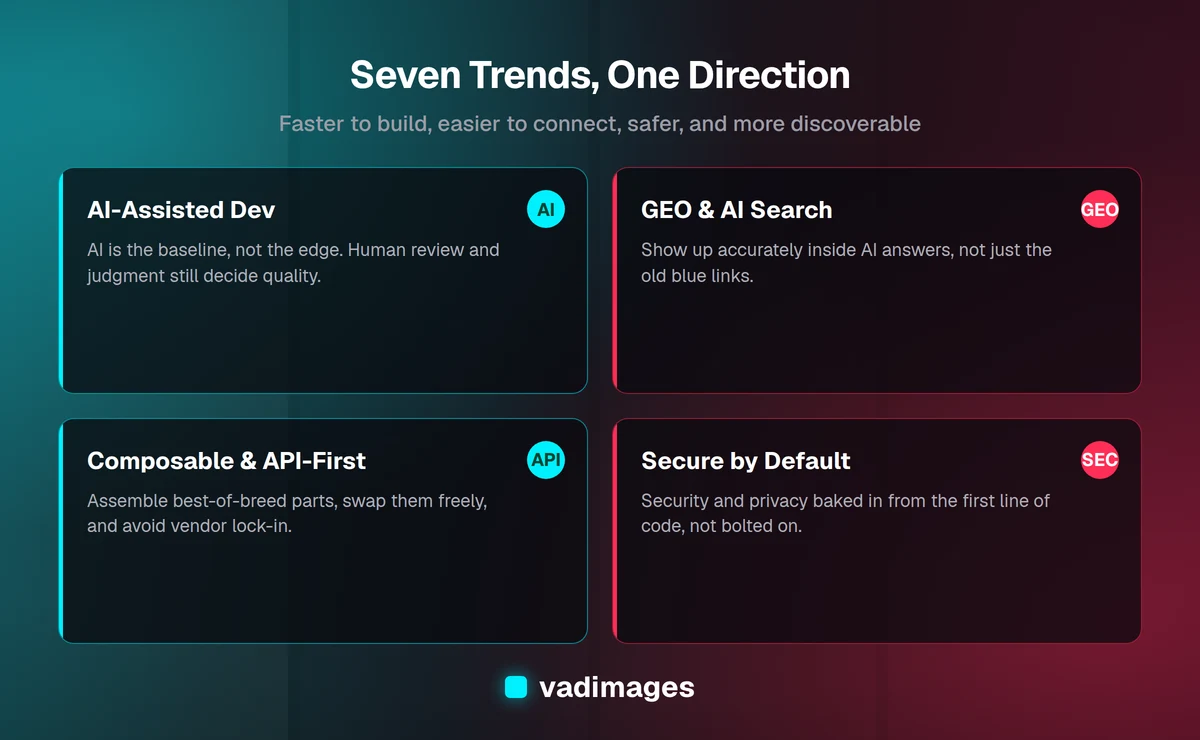
By 2027, writing software with AI assistance is simply how competent teams work. Developers use AI tools to draft code, write tests, explain unfamiliar systems, and catch bugs before they ship. This isn't about replacing engineers; it's about a good engineer getting more done and spending more time on the hard parts: architecture, data modeling, and understanding your business.
What it means for you as an owner: the practical effect is faster delivery and lower cost per feature, but only when the team using AI knows what "good" looks like. AI accelerates whoever is driving. In skilled hands, it compresses timelines; in unskilled hands, it produces plausible-looking code that quietly breaks. When you evaluate a vendor or a hire, don't ask "do you use AI?" Everyone will say yes. Ask how they review AI-generated code, how they test it, and who is accountable when something goes wrong. The teams worth paying treat AI as a power tool with a human holding the guardrails, not as an excuse to skip judgment.
One concrete implication: expect estimates and pricing to reflect this efficiency over time. If a build that took twelve weeks in 2024 can be done well in eight, that should show up somewhere, either in a lower price or in more capability for the same budget. Transparent shops will explain the tradeoff honestly.
GEO and AI search change how customers find you
For two decades, being found online meant ranking in Google's blue links. That world is shifting. A growing share of your customers now ask an AI assistant, like ChatGPT, Gemini, Claude, or Google's AI answers, a direct question and get a synthesized response, often without clicking a single website. Generative engine optimization (GEO), sometimes called answer engine optimization, is the practice of making sure your business shows up accurately inside those AI-generated answers.
What it means for you as an owner: if a prospect asks an assistant "who builds custom software for small businesses near me?" you want your company to be part of the answer, described correctly. That depends on things AI systems can read and trust: clear, factual content on your site; consistent business information across the web; structured data that machines can parse; and a reputation that shows up in the sources these models cite. It is less about keyword stuffing and more about being genuinely clear, credible, and well-organized.
This is one of the more important trends on this list because it's early. Most SMBs haven't adjusted, which means there's room to get ahead. If you're rethinking how customers discover you, our approach to SEO and GEO services is built around exactly this shift, optimizing for humans and for the AI systems that increasingly sit between your business and its next customer.
Composable, API-first architecture replaces the all-in-one box
The old model was a single monolithic system that tried to do everything. The trend heading into 2027 is composable: building your software out of well-defined components that talk to each other through APIs (application programming interfaces, the standardized connectors that let one system talk to another). Instead of one giant application, you assemble best-of-breed pieces, your storefront, your payments, your inventory, your customer records, and connect them.
What it means for you as an owner: composability is about flexibility and avoiding lock-in. When your systems are connected through clean APIs, you can swap out a payment provider without rebuilding everything, add a new sales channel without a six-month project, or plug in a new tool your team wants to try. It also makes your business more resilient; a problem in one component doesn't take down the whole operation.
The tradeoff to understand is that composable systems require thoughtful design. Stitching together ten tools with no plan creates a fragile mess of integrations that break at the worst moments. The value comes from an "API-first" mindset, where connections are designed intentionally from the start rather than bolted on later. When you commission new software, ask whether it's built to connect cleanly with the tools you already use and the ones you might adopt next.
Vertical SaaS: software built for your industry, not everyone's
General-purpose tools try to serve every business on earth, which means they serve none of them perfectly. Vertical SaaS is software built for a specific industry, dental practices, HVAC contractors, law firms, specialty manufacturers, with the workflows, terminology, and compliance needs of that field built in. This category is expanding fast, and by 2027 there's a credible industry-specific option for most niches.
What it means for you as an owner: if a vertical product fits your business well, it often beats both generic software and a fully custom build on time and cost, because someone already solved the common problems in your field. The smart move is to know the landscape before you build. Sometimes the right answer is to adopt a vertical platform and customize the last mile. Sometimes your competitive edge lives precisely in the part no off-the-shelf tool covers, and that's where custom development earns its keep.
A good partner will tell you honestly when you should buy instead of build. If someone recommends a full custom system without first asking whether an existing industry tool would serve you, be skeptical. The goal is the outcome your business needs, not the biggest possible project.
No-code and custom hybrids: the pragmatic middle
No-code and low-code platforms, tools that let you build applications with visual interfaces instead of writing everything by hand, have matured a lot. The 2027 trend isn't "no-code replaces developers" or "no-code is a toy." It's the hybrid: using no-code tools for the parts that fit them, internal dashboards, simple forms, quick internal tools, and reserving custom development for the parts that need it, your core product, complex logic, or anything that must scale and stay reliable.
What it means for you as an owner: this hybrid approach can save real money and time. A simple internal request form doesn't need a team of engineers; a no-code tool your operations lead can maintain is often the right call. But the thing that makes you money, the customer-facing product, the system that has to handle growth and edge cases, usually deserves custom work. The failure mode to avoid is building your entire business on a no-code platform, hitting its limits at exactly the moment you're scaling, and then facing an expensive rebuild under pressure.
The practical advice: use the right tool for each job, and be intentional about where the line sits. A good technical partner helps you draw that line so you get the speed of no-code where it's safe and the durability of custom code where it counts.
Security and privacy by default
Security is no longer a feature you add at the end; by 2027 it's an expectation baked in from the first line of code. Two forces are driving this. First, attacks on small businesses have become routine and automated, SMBs are targeted precisely because they're assumed to be soft targets. Second, privacy regulations and customer expectations keep rising, and mishandling data now carries real legal and reputational cost.
What it means for you as an owner: the practical takeaway is that "secure by default" should be non-negotiable in anything you build or buy. That includes basics that are easy to verify: encrypted data, sensible access controls so people can only see what they need, regular updates, and a clear plan for what happens if something goes wrong. It also means collecting only the customer data you actually need, because data you don't hold can't be stolen.
You don't need to become a security expert, but you should expect your technical partner to treat this seriously without being asked. Ask a vendor how they handle security and privacy. If the answer is vague or treats it as an upsell, that tells you something. Handled well, strong security is also a selling point; customers increasingly want to know their information is safe with you.
Automation everywhere, applied where it pays
The final trend is the quiet one that often delivers the most: automation woven through everyday operations. This is software doing the repetitive work your team currently does by hand, moving data between systems, sending follow-ups, generating reports, flagging exceptions, routing requests. Combined with AI, automation in 2027 can handle tasks that used to require judgment, like summarizing a support ticket or drafting a first-pass response.
What it means for you as an owner: automation's value is measured in hours reclaimed and errors avoided. The best candidates are tasks that are frequent, rule-based, and boring, exactly the work that drains your team and invites mistakes. The mistake to avoid is automating for its own sake. Automating a broken process just makes it break faster. Fix the process first, then automate it.
Start small and concrete. Pick one painful, repetitive workflow, measure what it costs you today in time and errors, automate it, and confirm the gain before moving to the next. This is how automation compounds: not one giant transformation, but a series of targeted wins that each pay for themselves.
How to turn these trends into decisions
Reading a trends list is easy; acting on it is where the value is. A few principles to keep you grounded. First, start from a business problem, not a technology. "We lose two days a week to manual invoicing" is a better starting point than "we should use AI." Second, prefer reversible bets, small experiments you can learn from beat big commitments you can't undo. Third, insist on transparency: clear pricing, honest tradeoffs, and a partner who will tell you when not to build something. At Vadimages, our pricing starts at $5,000 and we're upfront about scope precisely so you can make these calls with real numbers in front of you. If you want a sanity check on where to start, our services overview lays out how we approach custom software, web, and GEO work for growing businesses.
Frequently asked questions
Do I need to act on all of these software development trends in 2027? No. Most businesses should pick the two or three that map to a real problem, a way to win more customers, cut a specific cost, or reduce a real risk, and ignore the rest for now. Chasing every trend at once is a good way to spend money without moving the needle.
Will AI-assisted development make custom software cheaper? Over time, yes, for the same scope, because skilled teams deliver faster. But complexity, integrations, security, and ongoing support still cost real money. The honest framing is more value per dollar, not "software is now free." Be wary of anyone promising throwaway prices; that usually means corners are being cut somewhere you'll pay for later.
What is GEO and is it different from SEO? GEO (generative engine optimization) is about showing up accurately in AI-generated answers from assistants like ChatGPT and Gemini, while traditional SEO is about ranking in search results. They overlap, clear, credible, well-structured content helps both, but GEO is increasingly its own discipline as more people get answers without clicking through to a website.
Should I use no-code tools or build custom software? Often both. Use no-code for simple internal tools and quick wins; use custom development for your core product and anything that must scale or handle complex logic reliably. The right split depends on your business, and a good partner will help you draw the line rather than pushing you toward the biggest project.
How do I know if a vendor is actually keeping up with these trends? Ask specific questions: how they review AI-generated code, how they handle security and privacy, whether they'll recommend an off-the-shelf tool over a custom build when it fits. Vague, buzzword-heavy answers are a warning sign. Concrete, honest ones, including "you might not need us for this", are a good sign.
The bottom line
The software development trends worth watching in 2027, AI-assisted development, GEO, composable architecture, vertical SaaS, no-code hybrids, security by default, and pervasive automation, all point in the same practical direction: software that's faster to build, easier to connect, safer by design, and more discoverable in an AI-driven world. You don't need to chase all of them. You need to pick the ones that solve a real problem in your business and apply them with clear eyes and honest numbers. If you'd like help figuring out which trends actually matter for your situation, and which to skip, we're happy to talk it through. Reach out at https://vadimages.com/contact. We build for humans and optimize for growth.