
To choose a custom software development agency, define your project and budget first, then evaluate a short list of firms on relevant experience, a verifiable portfolio, clear pricing, honest communication, and code ownership terms that leave you in control. The right partner explains trade-offs plainly, shows real references, and puts everything in writing before you sign.
Hiring an agency to build custom software is one of the higher-stakes decisions a small or midsize business makes. You are trusting an outside team with money, time, and often a core part of how your company operates. Get it right and you gain a system that fits your business exactly and a partner who keeps improving it. Get it wrong and you can burn six figures on software you cannot maintain, do not own outright, or never launch. This guide walks through how to choose a software agency the way an experienced buyer would: with a clear process, sharp questions, and a healthy eye for red flags.
What should you decide before you start looking?
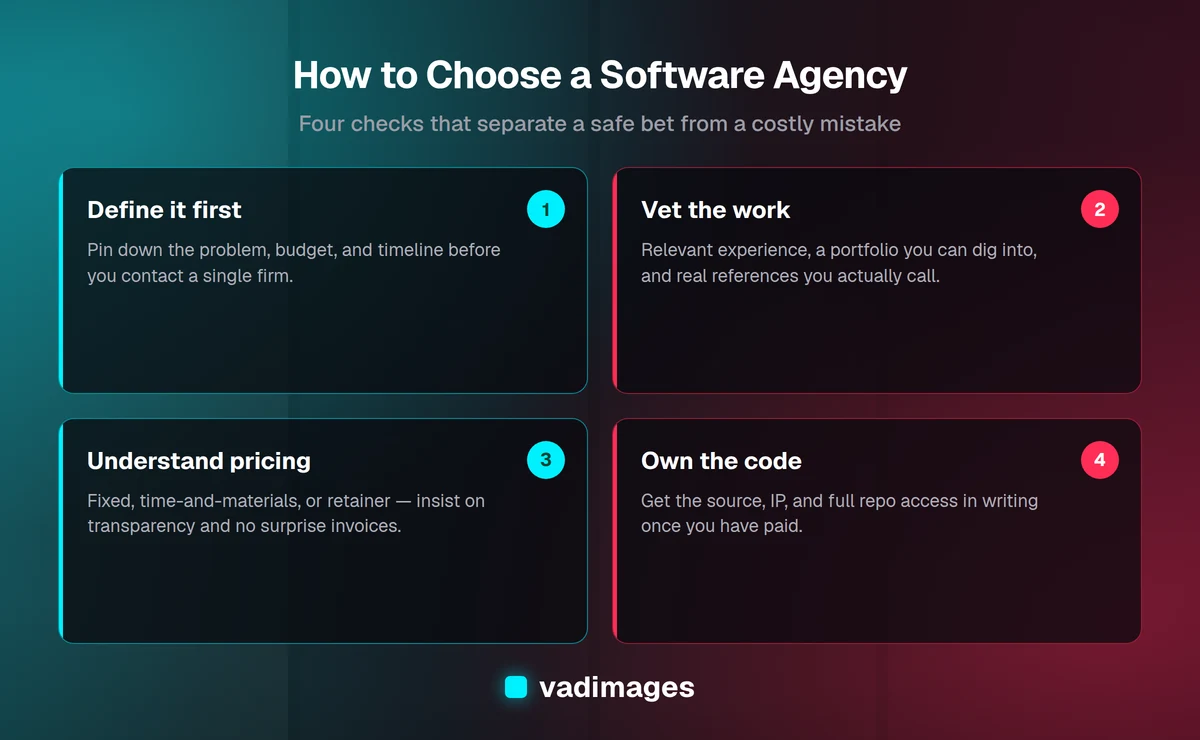
Before you contact a single vendor, get clear on what you actually need. Agencies can only give you a useful proposal if you can describe the problem you are solving. You do not need a full spec, but you should be able to answer a few things in plain language.
- The problem and the outcome. What is broken or missing today, and what does success look like in six or twelve months? "We lose two days a week to manual data entry" is a far better starting point than "we want an app."
- Budget range. Custom software is an investment, and serious projects generally start in the mid five figures. At Vadimages, transparent pricing starts at $5,000+, and knowing your ceiling helps an honest agency scope something real instead of overselling.
- Timeline and constraints. Is there a hard deadline, a compliance requirement, or an existing system this has to connect to?
- Who owns the decision. Name the person who will approve the work and be available for questions. Projects stall when no one internally can make a call.
Writing this down does two things: it filters out firms that cannot handle your type of work, and it gives you a yardstick to compare proposals fairly.
Freelancer, agency, or in-house team — which is right for you?
"Should I hire an agency at all?" is a fair first question. Each option has a real place, and the best choice depends on the size, risk, and lifespan of what you are building.
- Freelancers are often the most affordable and can be excellent for a small, well-defined task — a single feature, a quick integration, a design refresh. The trade-offs are capacity and continuity: one person can get sick, get busy, or move on, and you inherit the code with no team behind it.
- A custom software development agency brings a team — developers, designers, QA, and a project manager — with overlapping coverage and defined processes. That matters when the project is business-critical, spans multiple skill sets, or needs to be supported for years. You pay more than a freelancer, but you buy reliability and depth.
- An in-house team makes sense when software is central to your business and you need people who live inside your operations every day. It is also the slowest and most expensive path to stand up, and hiring senior engineers is hard for most SMBs.
Many companies blend these: an agency builds the first version and stands up the foundation, then an in-house hire or a smaller retainer keeps it running. If you are weighing the options, our how we work page explains how an agency engagement is typically structured so you can compare it against hiring internally.
How do you evaluate an agency's experience and portfolio?
Experience is only useful if it is relevant. A firm that has shipped dozens of marketing sites is not automatically the right team for a logistics platform or a HIPAA-sensitive tool. When you review a portfolio, look past the polish and ask what the firm actually did.
- Did they solve a problem like yours? Similar industry, similar complexity, or similar technical challenge counts for more than a long list of unrelated logos.
- What was their role? "We built this end to end" is different from "we contributed a component." Ask which parts they were responsible for.
- What happened after launch? Good agencies can tell you how a product performed and whether they still support it. Case studies that stop at "we shipped it" leave out the hard part.
Ask to see work in depth, not just screenshots. A confident team will walk you through a project, explain the decisions they made, and be candid about what they would do differently. You can review the kind of detail to expect on our case studies, which show the problem, the approach, and the result rather than just a gallery of pretty interfaces.
What questions should you ask a software agency?
The interview is where you learn how a team really works. Bring the same handful of questions to every firm so you can compare answers side by side. Strong candidates will give specific, unhurried responses instead of rehearsed pitches.
- Who exactly will work on my project? Meet the actual developers and project lead, not just the salesperson. Ask whether any work is subcontracted and to whom.
- How do you handle changes in scope? Requirements always shift. A mature agency has a clear, fair process for change requests rather than surprise invoices.
- What does your development process look like? Listen for how they break work into stages, how often you will see progress, and how they test what they build.
- How do you communicate and how often? Weekly demos, a shared board, a named point of contact — these signal a team that will keep you informed.
- What happens if we part ways? A good partner can describe a clean handoff: documented code, credentials, and a working system you keep.
- Who owns the code and the intellectual property? The answer should be simple: you do, once you have paid for it. More on this below.
- How do you handle security and data? Even basic answers about access control, backups, and dependencies tell you whether they take risk seriously.
Pay as much attention to how they answer as to what they say. A team that explains trade-offs honestly — including where your idea might be expensive or risky — is worth more than one that agrees with everything.
How should you check references?
References are the single best predictor of your own experience, yet many buyers skip them. Ask every finalist for two or three clients with projects similar to yours, then actually make the calls. Keep the conversation practical.
- Did the project land close to the original budget and timeline? If not, why?
- How did the agency handle problems or disagreements?
- Were you kept informed, or did you have to chase for updates?
- Do you still work with them, and would you hire them again?
- Is there anything you wish you had known before you started?
One glowing testimonial on a website means little. A candid ten-minute phone call with a past client — including the parts that were hard — tells you almost everything. Public reviews and independent profiles can supplement this, but a direct reference is the gold standard.
Which pricing model should you choose?
How an agency charges shapes how the project runs, so understand the model before you sign. There is no single "right" answer, but there is a right fit for your situation.
- Fixed price works best when the scope is well defined and unlikely to change. You get budget certainty, but changes become formal negotiations, and some firms pad the estimate to cover their risk.
- Time and materials bills for actual hours worked. It suits evolving projects where you want flexibility, but it requires trust and good reporting so costs stay visible.
- Retainer or dedicated team reserves a set amount of capacity each month. This fits ongoing product work and long-term partnerships where you need steady progress.
Whatever the model, insist on transparency. You should understand what you are paying for, see where the hours go, and never be surprised by an invoice. Beware quotes that are dramatically lower than everyone else's — an unusually cheap bid often means a shallow understanding of the work, and the gap tends to reappear later as change orders.
Why does code ownership matter so much?
This is the clause that quietly protects your investment, and it is one that inexperienced buyers overlook. When you pay to have custom software built, you should own the source code, the assets, and the intellectual property outright once the invoices are settled. Confirm it in writing.
Watch for arrangements that keep you dependent: code hosted only on the agency's private accounts, proprietary frameworks you cannot maintain without them, or licensing terms that make you rent what you paid to build. Ask directly where the code lives, whether you get full access to the repository, and whether the documentation is good enough for another team to pick it up. A trustworthy agency welcomes these questions because they plan to earn your continued business, not trap you into it.
What are the red flags to watch for?
Most bad engagements send signals early. Slow down if you notice any of these:
- Vague or evasive answers about process, team, or ownership.
- No questions about your business. A firm that jumps straight to a quote without understanding your problem is selling, not solving.
- Pressure to sign fast or "today only" discounts. Good agencies have a pipeline and do not need to rush you.
- Prices far below everyone else. If it sounds too cheap, the scope is probably missing something.
- Poor communication during sales. If they are slow to reply while trying to win you, it rarely improves after the contract is signed.
- No written contract, statement of work, or ownership terms. Handshake deals on six-figure software end badly.
How do you run a good selection process?
A simple, disciplined process beats gut feel. Here is a sequence that works well for most SMBs:
- Write a short brief covering the problem, desired outcome, budget range, and timeline.
- Build a short list of three to five agencies whose experience fits your type of project.
- Have a discovery call with each and share the same brief so proposals are comparable.
- Compare proposals on understanding, approach, team, timeline, and total cost — not price alone.
- Check references for your two finalists.
- Review the contract carefully, especially scope, payment schedule, change process, and code ownership.
- Start small if you can. A paid discovery phase or a first milestone lets you test the working relationship before committing to the whole build.
That last point is worth emphasizing. A well-structured discovery or pilot phase is the lowest-risk way to learn whether a team communicates well and delivers on its promises, and it usually pays for itself in a clearer, more accurate plan.
Frequently asked questions
How much does custom software cost? It depends heavily on scope, but serious custom projects generally start in the mid five figures and rise with complexity. At Vadimages, transparent pricing starts at $5,000+. Be cautious of any quote far below the market — it usually signals a gap that reappears later.
How long does a custom software project take? Small, focused projects can ship in a few weeks; larger platforms take several months. A good agency gives you a phased timeline with milestones rather than a single vague end date, so you can see progress along the way.
Do I own the code an agency writes for me? You should, once you have paid for it. Confirm ownership of the source code and intellectual property in the contract, and make sure you get full access to the repository and documentation.
Is a bigger agency always better? No. Larger firms bring depth but can be less flexible and more expensive for SMB projects. What matters most is relevant experience, clear communication, and the right team assigned to your work — not headcount.
What if the project goes off track? This is why communication cadence and a clean exit clause matter. Regular demos catch problems early, and a documented handoff means you always keep a working system and your code even if the relationship ends.
The bottom line
Choosing a custom software development agency comes down to preparation and honesty — yours and theirs. Define your problem and budget, build a short list of firms with relevant experience, ask sharp questions, check real references, understand the pricing model, and lock down code ownership in writing. The best partner will feel less like a vendor and more like an extension of your team: transparent about cost, candid about trade-offs, and focused on the outcome you actually need.
If you want a straightforward conversation about your project — with clear pricing and no pressure — reach out to Vadimages. We build for humans and optimize for growth, and we are happy to help you scope the right first step. Get in touch at https://vadimages.com/contact.