
Custom software for ecommerce is purpose-built software that fits your exact selling model instead of forcing your business into a platform's defaults. Most growing online retailers do not need it on day one, but many hit a point where off-the-shelf tools quietly cap their revenue, and that is when a custom build starts to pay for itself.
What does custom software for e-commerce actually mean?
When people hear "custom software," they often picture rebuilding a whole store from scratch. That is rarely what happens. In practice, custom software for ecommerce usually means building the specific pieces that platforms like Shopify, WooCommerce, or BigCommerce handle poorly for your particular business, and wiring them into the tools you already use.
That might be a back-office sync that keeps your online catalog, warehouse, and accounting system in agreement. It might be a custom checkout that supports the way you actually price and bundle products. It might be an inventory engine that understands your kits, your pre-orders, and your multi-location stock. The store your customers see can stay on a familiar platform while the machinery behind it becomes yours.
The goal is never custom for its own sake. It is to remove the manual work, workarounds, and revenue leaks that appear once your operation grows past what a template was designed to handle.
How do you know you have outgrown your platform?
Off-the-shelf platforms are excellent at getting you started and surprisingly capable well into the mid-market. The warning signs of outgrowing them are operational, not technical, and owners usually feel them before anyone says the word "software."
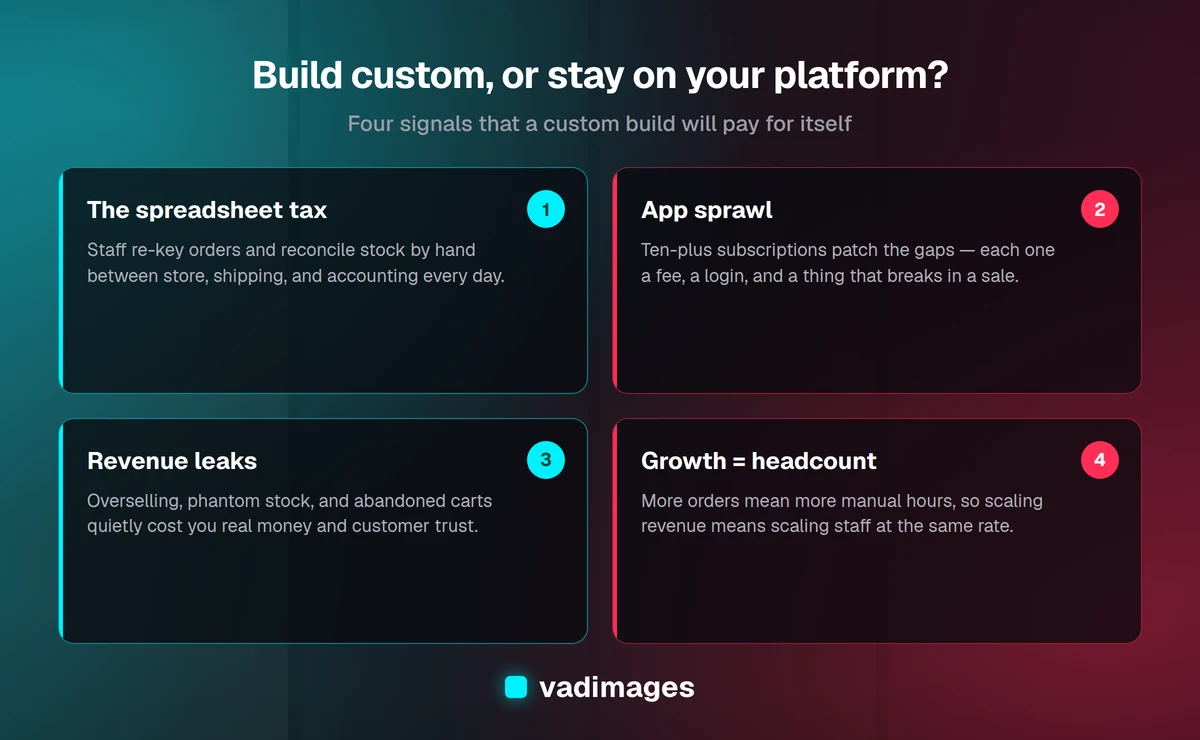
- Your team lives in spreadsheets. Staff export orders, re-key data, and reconcile numbers by hand between your store, your shipping tool, and your accounting system every single day.
- You pay per-app taxes. A stack of ten or fifteen subscription apps patches gaps, each one adding a monthly fee, another login, and another thing that breaks during a sale.
- Simple requests are impossible. "Can we show a different price to wholesale buyers?" or "Can we bundle these three SKUs and track stock correctly?" turns into a research project.
- Inventory is never quite right. Overselling, phantom stock, and manual adjustments across channels cost you real money and customer trust.
- Growth makes things slower, not faster. More orders mean more manual hours, so scaling revenue means scaling headcount at the same rate.
If two or three of these sound familiar, you are not failing at e-commerce. You have simply grown into problems that generic tools were never built to solve.
What can custom e-commerce software actually do?
The most valuable custom work tends to cluster around a handful of areas where standard platforms leave money and hours on the table.
Back-office and system sync. This is the quiet workhorse of e-commerce software. A custom integration layer keeps your store, ERP or accounting system, 3PL or warehouse, and marketing tools in constant agreement, so an order placed online updates stock, books revenue, and triggers fulfillment without anyone touching a spreadsheet. Most middleware apps do a thin version of this; a custom sync handles your edge cases.
Inventory and order management. Real businesses sell bundles, kits, pre-orders, and made-to-order items across multiple channels and locations. Custom inventory logic can reserve stock correctly, prevent overselling, and give your team one accurate view of what you actually have and where it is.
Custom checkout and pricing. Hosted checkouts are fine for simple carts, but B2B pricing, customer-specific catalogs, quantity breaks, subscriptions, and complex tax or shipping rules often demand more control than a platform will give you. A tailored checkout can lift conversion and support pricing models a template flatly refuses to.
Integrations with the tools you already run. Your CRM, email platform, support desk, marketplaces, and payment providers should share data automatically. Custom API integrations connect them so a customer's full history follows them everywhere, instead of sitting in five disconnected silos.
Automation of repetitive work. Fraud checks, purchase orders, restock alerts, returns processing, customer segmentation, and reporting can all run on rules instead of people. Automation is often where custom software pays for itself first, because it converts recurring labor into a fixed one-time build.
Analytics that answer your questions. Off-the-shelf dashboards report what the vendor thought was important. A custom analytics layer can tie marketing spend, margin, lifetime value, and inventory turns together so you can see true profitability by product, channel, and cohort.
Headless commerce. Going headless means separating your storefront from your commerce engine so the front end can be a blazing-fast custom site or app while orders, catalog, and payments run on a proven backend. It buys you performance and design freedom, but it adds complexity, so it is worth it mainly when speed, unusual UX, or multi-channel selling genuinely move revenue.
What does this look like in the real world?
A few composite examples, drawn from the kinds of projects growing retailers across many industries bring us, make the value concrete.
A specialty food brand selling on its own site plus two marketplaces was overselling perishable stock because each channel tracked inventory separately. A custom sync gave them a single source of truth updated in near real time. Overselling dropped to near zero, and the two staff who had spent mornings reconciling orders moved to work that actually grew the business.
A B2B parts distributor needed customer-specific pricing, net-30 terms, and quantity breaks that its platform could not express. A custom checkout and account portal let wholesale buyers log in, see their negotiated prices, and reorder in seconds. Average order value rose because reordering stopped requiring a phone call.
A fast-growing apparel company was paying for fourteen apps that still did not talk to each other. Consolidating the core logic into one custom back-office reduced their monthly app bill, cut the number of things that broke during flash sales, and gave the owner a single dashboard for the numbers that mattered.
None of these companies rebuilt their storefront. They built the specific machinery that generic tools could not, and left the rest alone.
How much does custom e-commerce software cost, and what is the ROI?
Cost depends entirely on scope, but it helps to have honest ranges. At Vadimages, custom work starts at $5,000+, and our pricing is transparent and scoped to the problem in front of you. A focused project, such as a single integration or an automation that eliminates a recurring manual task, often lands in the low five figures. A larger back-office platform, a custom B2B portal, or a headless build is a bigger investment that scales with complexity and the number of systems involved.
The more useful question is not "what does it cost" but "what is it replacing." Add up the fully loaded hours your team spends on manual reconciliation, the revenue lost to overselling and cart abandonment, and the stack of app subscriptions you would retire. When custom software removes twenty or thirty hours of manual work a week and closes a revenue leak, the build frequently pays back within months, not years, and then keeps paying because the cost does not recur.
The right way to judge ROI is to price the problem before you price the solution. If the problem is small, keep using your platform. If the problem is compounding as you grow, a one-time build almost always beats paying the tax forever.
Should you build custom or stay on a platform?
This is the decision that matters, and the honest answer is that most businesses should stay on a platform longer than vendors would like to admit. Use this rough test.
- Stay on the platform when your catalog and rules are standard, your volume fits comfortably in your current tools, and your workarounds are annoying but not costing real money. Platforms are cheaper, faster to change, and maintained for you.
- Build custom when your business model genuinely differs from what platforms assume, when manual work scales linearly with revenue, when app fees and lost sales exceed the cost of building, or when a specific capability would unlock a new channel or customer segment you cannot serve today.
A middle path is common and often smartest: keep the storefront on a platform and build only the custom pieces that pay for themselves, connected through clean integrations. You get the reliability of a proven system and the flexibility of custom exactly where it counts. If you want an outside read on which pieces are worth building, our custom software team can help you scope it honestly rather than sell you a rebuild you do not need.
Frequently asked questions
Do I have to leave Shopify or WooCommerce to get custom software? No. In most cases you keep your existing platform and add custom software around it through integrations and apps. A full replatform is a separate, much bigger decision that few businesses actually need.
How long does a custom e-commerce project take? A focused integration or automation can ship in a few weeks. A larger back-office system or B2B portal typically runs a few months. We scope in phases so you get a working, valuable piece early rather than waiting for one big launch.
Will custom software be harder to maintain than apps? It is different, not necessarily harder. You trade recurring subscription fees and vendor limitations for software you own and control. Good custom work is documented and built to be maintained, and a solid development partner supports it over time.
What if I am not sure custom is worth it yet? Then it probably is not urgent, and that is fine. Start by measuring the manual hours and lost revenue your current setup causes. If those numbers are large and growing, revisit the build. If they are small, keep your money.
Is headless commerce right for a small store? Usually not. Headless shines for performance-sensitive or multi-channel brands with specific UX needs. For a straightforward store, it adds complexity without a matching payoff.
The bottom line
Off-the-shelf platforms are the right choice for most e-commerce businesses most of the time. But when manual work scales with your revenue, when app fees and lost sales pile up, and when your business model no longer fits the template, custom software stops being a luxury and becomes the cheaper option. The smart move is to price the problem first, build only what pays for itself, and keep the rest simple. If you want a straight, no-hype assessment of whether custom software would help your store, or where to start, reach out through our contact page. We build for humans, optimize for growth.