

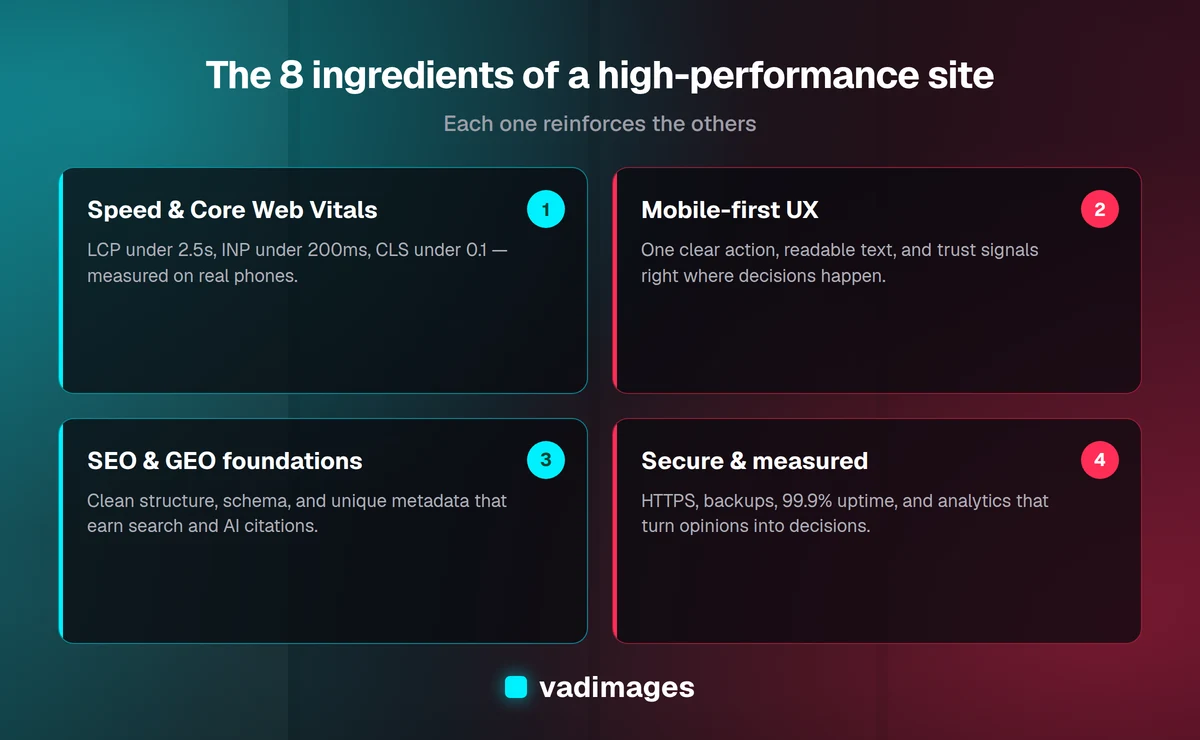
A high performance website is one that loads fast, works flawlessly on phones, guides visitors toward a clear action, and is easy for search engines and people to trust. It is the sum of eight ingredients working together: speed, mobile experience, conversion-focused UX, SEO foundations, security, accessibility, reliable hosting, and honest measurement.
Most business owners think of a website as a design project. In practice, the sites that actually drive leads and sales behave more like well-run machines. Every part is tuned, nothing is wasted, and the whole thing is measured so you know what to fix next. Below we break down what separates a site that quietly costs you money from one that earns its keep, in plain language you can act on.
What does "high performance" actually mean for a business website?
Performance is not just how fast a page loads, though that matters. A high-performing business site does three jobs well at the same time: it gets found, it earns trust in the first few seconds, and it makes the next step obvious. A gorgeous site that takes six seconds to load, or a fast site that buries your phone number, both fail the same test — they lose the visitor before the visitor becomes a customer.
A useful way to think about it: your website is your hardest-working, lowest-paid employee. It works nights, weekends, and holidays. If it is slow, confusing, or invisible in search, you are effectively sending that employee home early every day. The ingredients below are how you keep it on the clock and productive.
Why does speed and Core Web Vitals matter so much?
Speed is the first thing a visitor experiences, before they read a word. Study after study shows that conversion rates drop as load time climbs — every extra second of delay costs you a measurable share of leads and sales. On mobile connections, the effect is even sharper.
Google measures a specific set of speed and stability signals called Core Web Vitals, and they influence both user experience and search rankings. The three to know are:
- Largest Contentful Paint (LCP) — how quickly the main content of a page appears. Aim for under 2.5 seconds.
- Interaction to Next Paint (INP) — how quickly the page responds when someone taps or clicks. Aim for under 200 milliseconds.
- Cumulative Layout Shift (CLS) — whether the page jumps around as it loads. Aim for a score under 0.1.
You improve these by compressing and correctly sizing images, serving modern image formats like WebP or AVIF, trimming unused JavaScript and CSS, using a content delivery network (CDN), caching aggressively, and reserving space for images and ads so nothing shifts. These are technical jobs, but the payoff is not abstract — a faster site keeps more of the visitors you already paid to attract.
Is mobile experience really that important?
Yes, and it is not close. For most US small businesses, more than half of website traffic now comes from phones, and for local and consumer-facing businesses it is often well over 70 percent. Google also uses mobile-first indexing, which means it primarily looks at the mobile version of your site when deciding how to rank you.
A strong mobile experience means text you can read without pinching, buttons big enough to tap with a thumb, forms that use the right keyboard for each field, and a layout that reflows cleanly instead of forcing side-to-side scrolling. Tap targets should be comfortably spaced, and your most important action — call, book, buy, or request a quote — should be reachable without hunting. If your site was designed on a large monitor and never seriously tested on a phone, it is almost certainly leaking customers.
How do UX and conversion design turn visitors into customers?
Getting traffic is only half the equation. Once someone arrives, clear user experience (UX) and deliberate conversion design decide whether they act or leave. This is where many otherwise-attractive sites fall down.
The fundamentals are simple to state and easy to neglect:
- One clear primary action per page. Every page should answer "what do you want the visitor to do next?" with a single, obvious call to action.
- A message that lands in five seconds. Above the fold, a visitor should immediately understand what you do, who you help, and why you are worth their time.
- Trust signals where decisions happen. Reviews, client logos, guarantees, and real photos near your calls to action reduce hesitation.
- Short, forgiving forms. Ask only for what you truly need. Every extra field lowers completion rates.
- Obvious contact paths. Phone number, contact form, and location should never be more than a click away.
Good conversion design is not about manipulation or clutter. It is about removing friction and answering the visitor's unspoken questions in the order they ask them. When the path is clear, more people follow it. If you want help auditing where visitors drop off, our team offers web and app development services that pair design with conversion strategy rather than treating them as separate steps.
What SEO foundations does every high-performance site need?
Search engine optimization (SEO) is not a bolt-on you add later — the strongest results come from foundations built into the site itself. The good news is that much of technical SEO overlaps with the speed and mobile work you are already doing.
The non-negotiable foundations include:
- Clean, crawlable structure — logical URLs, a working
sitemap.xml, a sensiblerobots.txt, and internal links that help both people and search engines find your key pages. - Unique titles and meta descriptions on every page, written for humans first and keywords second.
- Proper heading hierarchy so content is scannable and machine-readable.
- Structured data (schema markup) to help search engines and AI assistants understand your business, services, reviews, and location.
- Fast, mobile-friendly pages — the same Core Web Vitals work that helps users also helps rankings.
Increasingly, these foundations do double duty for generative engine optimization (GEO) — being cited and recommended by AI tools like ChatGPT, Gemini, and Perplexity. Clear structure, factual content, and schema markup make your business easier for both traditional search and AI answer engines to quote accurately. A site built on solid foundations is discoverable today and adaptable to how people search tomorrow.
How do security and accessibility protect your business?
Security and accessibility are the ingredients owners most often ignore until something goes wrong. Both protect your reputation, and both increasingly carry legal and financial weight.
On security, the baseline is an HTTPS certificate on every page — browsers now flag sites without it as "not secure," which erodes trust instantly. Beyond that, keep your platform and plugins updated, use strong authentication, run regular backups, and put a web application firewall in front of the site. A single breach or defacement can undo years of goodwill, and recovery is far more expensive than prevention.
On accessibility, designing so that people using screen readers, keyboard navigation, or high-contrast modes can use your site is both the right thing to do and smart business. In the US, inaccessible sites have become a common target for demand letters and lawsuits under the Americans with Disabilities Act. Practical steps include descriptive alt text on images, sufficient color contrast, labeled form fields, keyboard-navigable menus, and semantic HTML. Following the Web Content Accessibility Guidelines (WCAG) widens your audience and lowers your legal risk at the same time.
Why does reliable hosting and infrastructure matter?
You can do everything else right and still lose sales if your site is slow or down when visitors arrive. Hosting is the foundation everything else sits on, and cheap shared hosting is often a false economy.
Reliable infrastructure means strong uptime (99.9 percent or better), servers or a CDN close to your customers, room to handle traffic spikes without slowing to a crawl, automatic backups, and an SSL certificate that renews itself. For most business sites, managed hosting or a modern cloud platform pays for itself by keeping the site fast and available. When a marketing email or a busy season sends a surge of visitors, your site should speed up under the load of interest, not fall over.
How do you know if your website is actually performing?
The final ingredient is measurement, because you cannot improve what you do not track. A high-performance site is instrumented from day one so you can see what is working and where visitors get stuck.
At minimum, set up:
- Analytics (such as Google Analytics 4) to see where traffic comes from and how people move through the site.
- Conversion tracking so form submissions, calls, and purchases are recorded as goals, not guesses.
- Google Search Console to monitor how you appear in search and catch technical issues early.
- Core Web Vitals monitoring using real-world data, not just one-off lab tests.
- Heatmaps or session recordings when you want to understand behavior on a specific page.
Measurement turns opinions into decisions. Instead of arguing about whether a headline or button color is better, you test, watch the numbers, and keep what works. Over months, those small, evidence-based improvements compound into a meaningfully more effective site.
How do these ingredients work together?
The reason we list eight ingredients rather than one silver bullet is that they reinforce each other. Speed improves SEO and conversions. Mobile optimization improves speed and accessibility. Security and reliable hosting protect the trust your UX works to build. Measurement tells you which ingredient to improve next. Neglect one and the others carry more weight than they should.
This is also why a high-performance website is rarely a one-time project. It is a system you maintain — testing, monitoring, and refining as your business, your customers, and search itself evolve. The businesses that treat their site this way tend to pull steadily ahead of competitors who launched once and walked away.
Frequently asked questions
How fast should my business website load?
Aim for a Largest Contentful Paint under 2.5 seconds and a total load time under 3 seconds on a typical mobile connection. Beyond that, conversion rates fall noticeably. Testing on a real phone over cellular data, not just office Wi-Fi, gives you the honest number.
Do I need to rebuild my whole site to make it high-performance?
Not always. Many sites gain a lot from targeted fixes — image optimization, better hosting, cleaner code, and clearer calls to action. A rebuild makes sense when the underlying platform is outdated, insecure, or too rigid to improve. A short audit usually reveals which path is right.
How much does a high-performance business website cost?
At Vadimages, custom web projects start at $5,000 and up, with pricing shaped by scope, integrations, and content needs. We keep pricing transparent so you can weigh the investment against the leads and sales the site should generate.
Is accessibility legally required in the US?
Courts have increasingly applied the Americans with Disabilities Act to websites, and inaccessible sites are a frequent target of demand letters. Following WCAG guidelines reduces legal risk and, just as importantly, lets more customers use your site.
What is GEO and do I need to worry about it?
Generative engine optimization is about being accurately cited and recommended by AI tools like ChatGPT and Perplexity. The same foundations that help traditional SEO — clear structure, factual content, and schema markup — also help here, so building it in now positions you well for how search is changing.
The bottom line
A high-performance business website is not one thing done brilliantly — it is eight things done well and kept in tune: speed, mobile experience, conversion-focused UX, SEO foundations, security, accessibility, reliable hosting, and honest measurement. Get these working together and your site stops being a brochure and starts being your most dependable source of new business.
If you would like a clear-eyed assessment of where your site stands and what to fix first, Vadimages can help. We build for humans and optimize for growth, with transparent pricing and no hype. Get in touch with us and we will walk you through it.