
Building a SaaS product means turning an idea into software people pay to use every month. It's one of the most rewarding things a company can build — recurring revenue, a scalable asset, real enterprise value — and one of the easiest to get wrong by building too much, too soon. This guide walks through the full journey from idea to launch, in plain English, so you know what each stage involves and where the money and risk really are. Whether you're a founder with a napkin sketch or an established business turning an internal tool into a product, the sequence is the same: reduce risk early, spend on the things that create value, and let real users tell you what to build next.
Step 1: Validate the idea before you build
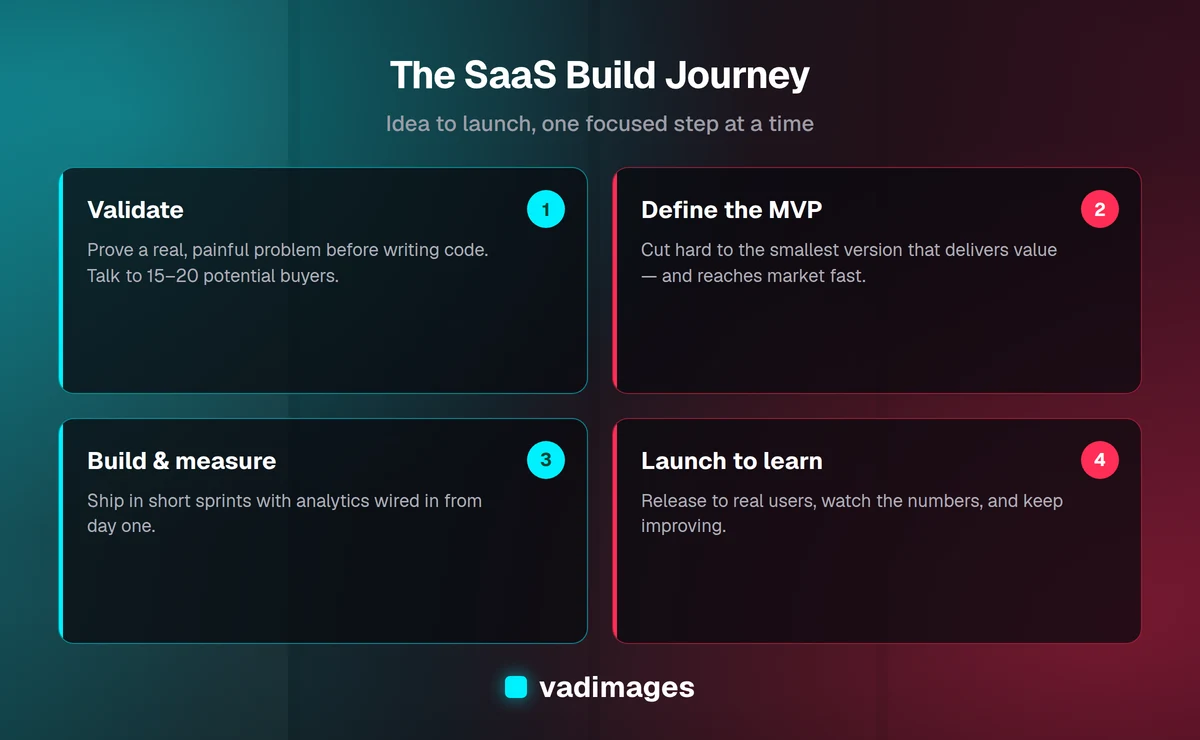
The most expensive SaaS mistake is building something nobody wants. Before writing code, prove there's a real, painful problem people will pay to solve. Talk to 15–20 potential customers. Ask what they do today, what it costs them, and what they've tried. Look for a problem people already spend time or money on — that's a market. If you can pre-sell, get a waitlist, or land a design partner before building, even better. Validation doesn't guarantee success, but skipping it almost guarantees waste.
A useful test: can you describe, in one sentence, who the product is for and what job it does for them? If the answer keeps changing, you're not ready to build yet — you're ready to talk to more people. The goal of this stage isn't a polished pitch; it's honest evidence that the pain is real, frequent, and expensive enough that someone will open their wallet. That evidence is what protects every dollar you spend later.
Step 2: Define the MVP — and cut hard
Your minimum viable product is the smallest version that delivers real value and teaches you something. The discipline here is subtraction. For every feature, ask: "Can a user get the core value without this?" If yes, it goes on the "later" list. A focused MVP with one thing done well beats a bloated one that does ten things poorly. It also gets you to market — and to revenue and feedback — months sooner.
In practice, cutting hard means picking the single workflow that matters most and making it genuinely great, then treating everything else as optional. Integrations, admin dashboards, granular permissions, and nice-to-have reports can almost always wait. This is where a seasoned custom software partner earns their keep — helping you separate the features that prove the business from the ones that just feel important. The narrower the first version, the faster you learn whether you're building the right thing at all.
Step 3: Design the experience
SaaS lives and dies by usability. In this stage you map the key user flows (sign up, get to first value, do the core job, invite a teammate) and turn them into wireframes and then a clean interface. Pay special attention to onboarding: the path from "just signed up" to "got real value" is the single biggest driver of whether people stay. A good design phase prevents expensive rework later.
Think of onboarding as its own product. Every extra field, confusing label, or empty screen is a place where a new user quietly gives up. The strongest SaaS products get someone to a small, real win in the first few minutes — a report generated, a task automated, a teammate invited. Designing that first win deliberately, rather than hoping users find it, is often the difference between a trial that converts and one that churns before you ever hear from them.
Step 4: Choose the right architecture
A few technical decisions made early will shape your SaaS for years:
- Multi-tenancy: how you securely serve many customers from one system while keeping their data separate.
- Authentication & roles: secure login and role-based access control (who can do what).
- Billing: subscription management — usually via Stripe or a billing platform rather than building it yourself.
- Scalable data model: a database design that won't buckle as usage grows.
- API-first design: building on clean APIs so integrations and a mobile app are easier later.
You don't need to build for a million users on day one, but you should avoid decisions that make growth painful. The right architecture is the one that fits your first realistic customers while leaving clear room to grow — not the most elaborate system you can imagine. Getting these foundations right is a core part of how we approach SaaS solutions, because they're expensive to change once real customer data is flowing through the system.
Step 5: Build in iterations
Good SaaS development happens in short sprints, with working software you can click at the end of each. This keeps the project visible, catches misunderstandings early, and lets you reprioritize as you learn. Avoid the "big reveal at the end" model — it's where budgets and timelines go to die. You should see your product taking shape week by week.
Iterative delivery also changes the conversation with your development team. Instead of guessing at a giant spec up front, you make small, informed decisions as real screens appear and real feedback comes in. That's exactly why our process is built around short cycles and frequent check-ins: it keeps you in control of scope and spend, and it means the product that ships is the one your users actually need, not the one you imagined six months earlier.
Step 6: Instrument analytics from day one
You can't improve what you can't see. Before launch, wire in analytics to track the metrics that matter: activation (did new users reach first value?), engagement, conversion from trial to paid, and churn. These numbers tell you what to build next far better than opinions do. Instrumenting them from the start saves you from flying blind after launch.
Analytics don't have to be complicated to be powerful. Even a handful of well-chosen events — account created, first key action completed, upgrade clicked — will show you exactly where users drop off and where they find value. That map becomes your roadmap. When every roadmap debate can be settled by looking at real behavior instead of the loudest opinion in the room, you build faster and waste far less.
Step 7: Get security and reliability right
Customers trust you with their data, so security isn't optional. At minimum: encrypted connections (HTTPS), secure authentication, sensible data handling, regular backups, and a plan for updates and patching. Reliability matters too — decide what uptime you're promising and build monitoring so you catch problems before customers do. For B2B especially, buyers will ask about this.
The good news is that most of this is standard practice when it's built in from the start, and painful only when it's bolted on late. Security-conscious industries — healthcare, finance, and other regulated fields — will scrutinize how you handle their data before they sign, so treating it as a first-class requirement rather than an afterthought becomes a genuine selling point. Reliable, secure software is easier to sell, easier to support, and far cheaper to run.
Step 8: Launch — then keep going
Launch isn't the finish line; it's the starting line. Release to real users (often starting with a beta or a small cohort), watch your analytics closely, fix what breaks, and talk to the people using it. The first weeks after launch teach you more than the months before it. Plan for a steady cadence of improvements — SaaS is a product you keep shaping, not a project you finish.
A soft launch to a small group is usually smarter than a big splashy one. It lets you catch the rough edges while the stakes are low, build a few reference stories, and turn early adopters into advocates. From there, growth becomes a rhythm: ship an improvement, measure its impact, talk to users, repeat. You can see that pattern play out in our case studies, where the products that succeeded kept evolving long after the first release.
How much does building a SaaS product cost?
It varies widely with scope, but a focused MVP is far cheaper than a full platform — which is exactly why you start there. Serious builds begin around $5,000 and scale with complexity, integrations, and design polish. The smartest way to control cost is to build the smallest valuable version first, get it in front of paying users, and let real usage fund and direct the rest. Beware anyone quoting a big number for a giant feature list before you've validated demand.
We keep our pricing transparent for exactly this reason: you should be able to see what you're paying for and why, and spend in step with what you're learning. Starting small isn't just cheaper — it's lower risk. Every dollar goes toward a version real users can react to, so you're never betting the whole budget on assumptions.
Common SaaS mistakes to avoid
- Building before validating: the classic, most expensive error.
- Feature bloat: shipping ten mediocre features instead of one great one.
- Ignoring onboarding: great software people never figure out how to use.
- No analytics: making roadmap decisions on gut feel.
- DIY billing and auth: reinventing solved problems instead of using proven tools.
Frequently asked questions
How long does it take to build a SaaS MVP? A focused MVP can often ship in around 90 days; timelines grow with scope and integrations.
Should I build for scale from day one? Build for your first realistic hundreds or low thousands of users, and choose an architecture that can scale — but don't over-engineer for millions before you have hundreds.
Do I need a technical co-founder? Not necessarily — a good development partner can take you from idea to launch, and many founders start that way before hiring in-house.
The bottom line
Building a SaaS product is a sequence: validate the problem, define a ruthless MVP, design for usability, choose an architecture that can grow, build in iterations, measure everything, and launch to learn. Do it in that order, start small, and let real users guide the investment — and you turn an idea into a product that earns while you sleep.
Have a SaaS idea? Talk to Vadimages about scoping your MVP — we ship focused SaaS products fast, with transparent pricing from $5,000+.