
You built your online store on Next.js because it’s fast, and now a note from the framework team has you refreshing the changelog. On July 13, 2026, Vercel announced that Next.js is moving to a scheduled security release program — and the very first release lands next Monday, July 20, 2026. It is a coordinated patch for Next.js 16.2 and 15.5 that fixes nine vulnerabilities, four of them rated high severity. If your storefront runs on Next.js, the honest question you’re asking is simple: am I exposed, and what do I actually have to do before the patch drops?
What Next.js is shipping on July 20
Historically, Next.js pushed security fixes as ad‑hoc patches with no warning. Starting now, the team is publishing advance notice of security releases roughly once a month so you can plan upgrades instead of scrambling. The first scheduled release targets July 20, 2026 and covers two supported lines: Next.js 16.2 and 15.5. It bundles nine fixes — four high severity and five medium — spanning Server Components, the App Router, and Middleware and Proxy handling. The categories named are denial of service, middleware and proxy bypass, cross‑site scripting (XSS), server‑side request forgery (SSRF), and cache poisoning. The specific CVE identifiers and affected version ranges will be published alongside the patch on the 20th, so treat the release date as your deadline, not a suggestion.
Advance notice is genuinely good for store owners — it lets you schedule a maintenance window and lets hosting providers pre‑deploy firewall rules. But the same calendar is public to attackers. The window between “patch published with CVE details” and “working exploit in the wild” keeps shrinking, especially now that vulnerabilities are increasingly surfaced by LLM‑assisted tooling. The React2Shell exploit disclosed last December was a reminder of how quickly a framework‑level flaw becomes a real‑world incident.
What happens if you do nothing
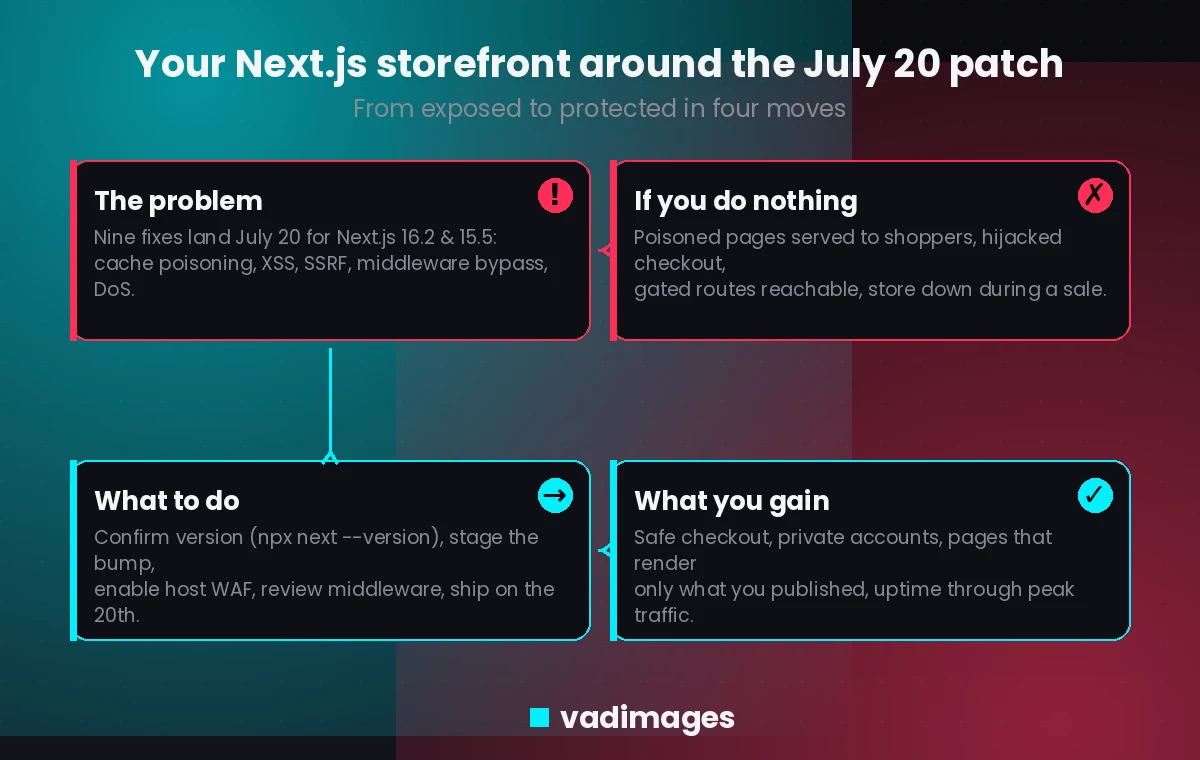
On a content site, these bugs are annoying. On a storefront that takes payments, they map directly to lost revenue and customer harm. A cache‑poisoning flaw can cause your CDN to serve a booby‑trapped version of a product page to real shoppers. An XSS bug can run attacker script inside a customer’s browser while they type their card details at checkout. A middleware or proxy bypass can let someone reach routes you thought were gated — account pages, order history, admin, or discount logic — without logging in. SSRF can trick your server into calling internal order, inventory, or payment APIs it should never expose. And a denial‑of‑service bug can knock your store offline in the middle of a promotion, when every minute of downtime is measured in abandoned carts.
Do nothing and you carry that exposure indefinitely, because once the CVEs are public the affected code paths are documented for anyone who wants to probe unpatched sites. For a US retailer, that is not just a technical risk: client‑side attacks on checkout pages are exactly what PCI‑DSS 4.0.1 script‑management rules exist to prevent, and a breach that leaks cardholder data invites chargebacks, forensic costs, and brand damage that outlasts the incident.
What your shoppers gain when you patch
Frame the upgrade around the person clicking “Buy,” not the framework version number. A patched storefront means a checkout that can’t be hijacked mid‑transaction, product pages that render only what you actually published, an account area that stays private to its owner, and a site that stays up when a sale drives a traffic spike. Those are the invisible trust signals that keep conversion rates healthy. Customers never see the CVE you closed — they just experience a store that feels safe, loads reliably, and doesn’t do anything strange with their card. Patching on schedule is one of the cheapest ways to protect the revenue you already earn.
What to do before and on July 20
Start by knowing exactly what you run. In your project, check package.json or run npx next --version to confirm your major and minor line in production. If you’re on 16.x or 15.x, plan to bump to the patched 16.2 or 15.5 release the moment it publishes on the 20th, then run your test suite and deploy through staging. If you’re on an older, unsupported line such as 14 or 13, treat this as the nudge to move onto a supported branch — unsupported versions won’t receive these fixes at all. While you wait for Monday, turn on your host’s managed web‑application‑firewall ruleset; Vercel, Cloudflare, and Netlify coordinated mitigations for the previous Next.js release and are likely to do so again. Finally, review any custom middleware you use for authentication, rewrites, or proxying, since that is one of the named affected surfaces.
Your quick-win checklist
Use this short self‑check to walk into Monday prepared instead of surprised:
- Confirm your production Next.js version in under a minute with
npx next --version. If you can’t answer “what version is live right now?” quickly, fix that first. - Note which affected surfaces you actually use: middleware for auth, rewrites or proxying, Server Components, and CDN caching or ISR.
- Subscribe to the Next.js blog and the vercel/next.js GitHub security advisories so the CVE details reach you the moment they publish.
- Book a maintenance window for July 20–21 and warn your team before, not during.
- Enable your host’s managed WAF ruleset today as interim cover for unpatched code.
- Keep a one‑click rollback to your previous deploy ready in case the upgrade needs a quick revert.
- Lock your dependency versions so the security bump is the only thing that changes in that deploy.
How Vadimages helps
Vadimages builds and maintains the storefronts and web apps this release affects, so a scheduled patch doesn’t have to eat your week. For existing stores, we run a dependency and version audit, stage the Next.js upgrade with full regression testing, review your middleware and authentication logic against the affected surfaces, tune your caching and rewrite rules, and set up a repeatable deploy‑and‑rollback pipeline so the next monthly release is a non‑event. For teams that want to modernize, we build headless Next.js storefronts, checkout and cart flows, customer account portals, order‑management dashboards, and the API integration layers that connect them to your payment, inventory, and fulfillment systems. The goal is the same either way: turn a scary framework advisory into handled, boring maintenance — and leave your store faster and safer than it was.
Bottom line
Next.js is closing nine security holes on July 20, 2026 across the 16.2 and 15.5 lines, and store owners who patch promptly protect their checkout, their customers, and their revenue. Confirm your version, pre‑stage the upgrade, switch on your host’s WAF, and be ready to ship the moment the release lands. This article is general security guidance, not legal or compliance advice — verify any PCI or regulatory obligations against your own stack and payment setup.