
In 2026, most custom software projects for US small and mid-sized businesses land somewhere between $5,000 and $150,000, with a simple internal tool starting around $5,000 and a full SaaS platform running well past $100,000. The honest answer is that "custom software" covers a huge range, so the real question is not "what does it cost?" but "what does my project cost, and what drives that number?" This guide gives you concrete ranges by project type, explains what moves the price, and shows how to budget without overpaying.
What are the real price ranges by project type in 2026?
Price is driven by scope, not by the word "custom." Here are the ranges we see across the US market in 2026 for well-built software from a professional team (not the cheapest offshore bid, and not a big-agency premium). Treat these as starting points for a serious conversation, not quotes.
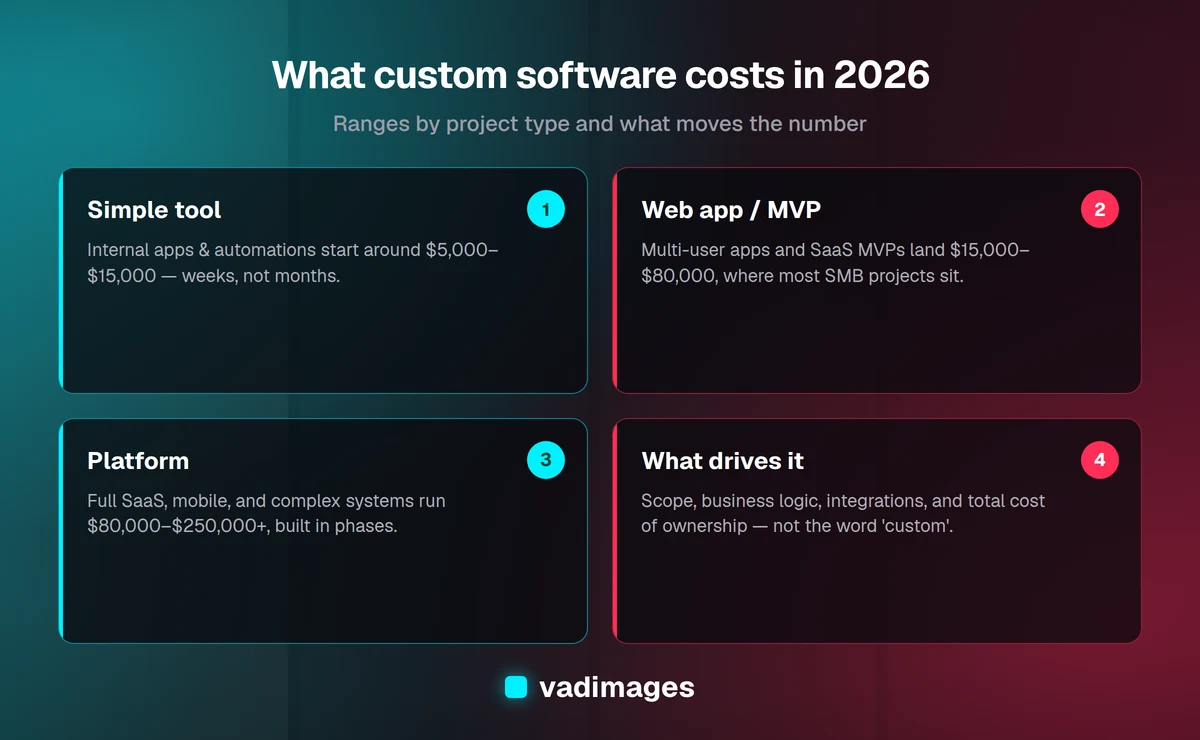
- Simple internal tool or automation ($5,000–$15,000). A single-purpose app: a form that replaces a spreadsheet, a booking tool, a small dashboard, an automation that moves data between two systems. Weeks, not months. This is where our from $5,000+ pricing lives.
- Custom web application ($15,000–$60,000). A multi-user app with logins, roles, a database, and real business logic — a client portal, an inventory system, a quoting tool, an internal operations platform. Most SMB projects sit here.
- Mobile app, iOS and Android ($30,000–$120,000). Native or cross-platform apps cost more because of app-store requirements, device testing, and often a companion backend. A simple app leans toward the low end; anything with payments, maps, or real-time features climbs quickly.
- SaaS MVP — a product you sell ($25,000–$80,000). A minimum viable product with signup, billing, a core feature set, and the plumbing to onboard paying customers. The goal is to reach the market and learn, not to build everything at once.
- Full SaaS platform or complex system ($80,000–$250,000+). Multi-tenant products, marketplaces, platforms with advanced permissions, analytics, and integrations. These are multi-month engagements, often built in phases.
- System integrations ($8,000–$50,000 per integration). Connecting your CRM, accounting, ERP, or e-commerce tools so data flows automatically. Cost depends entirely on how friendly the APIs are and how much data has to stay in sync.
If your project spans several of these — say a web app plus two integrations — add the ranges rather than picking one. And if a vendor quotes far below these numbers, ask what is being left out; the gap usually shows up later as rework.
What actually drives the cost of custom software?
Two projects with the same one-line description can differ by 5x. Here is what moves the number, roughly in order of impact.
- Scope and number of features. Every screen, user role, and edge case is real work. The single biggest cost lever is how much you build in version one.
- Complexity of the business logic. A to-do list is simple. Pricing engines, scheduling with constraints, approval workflows, and compliance rules are not. Complexity, not screen count, is where hours hide.
- Integrations. Every external system you connect to adds cost. Modern, well-documented APIs are cheap to work with; legacy systems and undocumented endpoints are expensive.
- Design and user experience. A functional interface is affordable. Custom, polished, brand-driven UX with animations and accessibility work adds design and front-end hours.
- Users and scale. Software for 20 internal users is architected differently than a platform expecting 200,000 accounts. Scale affects infrastructure, performance work, and security.
- Security and compliance. HIPAA, SOC 2, PCI, or handling sensitive data all raise the bar on how the software must be built, tested, and documented.
- Platforms. Web only is cheapest. Add iOS and Android and you are effectively maintaining more surfaces.
- Team and location. A US-based senior team costs more per hour than offshore contractors, but usually needs fewer hours and less rework. What matters is total cost to a working result, not the hourly rate in isolation.
What are the hidden costs people forget to budget for?
The build quote is only part of the picture. The costs that surprise business owners almost always fall into this list, so plan for them up front.
- Discovery and planning. Good software starts with figuring out exactly what to build. A short paid discovery phase (often $2,000–$10,000) reduces expensive changes later.
- Third-party services. Payment processors, email and SMS providers, mapping, authentication, and AI APIs carry monthly or usage fees that are yours, not the developer's.
- Hosting and infrastructure. Cloud hosting, databases, and storage typically run from $20 to a few hundred dollars a month for SMB apps, and scale with usage.
- Maintenance and updates. Software is never "done." Budget 15–25% of the build cost per year for fixes, dependency updates, security patches, and small improvements.
- Support and bug fixes. After launch, real users find real issues. A support arrangement keeps the software healthy.
- Change requests. Once people use the tool, they want more from it. That is a good sign — just budget for iteration.
- Data migration. Moving existing records into the new system cleanly is often underestimated, especially when the old data is messy.
How do I budget for a custom software project?
Budgeting is less about guessing a number and more about setting a realistic range and protecting yourself from surprises. Here is a practical approach.
- Separate must-haves from nice-to-haves. Write down every feature, then mark the handful that deliver the core value. Build those first.
- Set a total budget, not just a build budget. Include the build, third-party fees, hosting, and a year of maintenance so you are not blindsided in month four.
- Keep a contingency of 15–20%. Discovery reduces surprises but never eliminates them. A buffer keeps a small change from becoming a crisis.
- Ask for a phased plan. A good partner will propose a phase one you can afford and a roadmap for the rest, so you spend as you validate.
- Insist on transparent pricing. You should understand what each phase costs and why. See how we structure this on our pricing page.
Why does building an MVP first save money?
An MVP — minimum viable product — is the smallest version of your software that delivers real value and lets you learn from actual users. Building an MVP first is the single most reliable way to spend less and end up with better software, for three reasons.
First, it forces prioritization. When you commit to shipping the core in one phase, you stop paying to build features nobody has asked for yet. A surprising share of "essential" ideas turn out to be optional once real users weigh in.
Second, it de-risks the big spend. Instead of investing $120,000 before you know whether the concept works, you invest $30,000–$50,000, put it in front of users, and let evidence guide the next investment. If something needs to change, you change it cheaply, before it is baked into a large codebase.
Third, it gets you to revenue or savings sooner. A tool that launches in three months starts paying you back in month four. A "complete" build that takes a year is a year of cost before any return. In most cases, the MVP path has a lower total cost and a faster payback.
What is total cost of ownership, and why does it matter more than the quote?
Total cost of ownership (TCO) is what the software costs you over its whole life, not just to build. A useful rule of thumb: over three years, ownership costs — hosting, third-party fees, maintenance, support, and improvements — often add up to roughly the same as the original build, sometimes more for actively growing products.
This matters because the cheapest build is frequently the most expensive to own. Software written quickly and carelessly is harder to change, breaks more often, and costs more to maintain. Software built well costs a bit more up front and far less over three years. When you compare quotes, ask each vendor how their choices affect maintenance, hosting, and the cost of future changes — that conversation reveals more than the headline price.
Why does Vadimages start at "from $5,000+"?
Our transparent from $5,000+ framing exists because that is an honest floor for professional, custom-built software that solves a real problem and that you actually own. Below that, you are usually buying a template, a no-code setup, or an offshore quick build that costs more to fix than it saved.
Starting at $5,000 lets us take on focused tools and automations for smaller businesses without pretending every project needs a six-figure budget. From there, the number scales with your scope, and we tell you why at each step. We build for humans and optimize for growth, which means we would rather ship you a lean, well-made phase one than sell you a bloated build you do not need. If you want to see how a specific idea maps to a real range, that is exactly what a first conversation is for.
Frequently asked questions
What is the cheapest custom software worth paying for? Around $5,000 for a focused internal tool or automation. Below that, you are generally better served by an off-the-shelf product than by a rushed custom build.
How much does a custom web app cost in 2026? Most SMB web apps land between $15,000 and $60,000, depending on features, user roles, and integrations. A simple portal sits near the low end; an operations platform with complex logic sits higher.
Is custom software cheaper than SaaS subscriptions? It depends on the time horizon. Subscriptions are cheaper to start; custom software can be cheaper over several years because you stop paying per-seat fees and own an asset built for your workflow. Run the three-year math on both.
Why do quotes vary so much for the same project? Because "the same project" rarely is. Differences in scope assumptions, team seniority, location, and quality standards explain most of the gap. Always compare what is included, not just the total.
Can I build in phases to spread out the cost? Yes, and you usually should. A phased MVP approach lets you spend as you validate, which lowers risk and often lowers total cost.
What ongoing costs should I expect after launch? Plan for hosting, any third-party service fees, and 15–25% of the build cost per year for maintenance and improvements.
The bottom line
Custom software in 2026 ranges from about $5,000 for a focused tool to $250,000+ for a complex platform, and the number you land on depends on scope, complexity, integrations, and how much you choose to build in phase one. The smartest way to control cost is to start with an MVP, budget for total cost of ownership rather than just the build, and work with a partner who prices transparently. If you want a straight answer for your specific project, tell us what you are trying to build and we will map it to a real range. Start the conversation at https://vadimages.com/contact.