
You installed a single sign‑on plugin so your customers could reach their account portal with one click. It was supposed to make security easier. Instead, as of July 9, 2026, that plugin may be the widest hole in your entire website. Security firm Patchstack disclosed a critical flaw in miniOrange’s “OAuth Single Sign On – SSO (OAuth Client)” plugin for WordPress that lets a complete stranger log in as any user on your site — including the administrator — with no password, no account, and no clicks. If you run a US financial‑services or fintech site on WordPress, this is the kind of bug that turns a quiet Tuesday into a breach notification.
What actually broke (CVE-2026-57807)
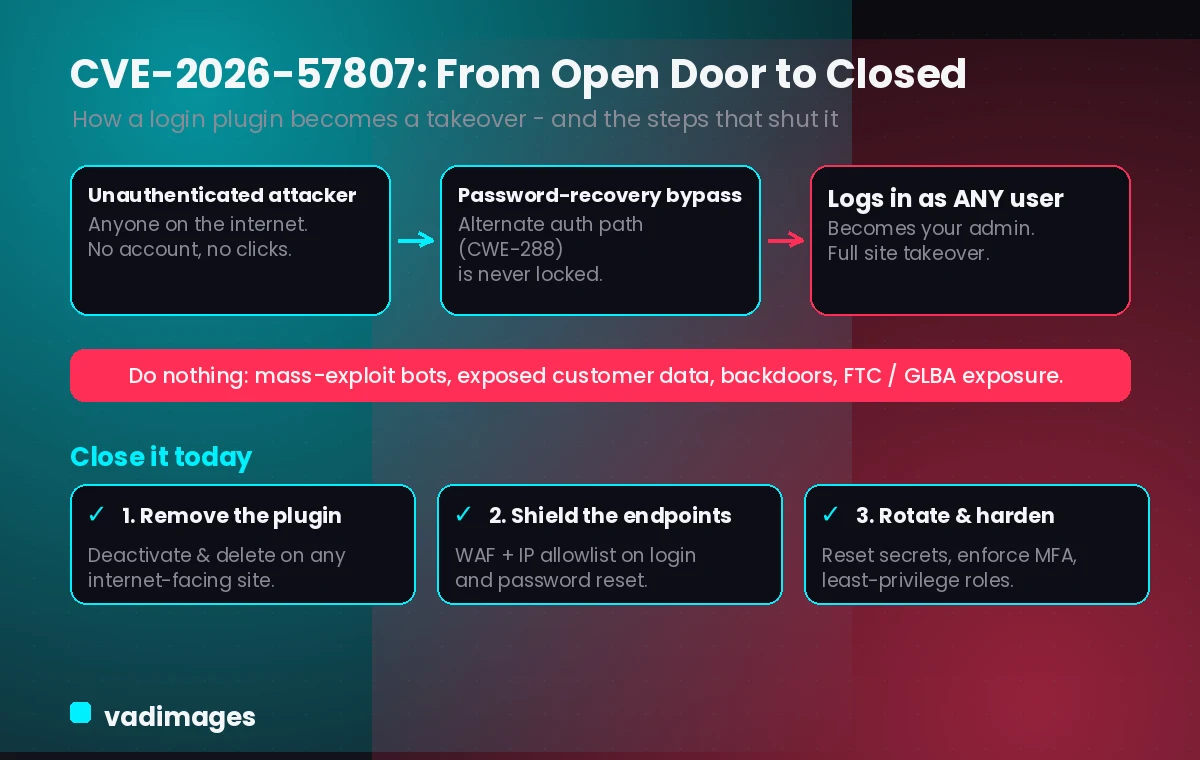
The vulnerability is tracked as CVE‑2026‑57807 and carries a CVSS score of 9.8 out of 10 — about as close to maximum severity as a web flaw gets. It is an authentication bypass (CWE‑288) that abuses the plugin’s password‑recovery flow: instead of proving who they are, an attacker walks in through an alternate path the plugin never locked. Patchstack rates the attack as requiring no authentication, no prior access, and no user interaction, with low complexity — meaning it can be launched from anywhere on the internet by an unsophisticated attacker.
Every version of the plugin up to and including 38.5.8 is affected. Watch the version track: miniOrange ships its paid OAuth client in the 38.5.x range, while the free WordPress.org build sits in the 6.26.x line, so “I’m on the latest” is not a safe assumption — check which edition and version you actually run. Security researcher Kim Dvash reported the issue on June 6, 2026, and the CVE was published to the National Vulnerability Database on July 10, 2026. As of disclosure, miniOrange had not shipped an official fix, though Patchstack released a virtual patch for its own customers.
What happens if you do nothing
Ignore this and you are betting your business on nobody scanning for a plugin that runs on a huge number of sites. Patchstack expects mass‑exploitation campaigns — automated bots that spray the exploit across thousands of sites regardless of size or traffic. Once an attacker authenticates as your admin, they own everything: customer records, connected payment and banking integrations, and the ability to inject malicious code or plant a hidden backdoor that survives even after you patch.
- Account takeover of customer‑facing portals — balances, statements, and personally identifiable financial data exposed.
- Silent backdoors and web‑skimming scripts injected into your login or checkout pages.
- Regulatory exposure under the FTC’s Safeguards Rule (GLBA), which expects “reasonable” security controls at financial institutions, plus state breach‑notification duties.
- Downtime, incident‑response costs, and the trust damage that follows a “we were breached” email to your customers.
What you — and your customers — gain by acting
Frame this for the person on the other side of the screen. When you close this hole, your customer’s login means something again: only they can reach their money and their data. You keep the convenience of one‑click SSO without handing an intruder the master key. And you avoid the single worst experience in fintech — a customer logging in to discover someone has already been inside their account. Acting fast is not just risk reduction; it is the reason a customer keeps trusting you with their financial life.
What to do on your site right now
Move today, in this order:
- Confirm exposure. In WP Admin → Plugins, look for “OAuth Single Sign On – SSO (OAuth Client)” by miniOrange and note the exact version. If it is 38.5.8 or earlier, treat the site as vulnerable.
- Deactivate and remove it from any internet‑facing site until miniOrange ships a patched release. Patchstack’s guidance is removal, not just deactivation.
- If you cannot remove it yet, restrict access to your
wp-login.phpand password‑recovery endpoints with WAF rules or IP allowlisting, and put a virtual patch in front of the site. - Rotate secrets and hunt for intruders. Reset admin passwords, rotate API keys for connected payment and banking services, and review user accounts, scheduled tasks, and recently modified files for anything you did not create.
- Watch for the fix. Monitor miniOrange advisories and update the moment an official patched build for your edition lands.
Your quick-win checklist
Beyond this one plugin, use today’s scare to harden your whole login surface. Run through this in about 30 minutes:
- Inventory every authentication, membership, and SSO plugin on the site — and delete any you are not actively using.
- Turn on real multi‑factor authentication for all admin and staff accounts.
- Set plugins to auto‑update, or subscribe to a vulnerability feed (Patchstack, Wordfence) so you hear about the next CVE before the bots do.
- Enforce least privilege: no customer or contractor account should hold an Administrator role.
- Confirm you have off‑site, restorable backups from the last 24 hours — and that you have actually tested a restore.
- Put a web application firewall in front of the site so one unpatched flaw does not equal an open door.
How Vadimages helps
miniOrange exists because bolting authentication onto WordPress is fiddly, and every bolted‑on plugin is another dependency that can fail the way this one did. Vadimages builds and hardens the software layer so your login stops being a liability. For fintech and financial‑services clients we design custom customer portals and account dashboards with authentication handled through vetted, standards‑based providers instead of a grab‑bag of plugins; we build the payment, reconciliation, and reporting web apps and the API integrations to your banking and processor partners; and we can migrate a fragile WordPress login flow onto a maintained, monitored architecture — or wrap your existing site in a WAF, MFA, and a real update process so the next CVE is a non‑event. Need a companion mobile app for account access? We build it on the same secure foundation. The goal is simple: your customers get frictionless, trustworthy access, and you stop losing weekends to emergency plugin patches.
Bottom line
CVE‑2026‑57807 is a 9.8‑severity, unauthenticated takeover in a plugin whose entire job was to protect your login. If your WordPress site runs miniOrange’s OAuth SSO client, remove it today, rotate your secrets, and put real guardrails around authentication. Do that, and a headline‑grade vulnerability becomes a footnote in your changelog instead of a breach in your inbox.
This article is for general informational purposes and is not legal, compliance, or security advice; consult qualified professionals about your specific obligations.