
If you run a growing business, you have probably hit a moment where your software stops keeping up. A spreadsheet that used to work is now a tangle of tabs. Two tools that should talk to each other don't, so someone re-types the same data twice a day. A process that felt simple at ten customers feels impossible at a thousand. When that happens, people start asking about custom software development — and quickly run into a wall of jargon. This guide explains what it actually means, in plain English, and how to tell whether it's the right move for your business.
What is custom software development?
Custom software development is the process of designing, building, and maintaining an application that is made specifically for one organization, rather than sold off the shelf to everyone. Instead of adapting your business to fit a generic product, you get a tool shaped around the way your team already works — your workflow, your rules, your data, and your customers.
A few everyday examples make it concrete. A custom system might be an internal dashboard that replaces a fragile web of spreadsheets, a customer portal where clients track their orders in real time, an automation that moves information between your CRM and your accounting software without anyone copying and pasting, or a full SaaS platform you sell to your own customers. The common thread is that the software fits your business exactly, because it was built for it.
Common types of custom software
"Custom software" covers a lot of ground. A few of the types businesses invest in most often:
- Internal tools and dashboards that replace spreadsheets and give your team one reliable place to work.
- Customer portals where your clients log in to place orders, track status, or manage their account.
- Workflow automation and integrations that connect the systems you already use so data moves on its own.
- Web and mobile apps built around a specific job your customers or staff need to do.
- SaaS products you sell to your own customers as a subscription.
Many projects combine several of these — an internal tool that later grows a customer-facing portal, for example. You can see the range on our custom software and industries pages.
Custom software vs. off-the-shelf: what's the real difference?
Off-the-shelf software — think of the subscription tools you sign up for in minutes — is a fantastic starting point. It's inexpensive up front, immediately available, and maintained by someone else. For common needs like email, accounting, or basic project tracking, you should almost always buy rather than build.
The trade-off shows up as you grow. A packaged product is designed for the average of thousands of companies, not for you. So you adapt: you add manual workarounds, keep a "real" version of the data in a spreadsheet on the side, and pay for features you never use while missing the one thing you actually need. Custom software flips that relationship. The tool bends to your process instead of the other way around.
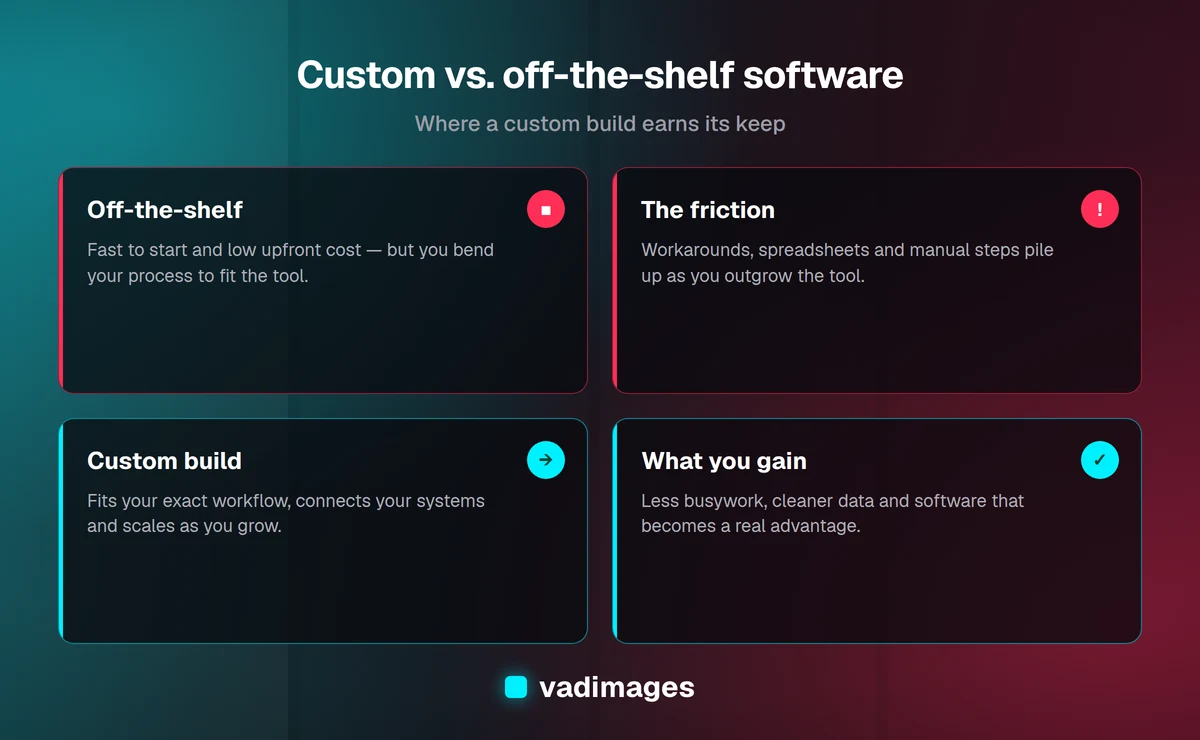
A simple way to decide: if a task is generic and not central to how you make money, buy it. If it's specific to your business, touches your customers, or is becoming a competitive advantage, that's where a custom build usually earns its keep.
Signs your business has outgrown off-the-shelf tools
You rarely need custom software on day one. The need tends to announce itself. Common signals include:
- Spreadsheet sprawl. Critical operations run on spreadsheets that only one or two people fully understand.
- Double entry. Staff copy the same information between systems that were never connected.
- Manual workarounds. Your team has invented elaborate steps to make a tool do something it wasn't built for.
- Ceilings on growth. Adding customers or orders means adding people, because nothing is automated.
- No single source of truth. Two reports disagree because the data lives in three places.
If several of these sound familiar, the cost of not building is already showing up — as wasted hours, avoidable errors, and missed opportunities. Custom software is simply a way to buy that time and reliability back.
What does the custom software development process actually involve?
Good custom software is far more than writing code. A dependable process moves through a handful of clear stages, and understanding them helps you know what to expect from a partner.
1. Discovery. Before anyone writes a line of code, a good team learns your business — the workflow, the pain points, the people who will use the tool, and the outcome you actually want. This is where scope gets defined and expensive misunderstandings get avoided. Skipping discovery is the single most common reason projects fail.
2. Design. The team maps the screens, the data, and the user experience. You should see what the software will look like and how it will flow before it's built, so feedback is cheap and changes are easy.
3. Build. Developers turn the design into working software, ideally in short cycles so you see progress every week or two rather than waiting months for a big reveal. Integrations with your existing systems — your CRM, accounting, or payment tools — happen here.
4. Testing and quality. The software is checked for bugs, security issues, and edge cases. Roughly half the real work of dependable software happens after the first version "works," which is exactly what protects you once real customers rely on it.
5. Launch and support. The tool goes live, your team is trained, and the software is monitored and maintained. Custom software is a living system, not a one-time delivery — ongoing support and iteration keep it valuable as your business changes.
How much does custom software development cost?
This is usually the first real question, and honest ranges help more than vague answers. At Vadimages, custom projects typically start around $5,000 for a focused tool or a well-scoped first version, and grow from there based on complexity. A simple internal tool or automation sits at the lower end. A multi-feature web application with integrations lands in the mid range. A full SaaS platform with user accounts, billing, and scale requirements is a larger, phased investment.
The biggest cost drivers are scope (how many features), integrations (how many other systems it must connect to), and complexity (unusual rules, compliance, or scale). The most reliable way to control cost is to start with a smaller, high-value first version — often called an MVP — prove it works, and expand from there. You can see how we structure this on our pricing page.
How long does it take to build?
Timelines follow scope. A focused internal tool or automation can be ready in a few weeks. A solid first version of a web application typically takes a couple of months. Larger platforms are built in phases, shipping useful pieces along the way rather than disappearing for half a year. A trustworthy partner will give you a realistic range up front and show working software regularly, so you're never guessing about progress.
Is custom software worth it?
Custom software is worth it when the problem it solves is specific, ongoing, and tied to how you operate or make money. The return usually shows up in three ways: time saved as manual work disappears, errors reduced as data lives in one reliable place, and growth unlocked as you serve more customers without adding proportional headcount. For many businesses, a tool that saves ten hours a week pays for itself within its first year — and then keeps paying.
It's worth being honest about when not to build. If a cheap off-the-shelf tool already does the job well, buy it. If the process is likely to change completely next quarter, wait. Custom software is an investment, and the best partners will tell you when it isn't the right one yet.
How to get started with custom software
You don't need a finished spec to begin. The best first step is a conversation about the problem — the workflow that's slowing you down, the system you wish you had, or the product idea you want to test. From there, a good partner helps you scope a realistic first version, gives you a transparent estimate, and builds in a way that lets you see progress and change direction as you learn.
Vadimages is a custom software and web development company based in Vancouver, WA, serving small and mid-sized businesses across the Portland metro and the wider US. We build websites, web and mobile apps, SaaS platforms, internal tools, and the automations and integrations that tie a business together — with transparent pricing and outcome-driven delivery. If any of the signals above sound like your business, tell us what you're working on and we'll suggest an approach and a realistic scope.
Frequently asked questions
What is custom software development in simple terms? It's building an application specifically for one business, shaped around its exact workflow, instead of using a generic product sold to everyone.
Is custom software cheaper than off-the-shelf? Not up front — packaged tools are cheaper to start. Custom software wins over time when a generic tool forces expensive workarounds, manual work, or limits on growth.
How do I know if I need custom software? If critical work runs on spreadsheets, staff re-enter data between disconnected systems, or growth means constantly adding people, you're likely ready to consider a custom build.
What's the smallest way to start? Begin with a focused first version that solves one high-value problem, prove the return, and expand from there. It lowers risk and gets you results faster.
Who owns the custom software once it's built? You do. With a custom build, the code and the intellectual property are yours — there's no vendor lock-in and no paying per-seat fees forever the way you would with a subscription product.