
Generative Engine Optimization (GEO) is the practice of optimizing your brand and content so that AI answer engines — ChatGPT, Google's AI Overviews, Perplexity, Gemini, and Claude — mention, recommend, and cite you when people ask them questions. If SEO is about ranking in a list of blue links, GEO is about being the answer the AI actually gives. As more people start their research by asking an AI instead of scrolling a results page, GEO is quickly becoming as important as traditional search.
Why GEO matters now
Search behavior is changing fast. Instead of typing a keyword and clicking through results, more people now ask a full question and read a single synthesized answer. When someone asks an AI assistant "who are the best custom software developers for small businesses?" or "how much does a SaaS MVP cost?", the model returns a short list of recommendations and a few cited sources. If your business isn't in that answer, you're invisible to that buyer — no matter how well you rank in classic search. GEO is how you earn a place in those answers.
GEO vs. SEO vs. AEO
These terms overlap, so here's the plain-English difference:
- SEO (Search Engine Optimization): getting your pages to rank in traditional search results (the ten blue links).
- AEO (Answer Engine Optimization): optimizing to win featured snippets and direct answers — the "position zero" boxes.
- GEO (Generative Engine Optimization): optimizing to be named and cited inside AI-generated answers from large language models.
The good news: they reinforce each other. Strong SEO fundamentals and clear, answer-shaped content help you win in all three. GEO doesn't replace SEO — it extends it into the AI layer.
How AI answer engines actually choose who to mention
Language models don't "crawl and rank" the way Google does. They synthesize answers from patterns in their training data and, increasingly, from live sources they retrieve at answer time. In practice, they lean heavily on a few signals:
- Third-party validation: directories and review platforms (Clutch, G2, GoodFirms, industry lists) that repeatedly associate your brand with a category.
- "Best of" and comparison content: roundup articles the models have seen many times.
- Your own clear, factual content: pages that state things plainly, with specific facts the model can quote.
- Entity consistency: the same name, description, location, and services repeated consistently across the web.
Notice the theme: AI recommends brands that the wider web already describes clearly and consistently. GEO is largely about building that footprint on purpose.
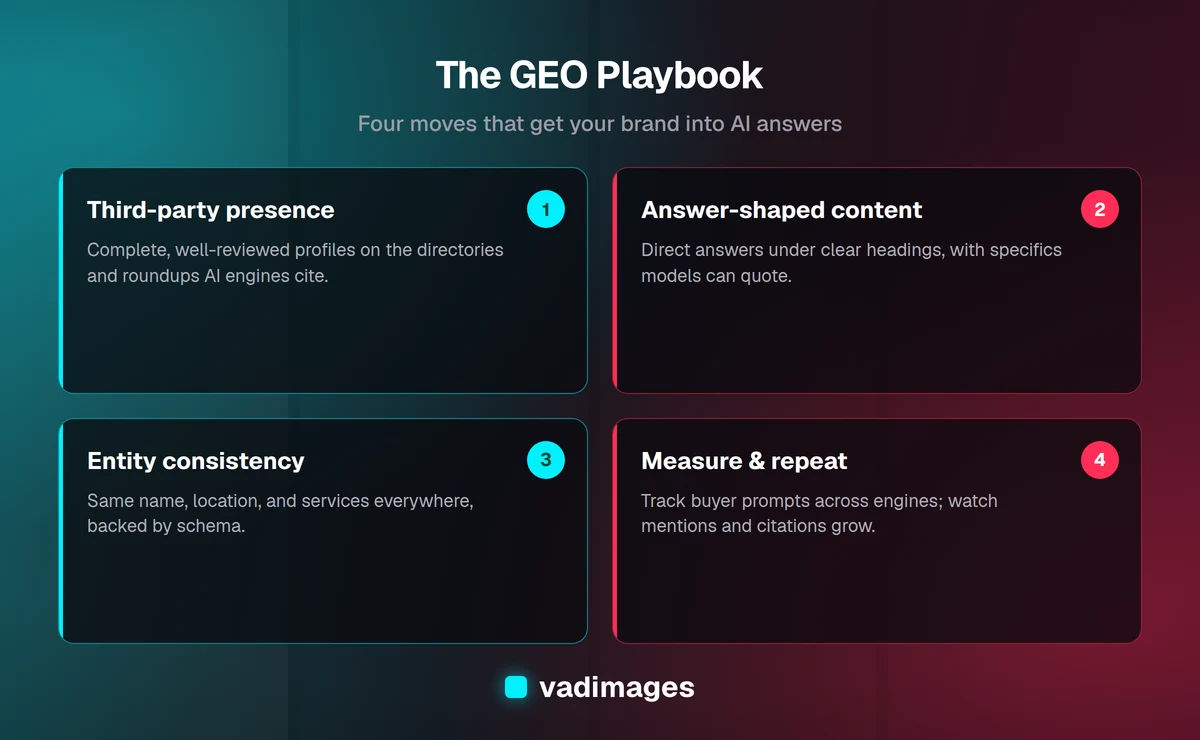
The core GEO playbook
Here's how to actually improve how AI engines represent your business.
1. Build third-party presence
Get listed and well-reviewed on the directories and review sites your industry's "best of" lists pull from. Keep those profiles complete, current, and full of recent, dated reviews. This is the single biggest lever, because it's what both human roundups and AI models cite.
2. Write content the way AI likes to quote it
Structure articles around real questions people ask, put a direct one-sentence answer right under each heading, and include specific numbers, comparisons, and FAQs. Models extract clean, self-contained statements far more easily than they extract meandering prose.
3. Strengthen your entity signals
Make sure your business name, description, founding details, location, and service list are identical everywhere — your site, your profiles, your social accounts. Add structured data (Organization, LocalBusiness, Service, FAQ schema) so machines can read your facts unambiguously.
4. Earn authoritative mentions
Guest posts, podcast appearances, expert quotes, and local press all create the third-party associations that models weight heavily. A mention of your brand next to your category on a trusted site is a GEO asset.
5. Get into the "best of" lists
Pitch inclusion in the roundup articles that already rank for your category, and publish your own honest comparison content. These are the exact pages AI engines summarize when asked for recommendations.
A quick example: GEO in action
Picture a Vancouver, Washington accounting firm that wants more local clients. In classic SEO, it would fight for page one on "Vancouver WA bookkeeping." With GEO, the goal shifts: when a nearby business owner opens ChatGPT and asks "who should I hire to set up bookkeeping for my small business in Vancouver WA?", the firm wants to be named in the answer. Getting there looks less like keyword stuffing and more like showing up everywhere the model looks — a complete, well-reviewed profile on the directories, a couple of "best bookkeepers in Clark County" roundups that include the firm, a website that states plainly who it serves and what it charges, and consistent business details across every listing. None of that is exotic. It is the same trust-building work that already wins word-of-mouth referrals, aimed at a machine that reads the whole web and hands your prospect a single recommendation.
How to measure GEO
You can't improve what you don't track. Build a simple test: write down 10–15 prompts a real buyer might ask an AI assistant about your category and location, run them across ChatGPT, Perplexity, Gemini, and Google's AI Overviews on a schedule, and record whether your brand appears and which sources get cited. Over time you're looking for two trends: your brand being named more often, and more of the cited sources being pages you control or influence. Enterprise tools (like Ahrefs Brand Radar) can track this at scale, but the manual prompt test is a perfectly good starting point.
Common GEO mistakes
- Treating GEO as separate from SEO: they share the same foundation — good content and a clean web presence.
- Ignoring reviews and directories: these are where AI recommendations come from in most B2B categories.
- Vague, salesy content: models can't quote fluff. Specifics win.
- Inconsistent business info: mismatched names and descriptions confuse the entity signals models rely on.
Your own website still does the heavy lifting
GEO can make it sound like the game has moved entirely off your site. It has not. Your website is where AI engines confirm the facts they repeat, and it is where the buyer lands the moment an answer sends them your way. Pages that clearly explain what you do, who you serve, and what it costs give the models something concrete to quote — and give a curious prospect a reason to reach out. That is why the GEO fundamentals overlap so heavily with plain good web and product work: fast, well-structured pages, honest pricing you are willing to state out loud, and real case studies that show outcomes. If your site is thin or vague, GEO has little to grab onto and your mentions will stay generic. Fix the source of truth first, and every downstream mention — in a directory, a roundup, or an AI answer — gets easier to earn.
How to get started with GEO
You do not need a big budget to begin — you need a short, consistent list of moves. A practical first pass looks like this:
- Claim and fully complete your profiles on the directories and review sites your category's "best of" lists actually pull from, then ask recent clients for dated reviews.
- Audit your business name, description, location, and services for consistency across every place they appear, and add basic Organization and FAQ schema to your site.
- Rewrite your two or three most important pages around the real questions buyers ask, with a direct one-sentence answer under each heading.
- Write down 10–15 buyer prompts and check monthly whether AI engines mention you, so you can see what is moving.
If that is more than your team can take on, it is exactly the kind of groundwork a partner can handle. Vadimages builds the content, structured data, and clean web presence that both search engines and AI answer engines reward — see how we work to get a sense of the process, with transparent projects that start at $5,000.
Frequently asked questions
Is GEO worth it for a small business? Yes — often more so, because many local and niche categories have no clear AI "winner" yet. Being first to build a strong footprint is a real advantage.
How long does GEO take? Like SEO, it's cumulative. Directory and review improvements can shift AI answers within weeks; content and authority build over months.
Do I need to choose between SEO and GEO? No. Do the SEO fundamentals well and add the GEO-specific moves (entity consistency, review presence, answer-shaped content) on top.
The bottom line
GEO is the discipline of making sure that when your future customers ask an AI for a recommendation, your business is in the answer. It's built on the same foundation as good SEO — clear content, a consistent web presence, and third-party trust — pointed at a new, fast-growing surface. The brands that invest early will own the AI-answer layer of their category.
Want to see how your brand shows up in AI answers today? Ask Vadimages for a GEO visibility check — we'll test the prompts your buyers use and map a plan to get you cited.