

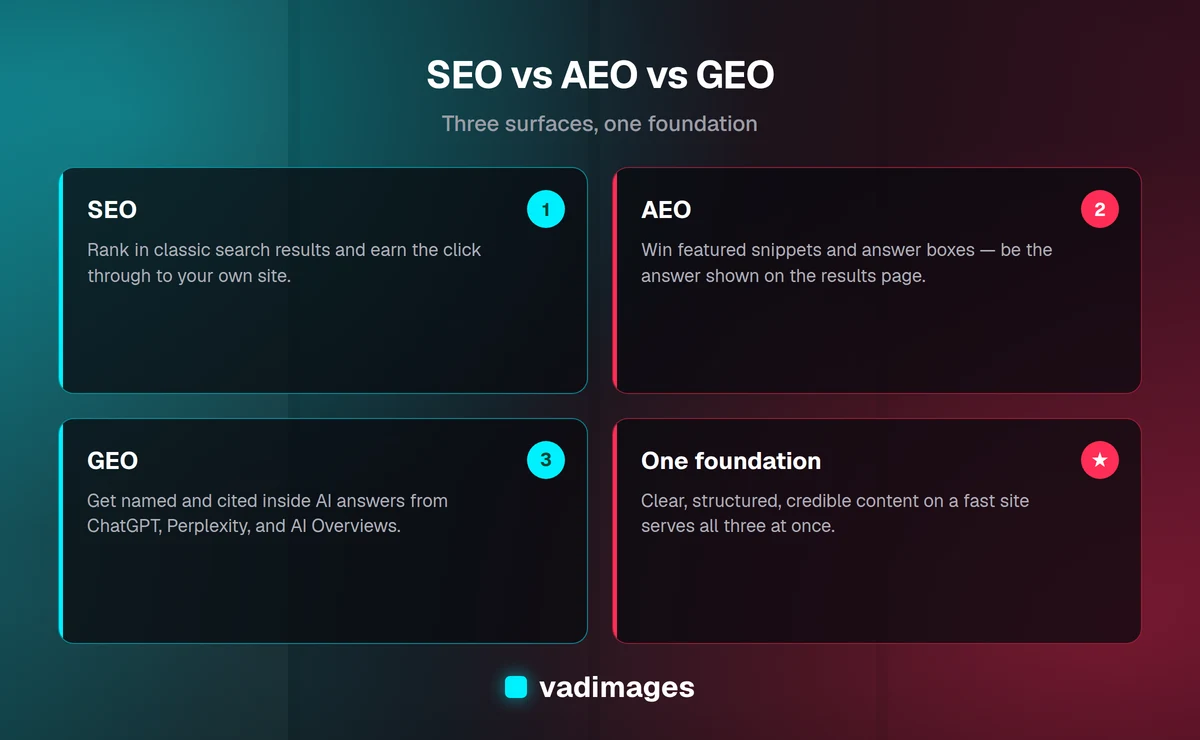
SEO, AEO, and GEO are three overlapping disciplines for getting found online. SEO (search engine optimization) helps your pages rank in traditional search results, AEO (answer engine optimization) helps you win featured snippets and direct answers, and GEO (generative engine optimization) helps your brand get cited inside AI-generated answers from tools like ChatGPT, Perplexity, and Google's AI Overviews. They share one foundation and differ mainly in where the answer is displayed and who does the displaying.
For most of the last two decades, "getting found" meant one thing: rank on the first page of Google. That is no longer the whole game. People now ask full questions, read answers pulled directly into the results, and increasingly get their information from an AI assistant that never shows a list of blue links at all. If you only optimize for classic rankings, you are competing for a slice of attention that keeps shrinking. This guide defines each discipline plainly, shows where they overlap and where they diverge, and gives you a practical plan to cover all three without tripling your workload.
What is SEO?
SEO (search engine optimization) is the practice of improving your website so it ranks higher in the organic results of search engines like Google and Bing. The goal is a click: someone types a query, sees your page in the list of results, and visits your site. SEO is the oldest and most established of the three disciplines, and it remains the foundation the other two are built on.
Classic SEO breaks into three parts. On-page SEO covers the content and HTML of a page: titles, headings, keyword usage, internal links, and how clearly the page answers the searcher's intent. Technical SEO covers everything that helps a crawler find and render your pages: site speed, mobile friendliness, clean URL structure, XML sitemaps, and structured data. Off-page SEO covers signals from elsewhere on the web, mostly backlinks from other reputable sites that vouch for your authority.
SEO answers the question: "When someone searches for what we do, does our page show up in the results, and is it good enough to earn the click?" It is still where the majority of measurable organic traffic comes from, which is why it is the base layer, not a legacy tactic.
What is AEO?
AEO (answer engine optimization) is the practice of structuring your content so a search engine can lift a direct answer from it and display that answer at the top of the results. Think of the featured snippet, the "People Also Ask" box, the definition card, and the answer a voice assistant reads aloud. With AEO, you are not just trying to rank; you are trying to be the answer.
AEO grew out of a shift in how people search. Instead of typing "best CRM small business," they ask "what is the best CRM for a small business" or "how much does a CRM cost." Search engines respond by pulling a concise, authoritative answer straight onto the results page, often above the number-one organic result. Winning that position, sometimes called "position zero," means your answer is the first thing a searcher sees and reads.
The mechanics of AEO are specific. You write content that answers a clear question in the first sentence or two, then support it with detail. You use question-style headings that mirror how people actually ask. You add structured data such as FAQ, HowTo, and Article schema so engines understand the format of your content. You keep the answer itself tight, usually 40 to 60 words, because that is roughly what fits in a snippet box. AEO answers the question: "When someone asks a question we can answer, does the engine choose our words as the definitive answer?"
What is GEO?
GEO (generative engine optimization) is the practice of making your content easy for AI systems to understand, trust, and cite when they generate answers. The "generative engines" are large language model products: ChatGPT, Claude, Google's AI Overviews and Gemini, Perplexity, and Microsoft Copilot. When a user asks one of these tools a question, it composes an answer in its own words and, increasingly, names or links the sources it drew from. GEO is how you become one of those sources.
This matters because a growing share of research now happens without a traditional search at all. A prospect asks an AI assistant "who builds custom software for small businesses in the Pacific Northwest" and reads a synthesized answer naming a handful of firms. If your business is not in that answer, you were never in the running, and there was no results page for you to climb. GEO is about earning a mention in the answer itself.
GEO rewards content that is clear, factual, well-structured, and quotable. AI models favor sources that state things plainly, define terms directly, back claims with specifics, and read as trustworthy and current. Being cited elsewhere on the web, mentioned by name across reputable sites, and consistent about who you are and what you do all raise your odds of being pulled into a generated answer. GEO answers the question: "When an AI assistant explains our topic to a potential customer, does it mention us, and does it get us right?"
How do SEO, AEO, and GEO overlap?
The three disciplines share far more than they differ. All three reward the same underlying qualities: content that genuinely answers a real question, clear structure that machines can parse, factual accuracy, topical authority, and technical health that lets crawlers and models reach your pages in the first place. A fast, well-organized page with a direct answer and credible sourcing performs better in all three arenas at once.
Structured data is a good example of the shared foundation. Schema markup helps Google rank you (SEO), helps it build a featured snippet from your page (AEO), and helps an AI model understand what your content is about (GEO). Question-style headings do the same triple duty. This is the encouraging part: you are not building three separate content programs. You are building one strong content foundation and then adding a thin layer of optimization for each surface.
How do SEO, AEO, and GEO differ?
The differences come down to where the answer appears and who controls the click. With SEO, the payoff is a link in a list and a visit to your site; you win attention by ranking. With AEO, the payoff is your content displayed as the answer on the results page itself; the user may read it without clicking, so visibility and brand authority matter as much as traffic. With GEO, the payoff is a mention or citation inside an answer an AI wrote; you often cannot see the query, there is no ranked list, and success looks like being named rather than being clicked.
They also differ in how you measure success. SEO is measured by rankings, organic clicks, and impressions in tools like Google Search Console. AEO is measured by how often you own featured snippets and answer boxes for your target questions. GEO is measured by share of voice in AI answers: how often, and how accurately, tools like ChatGPT and Perplexity mention your brand. The metrics for GEO are the newest and least standardized, but they are maturing quickly as brands realize AI referrals are real traffic.
One more difference worth naming: control. SEO gives you the most direct control, because you are optimizing your own pages against known ranking factors. AEO gives you slightly less, because the engine decides whether to build a snippet and which page to use. GEO gives you the least direct control, because the model synthesizes from many sources and its reasoning is opaque. That is exactly why the shared foundation matters so much: you cannot micromanage an AI's answer, but you can make your content the kind of source it prefers to trust.
Do I need all three?
For most US small and midsize businesses, yes, but not all at once and not with equal effort. SEO is non-negotiable because it is still where the largest, most measurable share of organic traffic lives, and because it produces the strong content and technical health that AEO and GEO both depend on. Start there. AEO is a natural, low-cost extension of good SEO: once you are writing content that answers real questions, formatting it to win snippets is a small additional step. GEO is the fastest-growing frontier, and getting in early is a genuine advantage, because AI answers tend to reinforce the sources they already trust.
The right sequence for most businesses is: build a healthy, well-structured SEO foundation, layer in AEO formatting as you create content, and adopt GEO practices in parallel so your brand starts showing up in AI answers while the field is still young. You do not have to choose. You have to sequence.
What is a practical plan to cover all three?
Here is a straightforward approach that serves SEO, AEO, and GEO from a single content effort:
- Fix the foundation first. Make sure your site is fast, mobile-friendly, crawlable, and free of technical errors. Add clean structured data. None of the three disciplines works well on a broken base. This is the core of a solid SEO and GEO service.
- Research the questions your buyers actually ask. Target real questions in natural language, not just short keywords. These questions are the raw material for rankings, snippets, and AI answers alike.
- Lead every piece with a direct answer. State the answer clearly in the first sentence or two, then expand. This "definition-first" style wins featured snippets and is exactly what AI models like to quote.
- Use question-style headings and schema. Mirror how people ask, and mark up your content with FAQ, HowTo, and Article schema so both engines and models can parse it.
- Back claims with specifics. Concrete numbers, clear definitions, and honest detail build the trust that earns rankings, snippets, and citations.
- Build authority off-site. Earn mentions and links from reputable sources. This lifts classic SEO and raises your odds of being cited in AI answers.
- Measure each surface. Track rankings and clicks for SEO, snippet ownership for AEO, and brand mentions in AI tools for GEO. Adjust based on what each surface tells you.
Notice that steps two through six are a single writing practice, not three. That is the whole point: one disciplined content process, optimized once, that shows up across search results, answer boxes, and AI answers.
Frequently asked questions
Is GEO replacing SEO? No. GEO is expanding the landscape, not replacing it. Traditional search still drives the majority of measurable organic traffic, and the content and technical work SEO requires is what makes GEO possible. Think of GEO as a new surface to optimize for, built on the same foundation.
What is the difference between AEO and GEO? AEO targets the answer boxes inside a search engine's own results, like featured snippets. GEO targets the answers generated by AI assistants such as ChatGPT and Perplexity. AEO keeps you inside the search results page; GEO puts you inside a conversational AI response, which may happen entirely outside a search engine.
How do I know if my content is showing up in AI answers? Ask the major AI tools questions your customers would ask and see whether your brand is named. Newer tracking tools also measure your "share of voice" in AI responses over time. It is less precise than rank tracking today, but it is improving fast.
Do I need special content for each discipline? Usually not. Content that is clear, well-structured, factually solid, and formatted to answer real questions performs well across all three. You add a thin optimization layer per surface rather than writing three separate versions.
How long does it take to see results? SEO and AEO improvements typically show up over weeks to a few months as engines recrawl and reindex. GEO visibility can move faster or slower depending on how often models refresh their sources, but the same foundational work drives all three, so the effort compounds.
The bottom line
SEO, AEO, and GEO are not competing strategies; they are three windows into the same room. SEO earns the click, AEO earns the answer box, and GEO earns the citation inside an AI's response. They rest on one foundation: clear, credible, well-structured content on a technically healthy site. Build that foundation once, and you can optimize for all three surfaces without tripling your work, positioning your business to be found however your customers choose to search, now and as the landscape keeps shifting.
If you want a partner who understands all three and can build a content engine that covers them together, talk to Vadimages. We build for humans and optimize for growth, with transparent pricing and no hype. Start the conversation at vadimages.com/contact.