
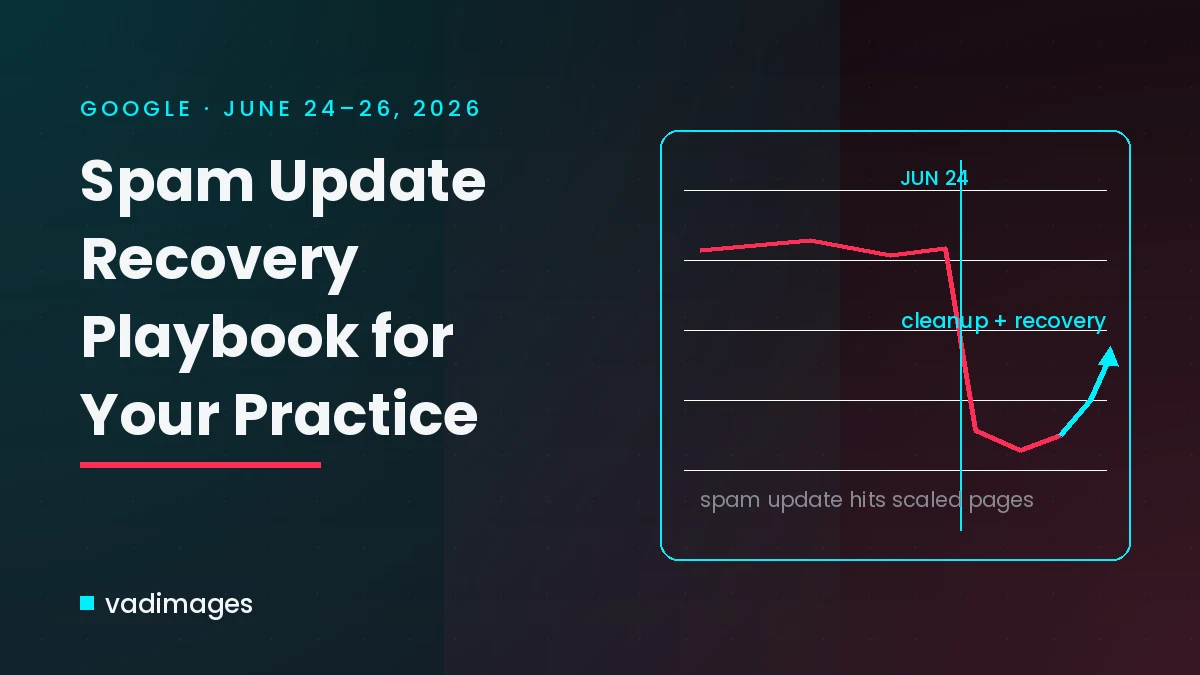
If the traffic to your practice’s website fell off a cliff in the last week of June — fewer visits, fewer form fills, a quieter front desk — you are not imagining it, and you are not alone. Google confirmed that its June 2026 spam update began rolling out on June 24 and finished on June 26 at 2pm ET. It is the second spam update of 2026, and observers at Search Engine Land and Search Engine Roundtable noted it felt broader than the March one. For a clinic, dental group, or multi-location provider that depends on local search for new patients, a drop like this is not an abstract SEO story. It is a revenue problem with a specific cause — and a specific fix.
What changed: the June 2026 spam update, in plain terms
A spam update is different from a core update. It does not re-weigh quality signals across the whole web; it targets sites that violate Google’s published spam policies. The practices most relevant to healthcare websites are scaled content abuse (large volumes of thin, templated, or AI-generated pages produced mainly to rank), doorway pages (near-duplicate “dermatologist in [city]” pages for every suburb you do not actually serve), keyword stuffing, cloaking, and expired-domain abuse. Reporting on this rollout indicates it did not target link spam or the site-reputation-abuse policy.
This matters because a lot of medical practices bought exactly this kind of SEO over the past two years. If an agency generated hundreds of condition pages or city pages for your site with light edits and no clinical review, those pages were the target. Health queries are also “Your Money or Your Life” territory, where Google applies its strictest quality bar — so thin medical content gets less benefit of the doubt than a thin plumbing page would.
First, confirm which update actually hit you
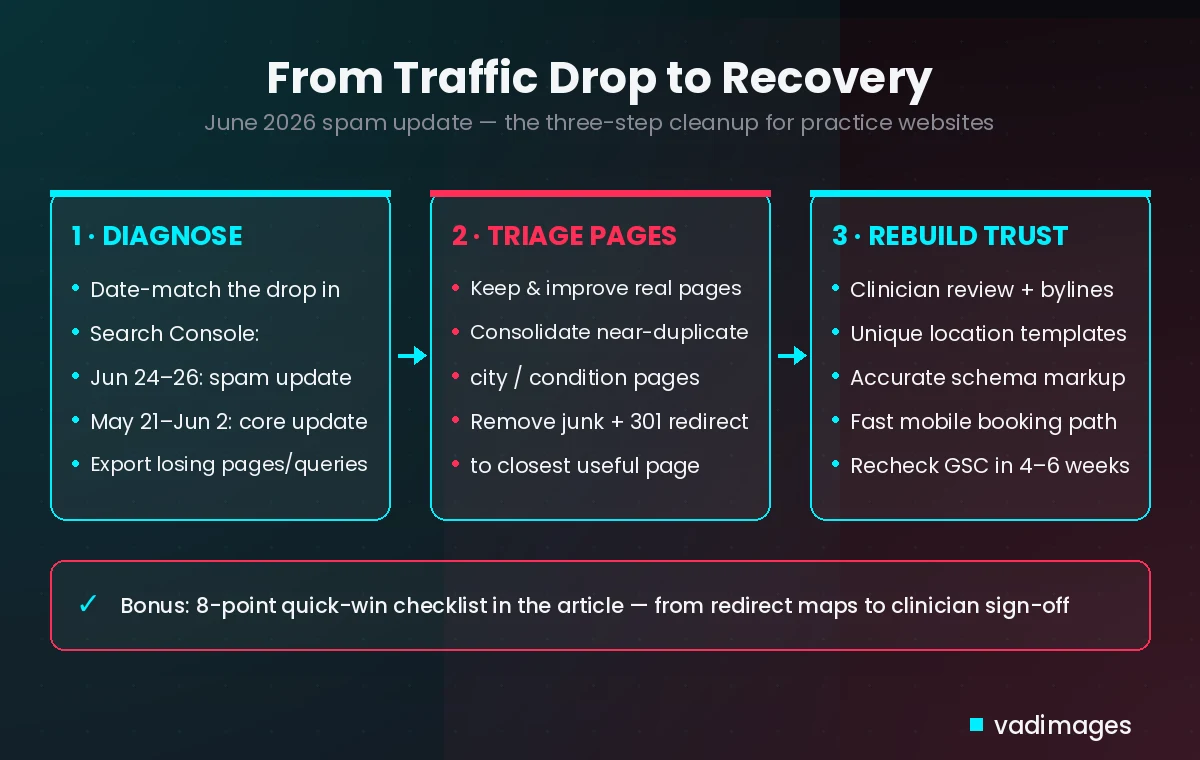
Before you fix anything, date-match the damage in Google Search Console. Open the Performance report and compare the week after June 26 against mid-June. If the decline snaps to the June 24–26 window, the spam update is the likely cause. If your slide started between May 21 and June 2, you were more likely caught by the May 2026 core update — a quality reassessment, not a spam action — and the remedy is improving content rather than removing it. Also segment branded versus non-branded queries: if searches for your practice name still find you but “knee pain treatment near me” vanished, the update suppressed pages, not your brand. Note exactly which URLs lost impressions; that list is your cleanup map.
What happens if you do nothing
Spam-update suppression does not quietly expire. Google’s own documentation says sites that improve may see recovery only over months, and often only after a future spam update reprocesses the signals. Waiting means every week of lost visibility is a week of lost appointment requests going to the practice across town. It also compounds: the same thin pages that tripped the spam systems make you less likely to be cited in AI Overviews, which now sit on top of many symptom and treatment searches. And if a patient does land on a doorway page stuffed with city names, they bounce — which wastes the traffic you still have.
What you gain by cleaning up — for your patients, not just for Google
The upside of this cleanup is not only algorithmic. Replace fifty templated condition pages with fifteen genuinely useful ones — reviewed by your clinicians, with clear symptoms, treatment options, insurance information, and a visible path to book — and real people get real answers. Patients find the right location, see who will treat them, and schedule in fewer clicks. Sites that make this shift typically convert a higher share of a smaller traffic base immediately, then recover rankings on the pages that matter. You end up with a site that is cheaper to maintain, faster to load, and credible to both Google’s systems and an anxious person searching at 11pm.
What to do on your site this month
Treat this as a content-architecture project, not a tweak. Inventory every page created programmatically or with AI assistance and sort them into three buckets: keep and improve (real demand, salvageable draft), consolidate (five near-duplicate city pages become one strong service-area page), and remove (no traffic, no purpose). Removed pages should 301-redirect to the nearest relevant page. Location pages you keep should be genuinely distinct: the actual providers at that office, its hours, parking, accepted plans, and reviews — not the same paragraph with a swapped city name. Add named authorship and clinician review to medical content, and make sure structured data (MedicalClinic, Physician, FAQ) matches what is visibly on the page. None of this requires waiting on Google; it requires editorial honesty and a developer who can execute redirects, templates, and schema cleanly.
Your quick-win checklist
- Date-match your drop in Search Console: June 24–26 points to the spam update; May 21–June 2 points to the core update.
- Export the queries and pages that lost impressions — this is your prioritized cleanup list.
- Count your location and condition pages; if the number is far larger than the services you actually deliver, consolidate.
- Spot-check five pages: would a clinician at your practice sign their name to each one? If not, rewrite or remove.
- 301-redirect every removed URL to its closest useful equivalent — never to the homepage in bulk.
- Add author bylines, reviewer credentials, and a last-reviewed date to medical content.
- Verify your booking or contact path works from every surviving page on mobile.
- Recheck Search Console in 4–6 weeks and after Google’s next confirmed update.
How Vadimages helps
Vadimages builds websites, patient portals, and web and mobile apps for US healthcare organizations, and this exact scenario — a practice site weighed down by scaled content — is web-development work at its core. We audit the site’s content architecture, implement the consolidation plan with correct 301 redirect maps, and rebuild location and service templates so each page is structurally unique, fast, and marked up with accurate schema. Where the old setup relied on page-generation tricks, we replace it with a maintainable CMS structure your staff can actually edit. And because recovered traffic only matters if it converts, we design the booking flows, intake forms, and patient-portal entry points that turn a returning visitor into a scheduled appointment. The outcome is a site that no longer depends on tactics an algorithm can revoke.
Bottom line
The June 2026 spam update finished rolling out on June 26, and it punished manufactured content — the kind many healthcare sites accumulated without realizing the risk. Diagnose the drop with dates, not guesses; triage every scaled page; and rebuild around content your clinicians would stand behind. The practices that treat this as a website-quality project, not an SEO trick to swap for another trick, are the ones that come back stronger.