
On 3 June 2026 the Angular team shipped Angular 22, the framework’s first release of what its maintainers are calling the “signal-first” era. For most businesses a front-end framework bump is background noise. For healthcare organisations that run patient portals, intake forms and scheduling apps in the browser and on mobile, this one is worth a closer look — because the headline features land squarely on the two things those products live or die by: forms and accessibility.
What actually changed in Angular 22
Angular follows a predictable six-month major-release cadence, and version 22 (current patch v22.0.1) is the June 2026 step in that rhythm. The release graduates several features that had been maturing in developer preview or experimental status:
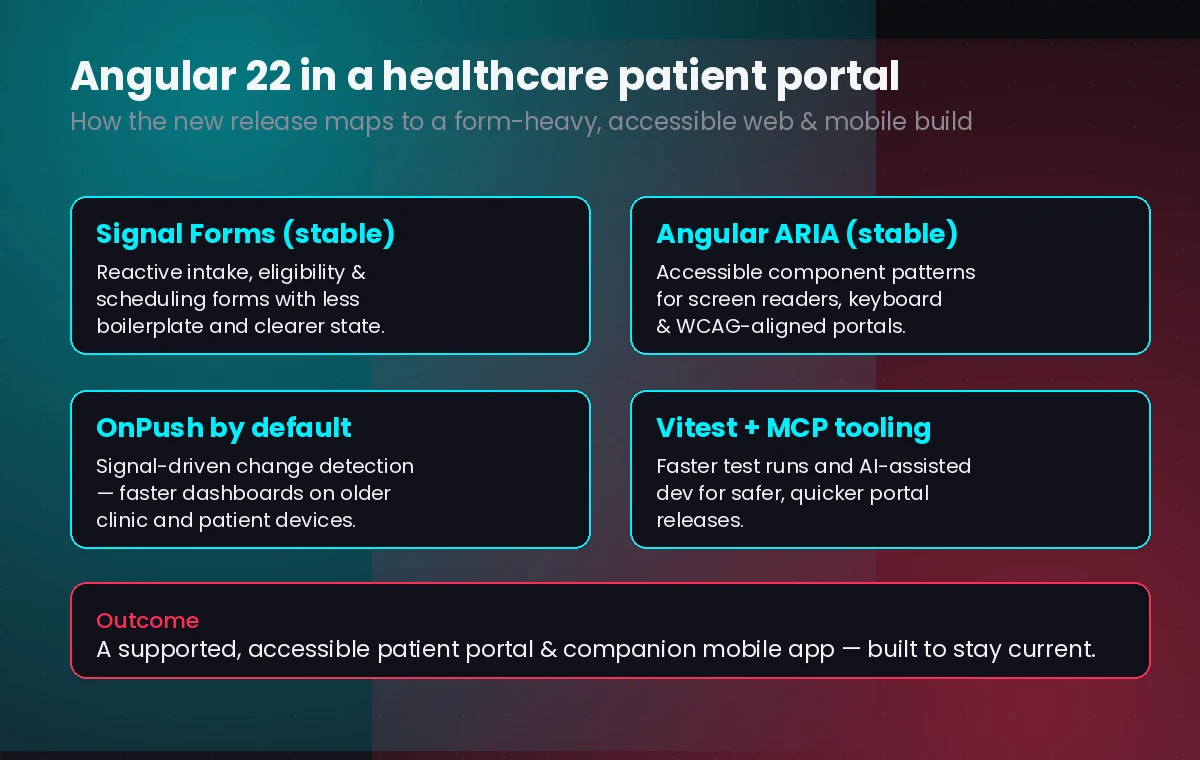
- Signal Forms are now stable. Introduced experimentally in Angular 21, the signal-based form system replaces the older subscription pattern with a lightweight, reactive API for building and validating forms.
- Angular ARIA is stable. The accessible component-patterns package — keyboard handling, focus management and screen-reader semantics — moves from developer preview to production-ready.
- Selectorless components. Components can be imported directly into templates without a selector string, simplifying how interfaces are composed.
- OnPush change detection is the default for new components, pushing teams toward efficient, signal-driven updates rather than broad re-renders.
- Tooling caught up too: Vitest is the default test runner for new projects, and the Angular CLI now ships stable Model Context Protocol support for AI-assisted development.
Why a framework release matters for healthcare
Healthcare digital products are unusually form-heavy. A patient signs up, completes intake and medical-history questionnaires, confirms eligibility, books and reschedules appointments, uploads documents and updates insurance details — almost all of it through structured forms with conditional logic, validation rules and error states. When that form layer is brittle, the cost shows up as abandoned registrations, mis-entered data and support calls. Signal Forms gives engineering teams a cleaner way to express that complexity: validation, derived values and form state become explicit and reactive, which tends to mean fewer edge-case bugs in exactly the flows where mistakes are most consequential.
Accessibility moves from afterthought to default
The stabilisation of Angular ARIA is the quieter but arguably bigger story for this sector. Patient-facing software is held to a high accessibility bar: U.S. providers and many of their vendors must consider Section 508 and ADA expectations, and Web Content Accessibility Guidelines (WCAG) 2.1 AA is the practical reference point that regulators, procurement teams and accessibility audits keep returning to. Building correct keyboard navigation, focus order and screen-reader semantics by hand is painstaking and easy to get wrong. Production-ready accessible component patterns lower that effort and make a compliant baseline the starting point rather than a retrofit — which matters when your users include people relying on assistive technology to manage their own care.
The support clock is the part most teams miss
There is a maintenance angle that healthcare leaders should not overlook. Each Angular major version gets roughly six months of active support followed by twelve months of long-term support — about an 18-month window from release to end-of-life. Angular 19 reached end-of-life on 19 May 2026, which means portals still running on version 19 or older are now on unsupported software, receiving no security patches. For systems that touch protected health information, running an unsupported framework is a risk that compounds quietly until an audit or incident surfaces it. Angular 22 is in active support, with Angular 21 in LTS through May 2027 and Angular 20 in LTS through November 2026 — useful waypoints when planning an upgrade path, since Angular only supports moving one major version at a time.
How Vadimages helps
Vadimages builds and modernises healthcare web and mobile software — we do not supply medical devices, run clinical systems or give regulatory advice. Where this release is concerned, our work is squarely in the product layer:
- Patient portals and companion mobile apps built on a current, supported framework, with intake, eligibility, document upload and account flows designed around reactive, well-validated forms.
- Scheduling and intake web apps where conditional questionnaires and booking logic are modelled cleanly so patients complete them without friction.
- Accessibility-first front ends that target WCAG 2.1 AA — keyboard navigation, focus management and screen-reader semantics baked in, then verified, not bolted on at the end.
- Provider-facing dashboards tuned for performance on the mix of older and newer devices found in clinics and at home.
- Framework upgrades and version-debt remediation — moving an Angular 19 or 20 portal onto a supported release one major version at a time, with testing and CI adjustments handled.
- Integration layers that connect the portal’s front end to your existing scheduling, records and payment systems through their APIs — without us operating those underlying systems.
Bottom line
Angular 22 turns two things healthcare software depends on — reliable forms and built-in accessibility — into first-class, production-ready defaults, while the support calendar makes staying current a security question rather than a cosmetic one. If your patient portal or mobile app is a version or two behind, this is a sensible moment to plan the upgrade and revisit how its forms and accessibility are built. If you want a second set of hands on that work, that is exactly the kind of web and mobile build Vadimages takes on.
This article is general technical information, not legal, compliance or medical advice; confirm accessibility and regulatory obligations for your organisation with a qualified professional.