
If you are searching for app developers in Portland, you are probably a business owner, not an engineer. You have a problem that software could solve: customers who want to book from their phones, a crew that needs a field tool, an internal process that lives in six spreadsheets. You want a team that will build the thing, explain it in plain English, and be around when you need changes. This guide is written from our side of the Columbia River in Vancouver, WA, and it is meant to help you choose well, whether you pick us or someone else.
We will cover what the Portland-Vancouver market looks like, the kinds of app developers you will meet, how to decide between a native app, a cross-platform app, and a web app, what a realistic budget looks like, and the questions that separate a dependable partner from a risky one. Nothing here is a sales trick. A good decision now saves you months later.
The Portland-Vancouver market in plain terms
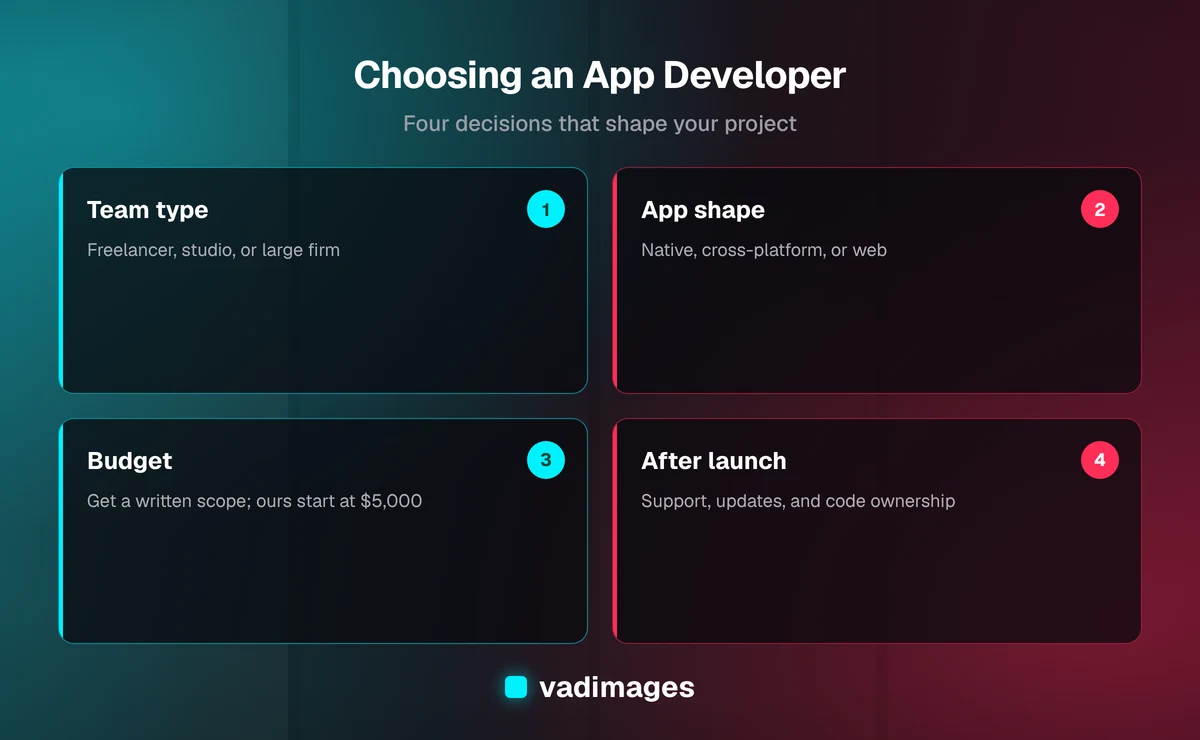
The Portland metro area is one economy that happens to be split by a river and a state line. Businesses in Vancouver, Camas, Battle Ground, Beaverton, Hillsboro, Gresham and inner Portland share customers, employees, and suppliers. Developers here tend to fall into a few groups, and knowing which group you are talking to makes the whole search easier.
- Freelancers. Often skilled and affordable. The risk is capacity: one person is the designer, developer, tester, and support desk. If they get sick or take a full-time job, your app can stall.
- Small studios and agencies. A team of designers, engineers, and a project lead. This is usually the best fit for small and mid-sized businesses that want a finished product and someone accountable for it.
- Large consultancies. Strong process and deep benches, but built for enterprise budgets and timelines. A small business can get lost in the queue.
- Offshore or marketplace teams. Lowest sticker price. The trade-offs are time zones, communication gaps, and code quality that is hard to judge until it is too late.
There is no universally right answer. The right group depends on your budget, your timeline, and how much of the project management you want to carry yourself. For most local businesses we talk to, a small studio that works in your time zone and answers the phone is the sweet spot.
Why working with a local team still matters
Software can be built from anywhere, so why does location matter? Not for the code itself. It matters for everything around the code.
- Context. A developer who understands how a Pacific Northwest contractor, clinic, brewery, or nonprofit actually operates asks better questions in week one.
- Same time zone. A quick call at 10 a.m. beats an email thread that takes three days to resolve.
- Face to face when it counts. Workshops to map out a workflow on a whiteboard are faster in person. We are happy to meet in Vancouver or Portland for kickoffs.
- Accountability. A studio with a real address and local references has a reputation to protect in a fairly small business community.
Local is not automatically better, and a great remote team beats a mediocre local one. But if two options are otherwise equal, proximity is a real tiebreaker.
Native, cross-platform, or web app: choose the right shape first
Before you compare developers, decide what kind of app you actually need. This one choice drives most of the cost and timeline, and many businesses are sold the more expensive option without being asked what they need.
- Native apps (built separately for iPhone and Android) give the best performance and full access to device features. They cost the most because you are effectively building twice. Choose native when you need heavy camera, sensor, or offline capabilities, or a highly polished consumer experience.
- Cross-platform apps (one codebase that runs on both iPhone and Android) cover the needs of most business apps at a lower cost. This is a common choice for customer portals, booking tools, and field-service apps.
- Web apps and progressive web apps run in the browser, install to the home screen, and avoid app store review. If your users are mostly at a desk, or you want to launch fast and learn, a web app is often the smartest first step.
A useful rule: start with the smallest version that proves the idea works. If a web app can validate that customers will use it, you can invest in a native version later with real evidence behind the decision. Our custom software work often begins this way, with a focused first release rather than a giant spec.
What an app project realistically costs
Pricing in this industry is famously opaque, so here is how we think about it. At Vadimages, projects start at $5,000 and up, and the final number depends on scope. We publish that starting point because we would rather you know it before a call than after. You can see how we frame pricing on our pricing page.
Whoever you hire, these are the factors that move the number:
- Number of user types. An app with one kind of user is simpler than one with customers, staff, and administrators, each with different screens and permissions.
- Integrations. Connecting to payments, accounting, scheduling, a CRM, or an existing database adds work. Each integration has its own quirks.
- Custom design. A clean, standard interface costs less than a bespoke brand-heavy experience with custom animation.
- Data migration. Moving years of records out of old spreadsheets or a legacy system is real work that is often underestimated.
- Compliance. Health, financial, or children's data brings extra requirements for security and documentation.
- Ongoing costs. Hosting, app store fees, third-party services, and maintenance continue after launch. Ask for these up front.
Be wary of two extremes. A quote that is dramatically lower than every other bid usually means a narrower scope than you think or corners cut somewhere you cannot see. A quote with no breakdown at all makes it impossible to compare options. Ask every developer for a written scope that lists what is included and what is not.
Questions to ask every app developer you interview
You do not need to be technical to run a good interview. These questions work because they reveal how a team thinks and behaves, not just what they claim.
- Who will actually work on my project? Meet the people, not only the salesperson.
- Can you show me similar work and let me talk to those clients? Any reputable team will say yes. Our case studies are a starting point for the kind of detail you should expect.
- How do you handle changes in scope? Every project changes. You want a clear process, not a surprise invoice.
- Who owns the code and the accounts? The answer should be you. Insist on owning the source code, the app store accounts, and the hosting.
- What happens after launch? Ask about bug fixes, updates for new phone operating systems, and monthly support options.
- How will I see progress? Look for regular demos of working software, not just status reports.
- What could go wrong with this project? A candid answer about risks is a good sign. A team that promises no problems has not done this much.
Red flags worth taking seriously
- Pressure to sign quickly or a "discount that expires Friday."
- Reluctance to put the scope, timeline, and price in writing.
- No working demos until the very end of the project.
- Vague answers on who owns the code, or contracts that lock you in.
- A portfolio of screenshots with no live products or reference clients.
- Guaranteed results such as rankings, downloads, or revenue. Nobody can promise those honestly.
If you want a deeper walkthrough, we wrote about how to evaluate a team's past work in our guide to vetting a development agency's portfolio. The same habits apply here: look at real, shipped products, and talk to the people who paid for them.
Industries where a custom app pays off
Not every business needs an app. But a handful of situations come up again and again around Portland and Vancouver, and they are worth recognizing. See our industries page for more, but here are common patterns.
- Field services and construction. Crews need job details, photos, time tracking, and sign-offs on a phone, often with weak signal on a job site. An app with offline support replaces paper forms and end-of-week data entry.
- Healthcare and wellness. Scheduling, intake forms, and secure messaging. These need careful handling of private information.
- Food, beverage, and retail. Ordering, loyalty, and inventory tools that tie into your point-of-sale system.
- Logistics and distribution. Portland's position as a port and freight hub means many businesses juggle drivers, dispatch, and tracking.
- Professional services. Client portals for documents, approvals, and billing that cut down on email back-and-forth.
- Nonprofits and membership groups. Event sign-up, volunteer coordination, and donor communication in one place.
In each case, the strongest projects start from a specific operational pain, such as "we retype every work order twice," rather than from a general wish to have an app. When the problem is clear, the scope stays tight and the budget stays reasonable.
How a well-run app project unfolds
Whichever team you hire, a healthy project follows a recognizable rhythm. Here is the shape we use, and you can hold any developer to a similar standard. More detail is on our how we work page.
- Discovery. A short phase of conversations and workflow mapping to define who uses the app, what they need to do, and what success looks like. You should leave with a written scope.
- Design. Clickable mockups you can react to before any code is written. Changing a drawing is cheap; changing finished software is not.
- Build in small releases. Working software shown every week or two, so problems surface early.
- Testing. On real devices, with real users from your team, not only automated checks.
- Launch. Including app store submission if relevant, training for your staff, and a plan for the first few weeks.
- Support and improvement. Software is never finished. Plan for updates, fixes, and the next round of features based on what you learn.
Your first step: write a one-page brief
You can make your search dramatically more productive before you contact anyone. Write a single page that answers these points: what problem you are solving, who will use the app, the three most important things it must do, what systems it needs to connect with, your target launch window, and your budget range. Developers respond to clear briefs with clearer, more comparable proposals.
Then talk to two or three teams, compare their written scopes side by side, and pay attention to who asked the best questions. The team that pushed back thoughtfully on your assumptions is often a better bet than the one that agreed with everything.
Bottom line
The best app developer in Portland for you is the one who understands your business problem, is honest about cost and trade-offs, shows you working software early, and hands you full ownership of what you paid for. Start small, insist on clarity in writing, and choose a partner you would be comfortable calling when something breaks at 8 a.m. on a Monday.
If you are weighing options and want a straight conversation, we are glad to help, even if the answer is that you do not need a custom app yet. Explore our solutions, then contact Vadimages for a free, no-pressure chat about your project. Projects start at $5,000.