

Why scope creep happens (and why it is rarely anyone's fault)
Scope creep is the slow growth of a software project beyond what was agreed at the start. Nobody sets out to cause it. A new idea shows up in a meeting, a staff member mentions a missing feature, a competitor launches something shiny. Each request sounds small, and each one gets a quick "sure, can we add that?" Ten small yeses later, the budget and the calendar have both moved.
The root cause is almost always the same: the original scope was a list of features instead of a shared understanding of the outcome. When the goal is fuzzy, every new idea looks like it might belong. When the goal is sharp, most new ideas can be judged in a minute. This guide walks through how we think about software project scope at Vadimages, so a custom build stays on budget and on time.
Start with the outcome, not the feature list
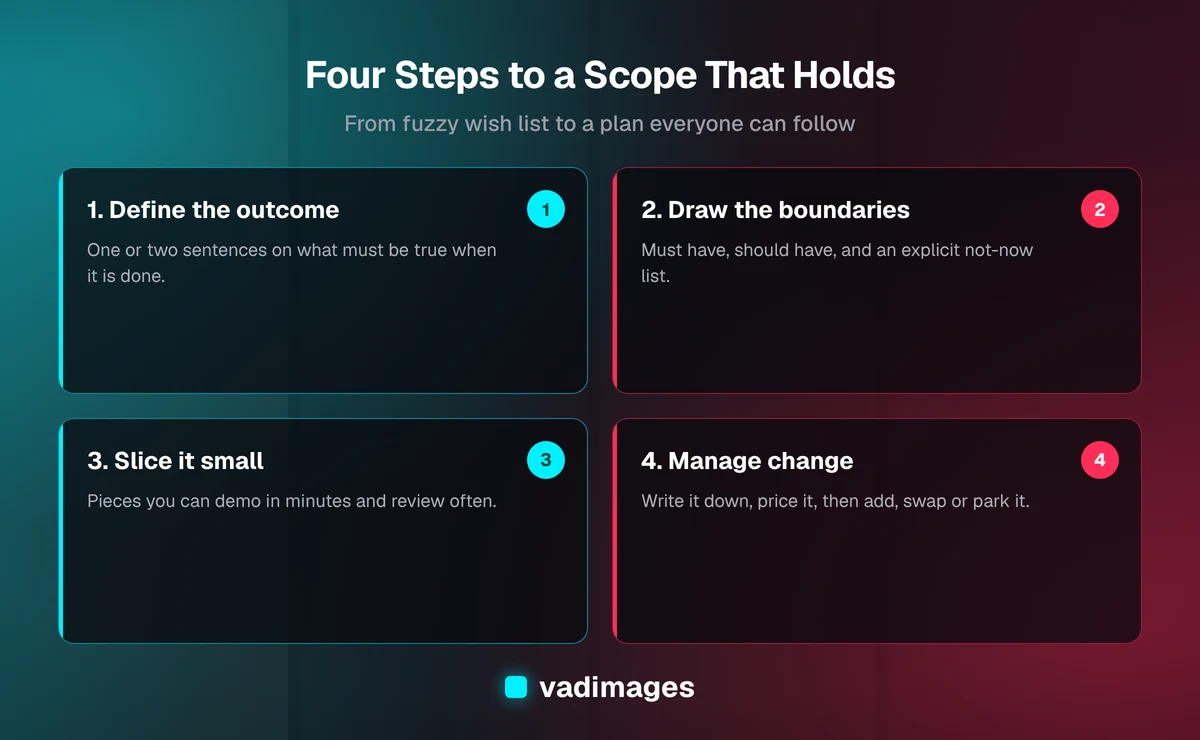
Before anyone sketches a screen, write one or two sentences that describe what must be true when the project is done. Good examples are plain and checkable: "Dispatchers can assign a job in under a minute without calling the office," or "Customers can book and pay online without anyone re-typing the order."
A feature list tells a developer what to build. An outcome tells everyone why. That "why" is the tool you use later when a new request arrives: does it move us toward the outcome, or is it a nice-to-have wearing a disguise?
- Who is the main user, and what do they do today instead?
- What is the one job the software must do well?
- How will we know it worked? Pick a signal you can observe, such as hours saved per week or fewer manual hand-offs.
- What happens if we do nothing? This keeps the project honest about its value.
Write down what is in, what is out, and what is later
Most scope documents list only what is included. The most useful part is the opposite: an explicit out of scope list. If you expect a mobile app but the first release is web only, say so in writing. If integrations with your accounting package are wanted but not essential, put them in a clearly labelled "later" column.
We like a simple three-bucket approach:
- Must have (release one): without these, the outcome is not achieved.
- Should have (next): valuable, but the product works without them.
- Not now: good ideas that are parked on purpose, not forgotten.
The "not now" bucket matters more than it looks. It gives people a place to put ideas so they feel heard. Nothing kills scope discipline faster than a stakeholder who feels their suggestion went into a black hole.
Break the work into small, reviewable pieces
Large vague deliverables are where creep hides. "Customer portal" can mean three screens or thirty. Break it into pieces small enough that everyone can picture them: log in, view open invoices, pay an invoice, download a receipt. Each piece should have a short description of what the user can do and what "finished" looks like.
Smaller pieces also make progress visible. When you can see a working slice every couple of weeks, disagreements surface early, while they are cheap to fix, instead of at the end when everything is built and expensive to change. Our approach to working together is built around exactly this rhythm.
Decide how changes will be handled before the first change arrives
Change is not the enemy. Software projects teach you things, and good teams adapt. The problem is unmanaged change, where requests slip in through hallway conversations and nobody tracks the effect. Agree on a simple change process at kickoff:
- Every new request is written down in one or two sentences.
- Someone estimates the effect on cost and timeline, in plain numbers.
- The person who owns the budget decides: add it, swap it for something of similar size, or move it to "later."
- The decision is recorded so the scope document stays current.
The "swap" option is the secret weapon. Instead of saying no, you say: "Yes, we can add that, and here is what it replaces or how much it adds." Trade-offs become visible, and decisions get made on purpose.
Name one decision-maker
Projects with five people who can each approve changes tend to collect five wish lists. Pick one person on your side who can say yes or no, and make sure the team knows who it is. They do not need to know every detail. They need the authority to decide and the context to weigh trade-offs against the outcome you wrote down at the start.
If several departments are affected, gather their input early, in one structured conversation, and then let the decision-maker settle conflicts. Gathering input once, up front, is far cheaper than discovering a missing requirement midway through the build.
Plan for the unknowns honestly
Some parts of a project are genuinely uncertain: a third-party system with poor documentation, a legacy database nobody has opened in years, a workflow that differs from branch to branch. Pretending these are known leads to surprise invoices later.
A better approach is to name the unknowns in the scope, investigate them first with a short discovery phase, and only then commit to firm numbers for the rest. A few days of discovery up front often prevents weeks of rework. If a part of the build depends on something you cannot see yet, we would rather say so than hide it inside a confident estimate.
Keep the budget visible
Money is the clearest boundary a project has. We publish our starting point openly: custom software projects at Vadimages start at $5,000+, and the final figure depends on the outcome you need and the pieces required to reach it. You can see how we think about this on our pricing page.
Whatever the figure, tie it to the scope buckets above. When everyone can see that the must-haves fit the budget and the should-haves are a clearly priced next step, requests stop being arguments and become choices.
Common scope traps to watch for
Even well-run projects fall into a few predictable traps. Knowing them by name makes them easier to spot in a meeting.
- The "while you're in there" request: a small addition attached to work already underway. It feels free because the developer is already in that part of the system, but it still needs design, testing, and review.
- The vague word: terms like "dashboard," "reporting," or "user management" mean very different things to different people. Ask for an example of one real screen or one real report.
- The silent assumption: something one side thinks is obviously included, such as data migration, training, or email notifications, but never appeared in writing.
- The late stakeholder: a person who was not part of early conversations and arrives near launch with a different picture of the product.
The fix for all four is the same: write things down in plain language, review them together, and ask "what would you expect to see on screen?" until the answer is concrete.
How to review scope as the project moves
A scope document is a living agreement, not a stone tablet. Set a short, regular check-in, even fifteen minutes, where the team looks at what was finished, what is next, and whether anything on the not-now list has earned a promotion. Keep the conversation anchored to the outcome statement from the start of the project.
At each check-in, ask three questions. Are we still solving the problem we set out to solve? Has anything we learned changed what matters most? Is the remaining budget still enough for the remaining must-haves? Honest answers to these three questions catch drift while it is still small, and they keep trust high on both sides because nobody is surprised by an invoice or a deadline.
A short checklist you can use today
- Can you state the outcome in one or two sentences a new employee would understand?
- Is there a written out-of-scope list, not just an in-scope list?
- Are features split into must, should, and not-now?
- Is each deliverable small enough to be demonstrated in a couple of minutes?
- Is there a named decision-maker and a simple process for change requests?
- Are the known unknowns identified, with a plan to investigate them first?
- Can you see how the budget maps to the release-one scope?
If you can answer yes to most of these, you are in better shape than many projects we are asked to rescue. If several answers are "not yet," that is useful information too, and it is the right time to fix them, before a single line of code is written.
What good scoping looks like in practice
Picture a small distribution company that wants to replace a tangle of spreadsheets and email threads with one internal tool for orders. The first instinct is to list every report, dashboard, and integration anyone has ever wished for. A better first conversation asks: what is the single most painful hand-off today? Say it is re-typing customer orders into the invoicing system. The outcome becomes "orders enter once and flow through to invoicing without re-typing." Everything else goes into the should-have and not-now buckets, and release one is small enough to ship and learn from. This is an illustrative example, not a specific client, but the pattern is one we see in many industries.
Once the first release is live, real usage tells you what to build next far better than any meeting could. The parked ideas get re-ranked against evidence, and the next release is scoped the same way. That is how a project grows deliberately instead of by accident. You can browse the kinds of solutions we build and our custom software services to see how this plays out across different business needs, and read our case studies for more detail.
The takeaway
Scope creep is not a developer problem or a client problem. It is a clarity problem, and clarity can be built on purpose. Define the outcome, write down what is out, slice the work small, agree how changes are handled, name one decision-maker, and keep the budget in view. Do those six things and most projects stay on course.
If you are planning a custom software project and want a scope you can trust, we are happy to talk it through in plain English, with no jargon and no pressure. Contact Vadimages to book a conversation about your project.