
Software-as-a-service has been the default way to buy business software for a long time. Heading into 2027, the model is not going away, but the ground under it is shifting. Buyers are tired of stacking subscriptions, AI features are showing up in every product, and custom software has become far more affordable to build than it was a few years ago. This is our read on where SaaS stands, what is changing, and what it means if you run a small or mid-sized business in the US. It is our perspective from building software for clients, not a market study, so you will not find invented statistics here.
Where SaaS stands going into 2027
SaaS won because it solved real problems. You did not need a server room, an IT team, or a big upfront check. You signed up, entered a card, and started working. For most businesses, that trade is still a good one, and nobody serious is arguing that you should build your own email, payroll, or accounting system.
But the bargain has quietly changed. The monthly price that looked small for one tool becomes a meaningful line item when you have fifteen of them. Each tool wants more seats, more tiers, and more add-ons. Data ends up scattered across products that do not talk to each other, and your team spends hours copying information from one screen to another. The question for 2027 is no longer "should we use SaaS?" It is "which parts of our business deserve a subscription, and which parts deserve something built for us?"
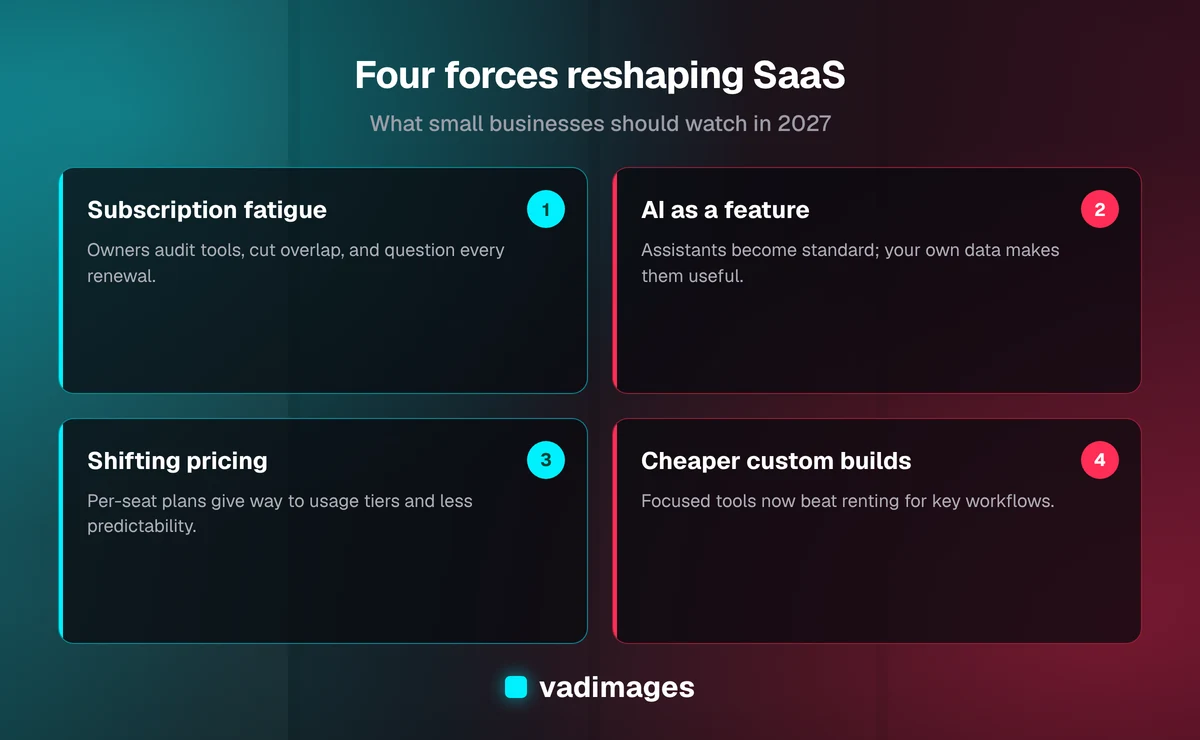
Trend 1: Subscription fatigue is turning into subscription audits
Many owners we talk to can name the tools they love and the tools they forgot they were paying for. Finance teams and operators are increasingly doing a plain-English review: what does each tool cost per year, who actually uses it, and what would break if we cancelled it?
That audit tends to sort software into three buckets:
- Commodity tools such as email, calendar, accounting, and file storage. Keep buying these. They are mature, cheap relative to their value, and not a source of competitive advantage.
- Overlapping tools where two or three products do roughly the same job. Consolidate these first.
- Workflow tools you have bent your process around. These are the ones worth a hard look, because the workaround cost is often higher than the subscription price.
If you are weighing that third bucket, our overview of custom software development explains what a replacement actually involves, and our pricing page shows what it costs, with projects starting at $5,000+.
Trend 2: AI is becoming a feature, not a product
Two years ago, adding "AI" to a product name was a marketing strategy. Going into 2027, AI assistance is simply expected inside the tools you already use: drafting text, summarizing records, suggesting next steps, answering questions about your data. That changes the competitive picture for SaaS vendors. When every product has a similar assistant, the assistant stops being the differentiator. What matters is whether it has access to good data and fits your actual workflow.
This is where general-purpose SaaS has a structural limit. A vendor's AI feature is trained to be useful to every customer, which means it is tuned for nobody in particular. An assistant built into your own system, with access to your own customers, jobs, and history, can answer questions the vendor's version never could. We expect more small businesses to ask for narrow, practical AI features inside their own software rather than another standalone AI subscription.
Trend 3: Pricing is moving away from simple per-seat plans
Per-seat pricing made sense when software was something a person sat down and used. As products automate more of the work, vendors are experimenting with usage-based pricing, credits, and tiered bundles. For a buyer, the practical effect is less predictability. A tool that costs one amount this year may be priced on a different basis next year, and the renewal conversation can feel like a negotiation you did not know you were entering.
Our advice is simple. Read the renewal terms before you sign, ask what happens to your price if your team or data grows, and find out how you export your data if you leave. Predictable costs are a feature. If a vendor cannot tell you what you will pay in year three, factor that uncertainty into the decision.
Trend 4: Integration is the real cost center
The sticker price of a SaaS tool is rarely the whole cost. The hidden cost is the glue: manual exports, spreadsheets that reconcile two systems, and a person whose real job is keeping data in sync. Integration platforms and built-in connectors help, but each connection is another thing that can break when a vendor changes an API or a plan.
In 2027 we expect the businesses that run smoothly to be the ones that treat integration as a first-class concern. That might mean choosing fewer tools that work well together, or building a thin layer of custom software that sits between your core systems and keeps them honest. It is often a smaller project than owners assume, and it removes a lot of daily friction.
Trend 5: Custom software is cheaper and faster to build than it used to be
Modern frameworks, managed hosting, and AI-assisted development have lowered the cost of building focused business software. A small internal tool that once needed a long project can now be scoped, built, and shipped on a much tighter timeline. That does not make custom software free, and it does not make every project a good idea. It does mean the break-even point has moved: more businesses now have a workflow where building beats renting.
The sweet spot is a tool that does one important job very well, fits how your team already works, and replaces a patchwork of subscriptions and spreadsheets. Think of a scheduling and dispatch system for a service company, a client portal for a professional practice, or an intake-to-invoice workflow for a contractor. You can see how this plays out across sectors on our industries page, and browse the kinds of systems we build under solutions.
Buy, build, or blend: a practical way to decide
The honest answer for most businesses in 2027 is a blend. Buy the commodity layer, build the parts that make you different, and connect them cleanly. Here is a short set of questions we use when helping a client decide:
- Does this process give us an edge, or is it the same as every competitor's? Edge points toward building; sameness points toward buying.
- How many workarounds has our team invented around the current tool? Many workarounds are a signal the tool does not fit.
- What does the current tool cost per year, including the staff time spent compensating for it?
- Can we get our data out cleanly if we leave? If not, the real price is higher than the invoice.
- Is the workflow stable enough to write down? Software built around a process nobody can describe tends to disappoint.
If most of your answers point toward fit problems and hidden costs, a custom build deserves a serious quote. If they point toward a commodity need, buy the off-the-shelf product and move on. Neither choice is a failure, and we would rather tell you to subscribe to something than sell you a project you do not need.
What SaaS vendors will have to get right
It is worth being fair to the other side. SaaS vendors are not standing still, and the good ones will adapt. We expect the strongest products to compete on a few things:
- Openness. Clear APIs, easy data export, and honest integrations rather than lock-in.
- Predictable pricing. Plans a small business can budget for without reading a rate card twice.
- Depth in a niche. Vertical products built for one kind of business will keep beating horizontal tools that try to serve everyone.
- Useful AI. Assistants that work on your actual records instead of generic suggestions.
Buyers who reward those behaviors will get better software over time. Buyers who ignore them will keep paying for friction.
The search and discovery angle
One more shift deserves a mention, because it affects how businesses are found, not just how they run. Buyers increasingly ask AI assistants and answer engines for recommendations before they ever open a search results page. For software companies and service providers alike, that raises the value of clear, well-structured, factual content that those systems can quote. Plain-English explanations, transparent pricing, and consistent information across your site are no longer nice extras. They are part of how you get recommended. If you are a vendor, or a business that sells through its website, this is worth treating as a core part of your strategy rather than an afterthought.
What we would do if we ran a small business in 2027
If we were in your seat, here is the order of operations we would follow:
- List every software subscription, what it costs per year, and who uses it.
- Cancel or consolidate anything that overlaps or sits unused.
- Mark the two or three tools your team complains about most or works around daily.
- For each of those, estimate the real annual cost, including staff time spent on workarounds.
- Get a quote for a focused replacement for the single most painful one, and compare it with the multi-year cost of staying put.
You do not need to rebuild your whole stack. You need to find the one or two places where renting software is costing more than owning it would, and fix those. Our how we work page lays out how a project like that runs, from first conversation to launch, so you know what to expect before you commit.
The bottom line
SaaS in 2027 is still the right answer for most of the software you use, and it remains a smart way to start. What is changing is the assumption that it is the only answer. Subscription fatigue, AI becoming a standard feature, shifting pricing models, and cheaper custom development are pushing smart businesses toward a blend: buy the commodity, build the differentiator, and integrate the two cleanly.
If you are not sure which side of that line your business falls on, we are happy to talk it through. We are a Vancouver, WA team that works with US small and mid-sized businesses, we quote in plain English, and projects start at $5,000+. Contact us and tell us which tool is giving you the most trouble. We will tell you honestly whether to keep it, replace it, or build around it.