
A portfolio is a marketing document. Read it like one.
Every agency portfolio looks good. That is the point of a portfolio: it is the best work, photographed from the best angle, with the awkward parts cropped out. If you are a business owner choosing who will build your website, web app or internal system, the portfolio is rarely a lie. But it is also rarely the whole truth.
This guide is for non-technical buyers. You do not need to read code or understand frameworks to vet a software agency portfolio well. You need to ask better questions than "do you like the design?" Below is a practical process we would want a client to run on us, and we say that plainly because we are a development agency in Vancouver, WA, and we would rather you hire the right team than the loudest one.
Start with what the portfolio is supposed to prove
Before you look at a single screenshot, write down what you need the agency to be good at. A portfolio can only prove relevance and capability, so define both:
- Relevance: have they built something like what you need (a booking system, a customer portal, an online store, an internal dashboard), or only brochure sites?
- Capability: can they handle the hard parts of your project, such as integrations, user accounts, payments, reporting or data migration?
- Staying power: do the projects still exist, still work and still look maintained a year or two later?
Most buyers skip this and judge on visual taste alone. Visual taste matters, but it is the easiest thing to fake and the least predictive of whether your project will ship on time and keep working.
Step 1: Check that the work is real and still live
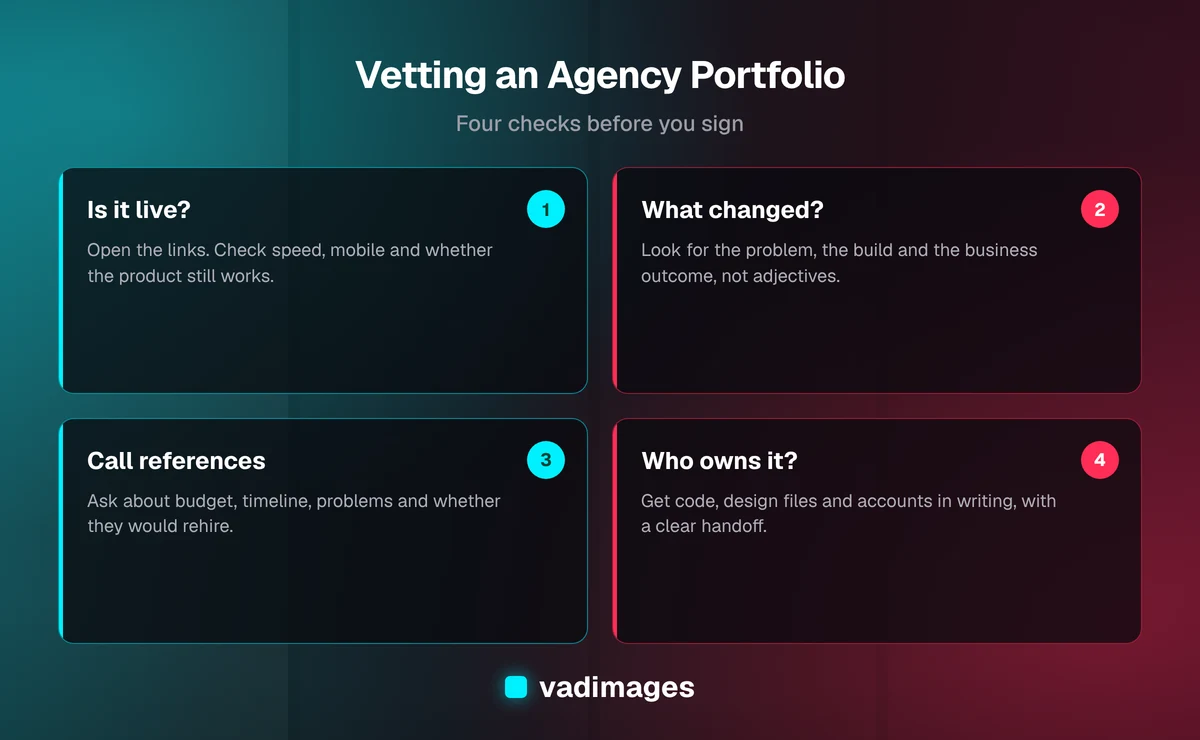
The cheapest test is also the most revealing. Open the live links.
- Do the sites load quickly and work on your phone, not just in a polished mockup?
- Are there broken pages, missing images or an expired certificate warning?
- Does the product still exist? A portfolio full of defunct projects is a signal worth understanding, even if the reason is innocent.
- Is the agency credited on the site, or is it a design concept that never launched?
Mockups and concept work are not dishonest by themselves, but they should be labeled as such. If you cannot tell which pieces are shipped products and which are speculative designs, ask. A good agency answers that question without hesitation.
Step 2: Separate design work from engineering work
Many agencies show beautiful screens. Fewer show you what is behind them. A marketing site and a system that processes orders, schedules technicians or syncs inventory are completely different kinds of work, even if both appear as a pretty homepage in a portfolio.
For each project you care about, ask:
- What was built on the back end, beyond the pages visitors see?
- Which outside systems did it connect to (payments, accounting, CRM, shipping, scheduling)?
- What did the client's team do differently after launch because of it?
- Who on the agency's team actually built it, and are they still there?
If the answers stay at the level of "we designed a modern, clean experience," you are looking at design work. That may be exactly what you need. Just make sure it is not being sold to you as engineering. If you need the latter, look at agencies that show real custom software work and can explain it simply.
Step 3: Look for outcomes, not adjectives
Portfolio copy is full of words like stunning, seamless and innovative. None of them is checkable. What you want instead is a plain description of the problem, what was built and what changed for the client.
Good portfolio entries tend to answer four things: who the client is, what was broken or missing, what the agency delivered, and how the business works differently now. Numbers are welcome, but treat any number with care. Ask where it came from, who measured it and over what period. A claim like "tripled conversions" with no baseline, no timeframe and no source is decoration, not evidence.
The reverse also matters. An honest entry sometimes says what did not go to plan, what was cut to hit a budget, or what was handled in a later phase. That kind of candor is a good sign. Perfection in every case study should make you a little suspicious.
Step 4: Ask for references, and ask them the right questions
A portfolio shows the result. A reference tells you what it was like to get there. Ask for two or three past clients you can speak to, ideally with projects similar in size and complexity to yours. If an agency has been working for years and cannot produce a single reference, that is information.
When you get on the call, skip "were you happy?" because everyone says yes. Try these instead:
- Did the project finish on the timeline and budget that was originally agreed? If not, why, and how was it handled?
- What happened when something went wrong, and how quickly did the agency respond?
- How clear was the communication? Did you always know what was happening and what it would cost?
- Who owned the code and the accounts at the end? Could you have moved to another provider?
- Would you hire them again for something bigger?
Listen for specifics. A happy client usually has a story. A lukewarm one gives you generalities.
Step 5: Understand who owns what
This is the part of vetting that almost nobody does, and it causes more regret than any visual flaw. Ask every agency in plain terms:
- Will you own the source code, the design files and the hosting and domain accounts when the project is done?
- Is anything built on a proprietary platform that only the agency can maintain?
- What does it take to hand the project to another team?
- What are the ongoing costs after launch, and are they written down?
Portfolios do not show this at all, which is exactly why you must ask. A beautiful site you cannot move is a lease, not an asset. We wrote more about this tradeoff in our piece on total cost of ownership; the short version is that the cheapest build is often not the cheapest thing to live with.
Step 6: Match the team shown to the team you will get
Some agencies show work from senior people and then staff your project with whoever is available. That is not always bad, but you should know it. Ask who will lead your project, who will write the code, and whether those people worked on the portfolio pieces you liked.
Also ask how the agency works day to day. Do you get a single point of contact? Regular demos of working software, or a long silence followed by a big reveal? A clear, repeatable process matters more than a clever pitch. You can see how we run projects on our how we work page, and it is a useful yardstick for comparing anyone else.
Red flags worth taking seriously
None of these alone disqualifies an agency, but several together should slow you down:
- Every project looks identical underneath, with only the colors changed.
- No client names, no links and no explanation for why, beyond a vague "NDA" for everything.
- Case studies with no description of the problem, only screenshots.
- Reluctance to provide references or to let you talk to anyone who has worked with them.
- A price that is far below everyone else's with no explanation of what is being left out.
- Pressure to sign quickly, or a proposal that cannot be traced back to your actual requirements.
- No clear answer on who owns the code and accounts.
Confidentiality is a genuine reason for some work to be unnamed, and plenty of good agencies work under NDAs. The test is whether they can still describe the situation and the outcome in useful detail, and whether they can offer at least some work you can inspect directly.
Green flags that are easy to overlook
- They ask hard questions about your business before they talk about technology.
- They tell you what they would not build, or what you should postpone.
- They put a price range and a timeline in writing, with assumptions listed.
- They show you older projects that are still running and well maintained.
- They are comfortable with you speaking to past clients.
- They explain trade-offs in plain English, without hiding behind jargon.
Transparent pricing is a particularly useful signal. Agencies that publish how projects are priced tend to scope more honestly, because they have nothing to hide at the proposal stage. Ours is on the pricing page: projects start at $5,000 and go up with scope, and we explain what drives the number.
A simple scorecard you can use this week
Pick your top three agencies and score each one from 1 to 5 on the following. Do this on paper, before the sales calls, so charm does not do the scoring for you.
- Relevance: have they built something genuinely similar to your project?
- Proof: are the projects live, working and described in terms of real outcomes?
- Depth: can they explain the engineering, not just the design?
- References: did past clients confirm the story with specifics?
- Ownership: are the terms around code, accounts and handoff clear and fair?
- Communication: were their answers direct, and did they respond promptly?
- Pricing clarity: do you understand what you are paying for and why?
An agency that scores well on relevance and ownership but is average on visual polish is usually a better bet than one that dazzles on design and is vague about everything else. You can improve a design in a revision round. You cannot easily fix a team that cannot deliver or a contract that traps you.
What to do if the portfolio is thin
A newer agency, or one that does mostly private work, may not have a rich public portfolio. That is not automatically a problem. In that case, ask for a small paid discovery or planning engagement before committing to the full build. A short, paid first phase lets you see how the team thinks, communicates and handles surprises, with a limited amount of money at risk. It is a much better test than any screenshot.
You can also ask for a walkthrough of a relevant project over a screen share. Watching someone navigate a real system, explain why a decision was made and show you what happens when something goes wrong tells you more in twenty minutes than a page of marketing copy.
How we would answer these questions
Since we are asking you to hold agencies to a high standard, it is only fair to say how we think about it. You can browse examples on our case studies page and see the kinds of problems we solve across different industries and solutions. Ask us the same questions in this guide: who built it, what is behind it, what changed for the client, who owns it, and what it costs to keep running. If an answer is not good enough, we would rather you know that before you sign.
The short version
Vetting a portfolio comes down to a few habits: click the live links, separate design from engineering, look for outcomes rather than adjectives, talk to real references, get ownership in writing and match the team you meet to the team you get. None of it requires technical knowledge. It requires patience and a willingness to ask direct questions.
If you are weighing agencies for a project and want a second set of eyes on a proposal or a shortlist, we are happy to take a look, with no pressure to hire us. Contact us and tell us what you are planning, and we will give you an honest view of what it should involve and what it should cost.