
Financial software is different from almost every other kind of business software. When a scheduling tool fails, people get annoyed. When a payments, lending, or money-movement product fails, people lose money, regulators ask questions, and trust, which took years to earn, disappears in an afternoon. If you are planning fintech software development, the most important decision you make is not which framework to use. It is whether compliance and trust are designed into the product from day one or bolted on after launch.
This guide is written for founders, operators, and finance leaders at small and mid-sized companies in the US who are considering a custom financial product or an internal money-handling system. It is plain-English and outcome-driven. It is not legal advice. Regulations change and depend on your exact business model, so you should always confirm requirements with a qualified attorney or compliance advisor before you build.
Why “we’ll add compliance later” is the most expensive plan
Many teams treat compliance as a checklist that happens just before launch. In fintech, that approach tends to backfire for a simple reason: compliance requirements shape the data model, the permissions model, and the way every feature behaves. You cannot easily retrofit an audit trail onto a database that never recorded who changed what. You cannot easily add data-retention rules to a system that scattered customer records across a dozen tables and three third-party tools.
Rebuilding foundations after launch means paying twice: once to build the product and again to rebuild it. Designing with compliance in mind from the first sprint costs far less than it seems, because the early decisions are mostly about structure rather than extra features.
What “compliance and trust by design” actually means
It means a handful of principles are treated as product requirements, not afterthoughts:
- Minimize what you hold. Every piece of sensitive data you store is a liability. If a payment processor or identity provider can hold it for you, let them.
- Record everything that matters. Every action that moves money or changes a customer’s status leaves a permanent, tamper-resistant record.
- Limit who can do what. Staff, partners, and systems get only the access their role requires.
- Make the safe path the easy path. Good design prevents mistakes before they happen.
- Be able to explain yourself. When an auditor, a partner bank, or a customer asks “what happened here?”, you can answer quickly and with evidence.
Know which rules apply to you
“Fintech” covers a wide range of products, and the rules differ sharply between them. A few examples of frameworks that commonly come up in the US, depending on what you build:
- PCI DSS applies when you store, process, or transmit payment card data. Most small companies reduce their exposure by using a hosted payment page or tokenization from a processor so raw card numbers never touch their own servers.
- KYC and AML obligations (know your customer and anti-money-laundering) can apply to businesses that move or hold money for others, often through a bank or licensed partner.
- Money-transmission rules vary by state and depend heavily on whether you actually hold customer funds or simply orchestrate payments through a licensed provider.
- Consumer lending and disclosure rules apply if your product extends credit or displays rates and terms to consumers.
- Privacy and security expectations, including state privacy laws and the safeguards expected of financial institutions, apply to how you collect, store, and share customer data.
- SOC 2 is not a law, but business customers and partner banks frequently ask for it as proof of mature security practices.
The key point: many of the heaviest obligations depend on your business model and your partners, not just your code. A conversation with a compliance advisor before you design the product can shrink your regulatory footprint dramatically. For example, building on top of a licensed banking or payments partner often changes which responsibilities sit with you versus with them.
Design principle one: separate the sensitive from the everything else
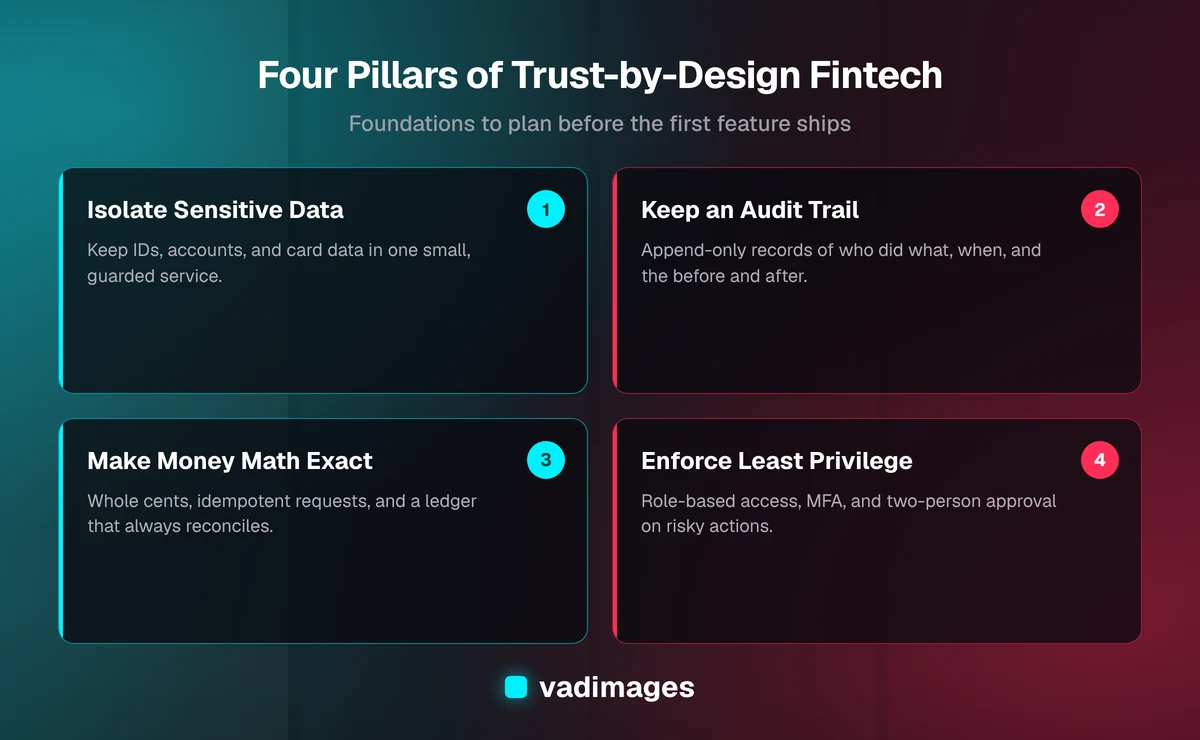
One of the most effective architectural choices is isolating sensitive data and functions into a small, well-guarded part of the system. Customer identity documents, bank account details, and payment credentials live in a narrow service with strict access rules, while the rest of your application works with harmless references to them.
This approach pays off in several ways. Your security reviews focus on a smaller surface. A bug in the marketing pages or the help center cannot expose account numbers. And if you ever pursue an audit, you can show the boundary clearly rather than defending an entire sprawling codebase.
Design principle two: an audit trail you can trust
An audit trail is a running record of who did what, when, and why. In fintech it is not optional polish. It is how you investigate a disputed transaction, answer a partner bank’s review, and prove that your own team did not make an unauthorized change.
A trustworthy audit trail has a few properties:
- It is written automatically by the system, not typed in by people.
- Entries are append-only. Corrections are new entries that reference the old ones, never edits or deletions.
- Each entry captures the actor, the action, the time, and the before-and-after state of what changed.
- Access to the trail itself is restricted and logged.
Building this in from the beginning is routine work. Adding it to a finished system, where changes are scattered across code paths nobody fully remembers, is slow and error-prone.
Design principle three: money math must be boring and exact
Financial calculations have no room for “close enough.” A few habits prevent the classic problems:
- Store amounts as whole minor units (cents) or with exact decimal types, never as floating-point numbers.
- Make money-moving operations idempotent, so a retried request after a network hiccup never charges or pays twice.
- Use a double-entry ledger when you hold balances, so every movement has an equal and opposite entry and totals always reconcile.
- Reconcile your records against your bank or processor statements on a schedule, and surface mismatches automatically.
These are unglamorous details, and they are exactly the details that separate a product people trust with their money from one they do not.
Design principle four: least privilege for people and systems
Most serious incidents in financial products involve access that was broader than it needed to be: a support agent who could see everything, an API key with full permissions, a shared admin login. Role-based access, separate credentials per system, and approval steps for high-risk actions reduce that exposure.
Consider requiring two people for sensitive operations such as changing payout details, issuing large refunds, or altering customer limits. The extra step costs seconds and prevents both honest mistakes and fraud. Combine it with strong authentication, including multi-factor sign-in for every staff account that touches customer data or money.
Design principle five: protect data in transit, at rest, and in your logs
Encryption is table stakes: encrypted connections everywhere, and encryption for sensitive data at rest with keys managed separately from the data. The subtler failure is leaking sensitive values into places nobody thinks about, like application logs, error reports, analytics tools, or support screenshots. Mask or exclude sensitive fields by default so they never reach those systems at all.
Also plan for the full data lifecycle. Know how long you must keep records, when you must delete them, and how you will actually do both. Retention and deletion rules are far easier to honor when the data model anticipated them.
Trust is also what the customer sees
Compliance protects you. Trust is what makes customers choose you. The two overlap, but trust is also a user-experience problem. People trust a financial product when it:
- Shows clear, honest fees and terms before they commit, not after.
- Confirms every money movement with a plain-language receipt or notification.
- Explains why it is asking for sensitive information and what it will do with it.
- Makes it easy to reach a human when something looks wrong.
- Handles failure gracefully, with clear messages instead of cryptic errors and a promise that nothing was charged twice.
These touches cost little to build when they are planned. They are the difference between a customer who stays and one who quietly moves their money elsewhere.
Build with partners wisely
Almost no small company builds a financial product entirely alone. You will lean on payment processors, banking-as-a-service providers, identity verification vendors, and compliance tooling. That is usually the right call, but each partner is also a dependency and a risk. Evaluate them on their regulatory standing, their uptime history, how clearly they document their APIs, and what happens to your customers if you ever need to switch.
Design your integrations behind a thin internal layer so a vendor can be swapped without rewriting your product. Keep your own record of every transaction rather than relying solely on a partner’s dashboard. And read the contracts, because responsibility for compliance is often split in ways that surprise first-time founders.
A sensible phased approach
You do not need to build everything before you launch. A phased plan keeps cost and risk manageable:
- Discovery and compliance mapping. Define the business model, identify which rules apply, and decide which responsibilities you will hand to licensed partners.
- A narrow, solid first release. One core flow, built on the foundations above: isolated sensitive data, audit trail, exact money handling, least-privilege access.
- Hardening and review. Independent security testing, a review with your compliance advisor, and a rehearsal of incident response before real money flows.
- Controlled launch. Start with a limited group of users and watch reconciliation, support tickets, and error rates closely.
- Expand deliberately. Add features and volume only as your controls keep pace.
This is the same incremental, outcome-first approach we describe on our how we work page: small releases, visible progress, and no surprises.
Common mistakes to avoid
- Storing data you do not need. If you do not need a full card number or an entire ID scan, do not keep it.
- Treating security as a one-time project. Dependencies age, staff change, and threats evolve. Plan for ongoing updates and reviews.
- Skipping the unhappy paths. Failed payments, disputes, refunds, and chargebacks are where trust is won or lost. Design them as carefully as the happy path.
- No plan for incidents. Decide in advance who is told what, and how quickly, if something goes wrong.
- Relying on a single admin account or shared credentials. Every action should trace to a person.
What does fintech software cost?
Costs vary widely with scope, the number of integrations, and the compliance burden. Because of the extra rigor around security, testing, and documentation, financial products typically cost more than a comparable non-financial application. At Vadimages, custom projects start at $5,000+, and you can see how we price and scope work on our pricing page. A focused internal tool, such as an invoicing or reconciliation system, will sit at the lower end. A customer-facing product that holds balances and integrates with several partners will cost considerably more and benefits from a phased plan. We always scope openly, so you know what drives the number before you commit.
Where we fit
Vadimages is a Vancouver, WA team that builds custom software for small and mid-sized businesses. For financial products we focus on the engineering foundations described here: clean data models, audit trails, exact money handling, careful access control, and well-structured integrations with the processors and banks you choose. We are not a law firm or a compliance auditor, so we work alongside your attorney and advisors to make sure what we build matches the rules that apply to you.
If your business handles money in some form, from payments and invoicing to lending workflows and internal reconciliation, you may also find our industry pages and solutions overview useful, along with our case studies for examples of how we approach real projects.
The bottom line
In fintech, trust is the product. Customers cannot inspect your code, so they judge you by how carefully you handle their money and their information. Compliance and trust by design means making that care visible in the structure of the software itself: less sensitive data held, every action recorded, every calculation exact, and every permission earned. Teams that start there launch with fewer surprises, pass reviews more smoothly, and spend their later years growing rather than rebuilding.
Planning a financial product or a money-handling tool? Contact us for a free, no-pressure conversation about scope, risks, and a realistic budget before you write a single line of code.