

What Quality Score actually is
If you run Google Ads, you have probably seen a small number next to each keyword: a score from 1 to 10. That is Quality Score. Google describes it as a diagnostic tool, a quick read on how your ad experience compares with other advertisers who target the same kind of search. It is not a grade on your business, and it is not a number you should chase for its own sake.
Here is the part that matters for your budget: the signals behind Quality Score are the same signals that help decide whether your ad shows, where it shows, and what you pay for the click. Fix those signals and you usually get more visibility for the same spend. Ignore them and you quietly pay more for worse placement.
This guide explains Quality Score in plain English, shows how its three parts work, and gives you a practical order of operations for improving it. We write it from the point of view of a US small or mid-sized business owner who wants leads, not dashboards.
The three parts of Quality Score
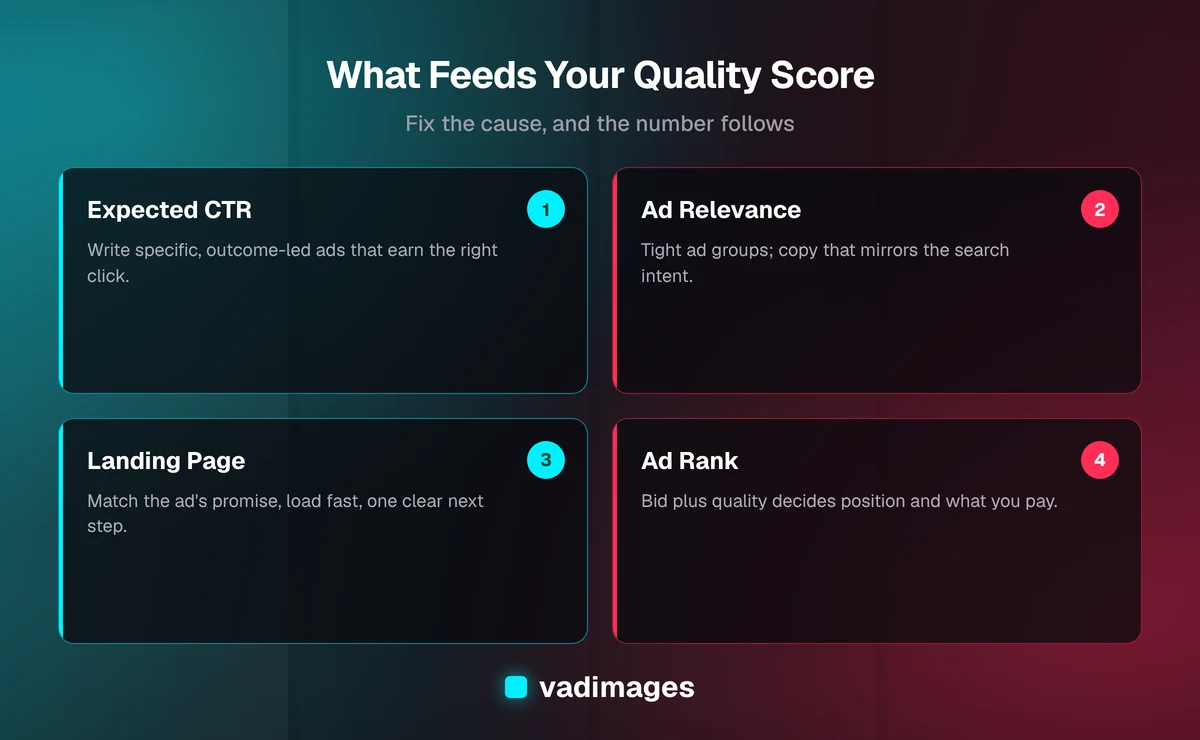
Google breaks Quality Score into three components. Each one is reported as above average, average, or below average at the keyword level.
- Expected click-through rate (CTR): how likely people are to click your ad when it appears for that keyword, based on how comparable ads have performed.
- Ad relevance: how closely your ad copy matches the intent behind the search.
- Landing page experience: how useful, relevant, and easy to use the page is for someone who clicks.
Notice that two of the three are about your words and your page, not your bid. That is good news. You cannot outspend a poor landing page forever, but you can fix a poor landing page in a week.
Why it matters: Ad Rank and what you pay
Every time a search triggers an auction, Google decides which ads show and in what order using Ad Rank. Your bid is one input. The others include the quality of your ad and landing page, the expected impact of your ad assets (formerly called extensions), and the context of the search such as device and location.
In practical terms, a higher-quality ad can win a better position than a competitor who bids more, and it can do so at a lower cost per click. That is why two businesses in the same market can pay very different prices for the same keyword. Quality Score is a convenient window into that gap, even though it is the underlying components, not the single number, that Google uses in the auction in real time.
So the right mental model is simple: Quality Score is a symptom, relevance is the cause. Treat the number as a prompt to look at the three components and ask what a searcher would experience.
Where to find it in your account
Quality Score is not shown by default. In the Google Ads interface, open the Keywords view, then add columns: Quality Score, Exp. CTR, Ad relevance, and Landing page experience. Add them from the Columns menu under the Quality Score group. Once visible, sort by Quality Score and look at your highest-spend keywords first. A weak score on a keyword that barely gets impressions is not worth your time.
Two cautions. First, the score is only calculated for keywords with enough search activity, so new or low-volume keywords may show a dash. Second, the number is an estimate. Use it to find problems, then confirm with real results such as conversions and cost per lead.
Expected CTR: earn the click
Expected CTR is Google's prediction of how often your ad gets clicked compared with others on that keyword. You improve it by making the ad more compelling to the right person. A few habits help:
- Put the searcher's main phrase in the headline, and say something specific. "Custom Booking Software for Salons" beats "Quality Software Solutions."
- Lead with the outcome, then the proof. If you offer transparent pricing, say so. Buyers notice when you do.
- Use every relevant ad asset: sitelinks, callouts, and a call extension if phone calls matter to you. More useful real estate usually earns more attention.
- Cut keywords that attract the wrong click. A broad term that draws curious researchers drags your CTR down and wastes budget.
Do not write clickbait. A misleading ad may lift clicks short-term, but the visitor leaves the moment the page fails to deliver, and your landing page score and conversion rate suffer.
Ad relevance: say what they searched for
Ad relevance asks a blunt question: does your ad speak to what this person typed? The most common cause of a weak rating is a campaign that dumps dozens of unrelated keywords into one ad group with one generic ad.
The fix is structure. Group keywords by theme, so each ad group covers one tight idea. Then write ads for that idea. If you sell both inventory software and customer portals, those deserve separate ad groups with separate copy, even if the same team builds both.
- Keep each ad group to a small set of closely related keywords.
- Make sure the headline and description reflect the exact theme of the group.
- Use responsive search ads with a healthy variety of headlines, and pin only what you truly must.
- Review the search terms report regularly and add irrelevant queries as negative keywords.
Landing page experience: finish the job
Landing page experience is where many small businesses lose the most money, because the page is an afterthought. Google looks at relevance to the ad and keyword, how clear and trustworthy the content is, how easy the site is to navigate, and how quickly it loads, including on a phone.
Think about it from the visitor's side. They clicked an ad promising a specific thing. If they land on your home page and have to hunt, many will not bother. A dedicated landing page that matches the ad is almost always better. For example, an ad about custom software development should land on a page about exactly that, not on a general page about everything you do.
A strong landing page for paid traffic usually has:
- A headline that repeats the promise made in the ad.
- One clear action, such as a quote request or a booking form, repeated where it makes sense.
- Plain-language proof: real case studies, clear pricing, and a description of how the work happens.
- Fast loading and a layout that works on a phone, since a large share of searches happen there.
- Honest content. Say who you serve, where you are, and what you will not do.
Page speed and mobile usability are not nice-to-haves. A slow, cluttered page hurts the score and the conversion rate at the same time, so the work pays twice.
A practical improvement order
When owners ask where to start, we suggest a simple sequence. It avoids the trap of tweaking everything at once and learning nothing.
- Find the money keywords. Sort by cost and focus on the few keywords that take most of your spend.
- Read the three component ratings. Whichever says below average is your first lead.
- Fix structure before copy. If the ad group is a grab bag, split it into tight themes.
- Rewrite the ads. Match the search intent and test a couple of variants.
- Improve the landing page. Match the promise, speed it up, and simplify the next step.
- Wait, then judge by conversions. Give changes enough time to gather data before deciding.
Resist changing everything in a single afternoon. If you alter structure, copy, and the page together, you will not know which change helped.
Common mistakes to avoid
- Obsessing over a 10/10. A 6 on a keyword that brings profitable leads beats a 9 on one that brings none. Business results are the real goal.
- Pausing keywords just because the score is low, without checking conversions first.
- Sending every ad to the home page. It is the easiest mistake to make and one of the costliest.
- Ignoring negative keywords. Irrelevant clicks lower CTR and burn budget.
- Treating the score as the cause. It is a readout. The underlying relevance is what you actually improve.
Quality Score and the bigger picture
Paid search works best when the ad, the page, and the follow-up all tell the same story. Quality Score is one way Google reflects that coherence back to you. When a business has a focused website with clear service pages, honest pricing, and a simple way to get in touch, paid traffic tends to behave better because the visitor's path makes sense.
That is why we often treat advertising and the website as one project. A campaign sent to a page built for it is easier to improve than one patched onto a site that was never designed for conversion. If you serve a specific sector, pages shaped around your industry and the solutions you offer give both Google and the visitor a clearer signal.
What this means for your budget
We do not promise specific savings, because every account, market, and keyword is different. What we can say is that the direction is reliable: more relevant ads sent to more relevant pages tend to earn better placement and better value per click than generic ones. The work is mostly unglamorous, such as tighter ad groups, sharper copy, and faster pages, and it compounds because the improvements stay in place after you make them.
If you want a second pair of eyes, start with your top five keywords by spend. Check the three components, read the ad as a stranger would, then open the landing page on your phone. Most owners spot the first problem within ten minutes.
Next step
If your ads bring clicks but not enough enquiries, the page behind them is often the weak link. Vadimages builds fast, focused websites and landing pages for small and mid-sized businesses, with transparent pricing: projects start at $5,000+. Contact us and we will look at your campaign and landing page and tell you plainly what we would change first.