
The honest answer: later than you think, and sooner than you fear
If you run a small or mid-sized business, someone has probably told you that you need an app. A competitor launched one. A vendor pitched one. A board member asked why you don't have one. The question "should I build a mobile app?" is reasonable, but it is usually asked in the wrong order. The right first question is not can we build an app. It is what outcome do we want that a website cannot already deliver?
At Vadimages we build both websites and apps, and a large share of our early conversations end with the same recommendation: do not build an app yet. Sometimes the right move is a faster, better website. Sometimes it is a progressive web app. And sometimes an app really is the right call. This guide gives you a plain-English way to tell which situation you are in, before you spend a dollar.
What a mobile app can do that a website cannot
Modern mobile websites are very capable. They load fast, work on every phone, show up in Google, and cost far less to maintain than an app. So an app has to earn its place by doing something the browser genuinely cannot do well. In practice, the list is short:
- Deep device access. Reliable camera and barcode scanning, Bluetooth connections to hardware, background location, health sensors, and offline-first storage that holds up for days.
- Push notifications people actually opt into. Notifications are the strongest reason many businesses build apps, and also the most overestimated one. They only work if the message is useful enough that people leave them on.
- A daily or weekly habit. If customers use your product several times a week, a home-screen icon removes friction in a way a bookmark never will.
- Work that must happen with no signal. Field crews, warehouse staff, inspectors, and drivers often work in places with no coverage. An app can capture data offline and sync later.
- A better experience for complex tasks. Smooth gestures, native camera flows, and fast, app-like screens matter when the task is the whole product.
If your needs do not appear on that list, a website is very likely the better investment. If several of them do, keep reading.
Five signs you should build a mobile app
1. Your customers already come back often
Frequency is the single best predictor of app success. A loyalty program people check weekly, a booking tool clients use every month, or a dashboard your team opens every shift all justify an app. A service people use once a year does not. Look at your current website analytics: if a meaningful group of visitors returns several times a month, you have the habit an app can build on.
2. Your staff work away from a desk
Internal apps are the most underrated category. When technicians, drivers, sales reps, or inspectors fill out paper forms or text photos to the office, an app that captures the job, the photos, the signature, and the time in one place can remove hours of re-typing every week. The return is easy to measure because you already know what the manual process costs. This is often where custom software pays for itself fastest.
3. The product needs hardware or sensors
If the experience depends on Bluetooth devices, scanners, NFC, or continuous location, the browser's limits will frustrate you. These are cases where a native or cross-platform app is not a luxury but a requirement.
4. The app is the product
Some businesses are not adding an app to an existing service. They are launching a new product whose home is the phone. In that case you are building a software company's core asset, and you should treat it like one: validate it, scope it tightly, and plan for ongoing development rather than a one-time launch.
5. Your website is already excellent and you have hit its ceiling
This one matters most. An app built to cover for a slow, confusing website just gives you two problems. But if your site loads quickly, converts well, and customers still ask for something it cannot do, that is real evidence of demand, and it is the best moment to invest.
Five signs you should wait
- You want an app because a competitor has one. Their reasons may not be yours, and you cannot see their usage numbers.
- Your customers use you once or twice a year. Few people install an app for something they need rarely.
- Your website is slow, dated, or hard to use on a phone. Fix that first. It is cheaper and helps every visitor, including those arriving from search.
- You have no plan to get people to install it. Getting a download is a marketing problem, not a technical one. If you cannot say how the first 500 customers will find it, pause.
- You cannot fund ongoing work. Apps are not finished at launch. Operating systems change every year, devices change, and users expect updates.
None of these mean "never." They mean "not yet" and "do something cheaper first." That is usually a good place to be, because the cheaper options teach you what customers really want.
The in-between options most businesses overlook
The choice is not only "website or app." There is a ladder, and you can climb it one rung at a time.
- A mobile-first website. Fast, clear, built for thumbs. This is the right answer for most local and service businesses.
- A progressive web app (PWA). A website that can be added to the home screen, work partly offline, and send some notifications. It is a strong middle step for many tools and portals, though device support for certain features varies, especially on iPhone.
- A cross-platform app. One codebase that ships to both iPhone and Android. This is often the sensible way to build a first real app, because you pay for one build instead of two.
- Two fully native apps. Best for graphics-heavy, hardware-heavy, or performance-critical products, and the most expensive to build and maintain.
Starting lower on the ladder lets you collect evidence. If a PWA gets used heavily, you have a strong case for a full app. If nobody uses it, you have saved yourself a much larger bill.
What building an app really costs
We believe in transparent pricing, so here is the plain version. At Vadimages, projects start at $5,000, and that is where focused work begins: a tightly scoped internal tool, a PWA, or a simple cross-platform first version. A customer-facing app with accounts, payments, integrations, and an admin dashboard is a larger project, and the scope drives the number. You can see how we think about this on our pricing page.
Beyond the build, budget for the things quotes often leave out:
- Developer accounts with Apple and Google, and the review process for each store.
- Hosting, databases, and third-party services such as maps, messaging, or payments.
- Ongoing updates for new operating system versions and security patches.
- Support, bug fixing, and the improvements your first users will ask for.
- Marketing to get people to install and keep using it.
A useful rule of thumb is to expect to keep investing after launch rather than treating the first build as the finish line. Teams that plan for that tend to end up with an app that grows. Teams that do not often end up with one that quietly goes stale.
A simple decision test you can run this week
Answer these five questions honestly. You do not need a consultant for this.
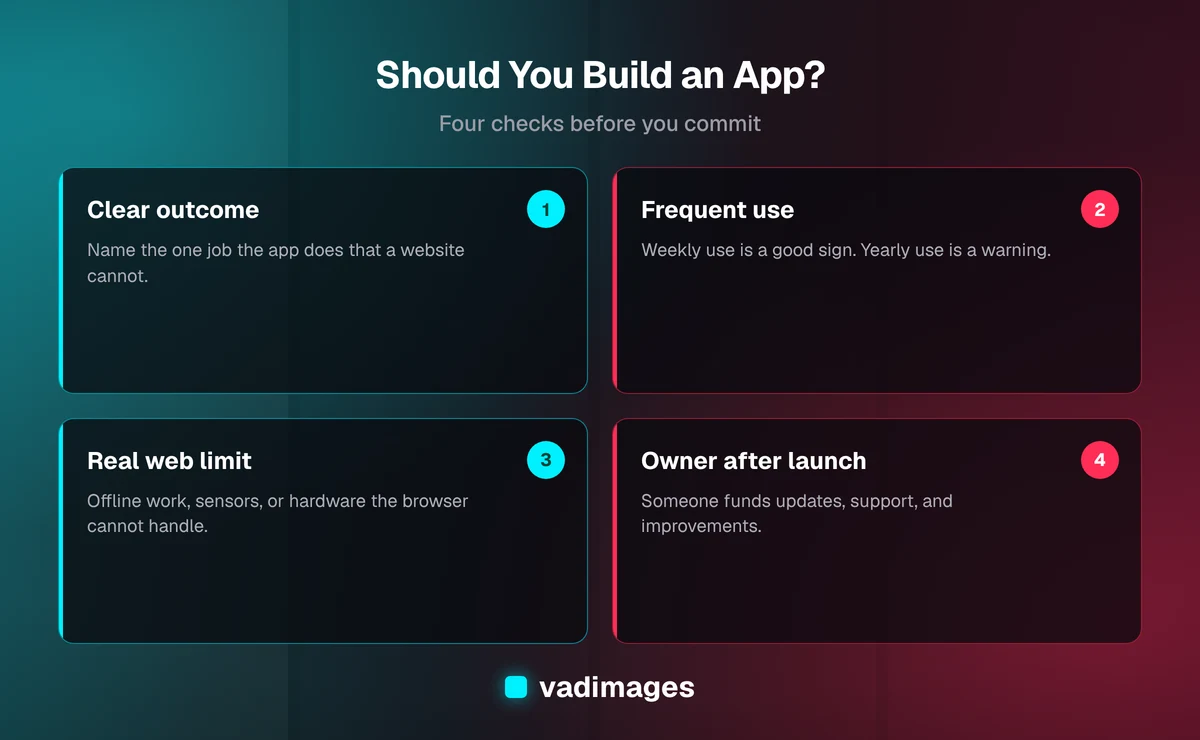
- What is the one job the app must do? If you need more than a sentence to answer, the idea is not focused enough yet.
- Why can't a mobile website do that job? If you cannot name a concrete limitation, start with the website.
- How often will the same person use it? Weekly or more is a good sign. Yearly is a warning.
- What happens if it works? Name the outcome: hours saved, repeat bookings, fewer errors, faster payment. If you cannot attach an outcome, you cannot judge success.
- Who will own it after launch? Someone needs to approve updates, answer users, and decide what to build next.
If you have clear answers to all five, you are probably ready. If two or more are fuzzy, spend a few weeks sharpening them. That time is cheap compared to rebuilding a misdirected app.
How to reduce risk if you do build
The teams that do well with a first app follow a pattern. They start small, prove demand, and expand.
- Ship a narrow first version. One audience, one core job, a handful of screens. Everything else goes on a list for later.
- Test with real users early. Put a clickable prototype in front of five customers or staff members before writing production code. Watching someone get stuck teaches more than any meeting.
- Connect it to your existing systems. An app that cannot talk to your CRM, booking, accounting, or inventory tools creates double entry. Plan the integrations up front.
- Measure from day one. Decide in advance which two or three numbers show it is working, such as weekly active users, tasks completed, or time saved.
- Plan the first six months of improvements. Real usage will reveal what matters. Leave room in the budget to respond.
This is how we run projects at Vadimages, and you can read more about our process on the how we work page. We would rather help you launch a small version that gets used than a big one that does not.
Which industries tend to benefit most
Patterns differ by sector. Field-service companies, logistics and delivery operations, healthcare and wellness providers with recurring appointments, membership and fitness businesses, and manufacturers with floor-level workflows tend to see a clear case for apps because their work is repeated, mobile, and time-sensitive. Retail and professional services often get more from a strong website and good local search first. If you are unsure where your business sits, our industries and solutions pages show the kinds of problems we help with, and the case studies section shows how we describe our work.
Common mistakes to avoid
- Building for the owner's phone, not the customer's. Your preferences are one data point. Ask real users.
- Copying every feature of a big brand. Large companies have teams of dozens. You win by doing one thing clearly.
- Skipping the website. Your site is how most people will discover you, including how they find the app. Do not let it decay.
- Choosing the cheapest bidder without checking scope. A low quote that leaves out testing, store submission, or integrations will cost more later.
- Forgetting store rules. Apple and Google review every app and update. Build time for that into your launch plan.
So, when should you build a mobile app?
Build a mobile app when there is a specific outcome that a website cannot deliver, when people will use it often, and when you are ready to support it after launch. Wait when the reason is imitation, when usage would be rare, or when your website still has easy wins left. And when you are unsure, climb the ladder: improve the site, try a PWA, then commit to a cross-platform app with evidence in hand.
If you would like a straight answer for your business, we are happy to give one, even when that answer is "not yet." Tell us what you are trying to achieve, who will use it, and what it needs to connect to. We will tell you whether an app, a PWA, or a better website is the smartest next step, and give you a clear price range before any work begins. Contact Vadimages to start the conversation.