
MVP cost savings are the money you keep by building the smallest working version of a product first, putting it in front of real users, and paying for more software only after you see what they actually use. An MVP (minimum viable product) is not a cheap prototype or a half-finished app. It is a real, usable product that does one important job well, and it saves money because it stops you from paying to build features nobody needed.
For a US small or mid-sized business, the savings come from three places: a smaller first invoice, fewer expensive rebuilds, and faster feedback from customers or staff. This article explains how each one works, where an MVP does not save money, what one typically costs in 2026, and how to scope one without cutting the wrong corners.
Why building everything up front is the expensive path
Most software budgets go wrong in the same way. A team writes a long list of features, gets a quote for all of them, and spends months building before anyone outside the project team touches the product. Every item on that list is a guess about what users want, and guesses are the costliest thing you can pay developers to build.
The cost shows up in a few predictable places:
- Features nobody uses. Every feature has to be designed, built, tested, documented, and maintained. A feature that never gets used still costs money every year it stays in the code.
- Late discovery. If you learn in month eight that users want something different, fixing it means reworking code that was built on the wrong assumption.
- Delayed return. Software that is not live is not saving staff time or earning revenue. A long build keeps that benefit waiting.
- Locked-in decisions. The more you build before launch, the harder it is to change direction without throwing work away.
An MVP attacks all four at once by shrinking the first build to what is needed to test the idea in real use.
What an MVP actually is (and what it is not)
An MVP is the smallest version of a product that delivers real value to a real user and lets you learn from their behavior. The key word is viable: it has to work, be reliable enough to trust, and solve the core problem. It just does not try to solve every problem yet.
It helps to be clear about what an MVP is not:
- Not a mockup. Clickable designs are useful for early feedback, but users cannot run their business on them.
- Not a low-quality build. The code, security, and data handling should be sound. You are cutting scope, not quality.
- Not the final product. It is a starting point designed to be extended, not thrown away.
- Not only for startups. An established company replacing spreadsheets with an internal tool benefits from the same approach.
Where the savings come from
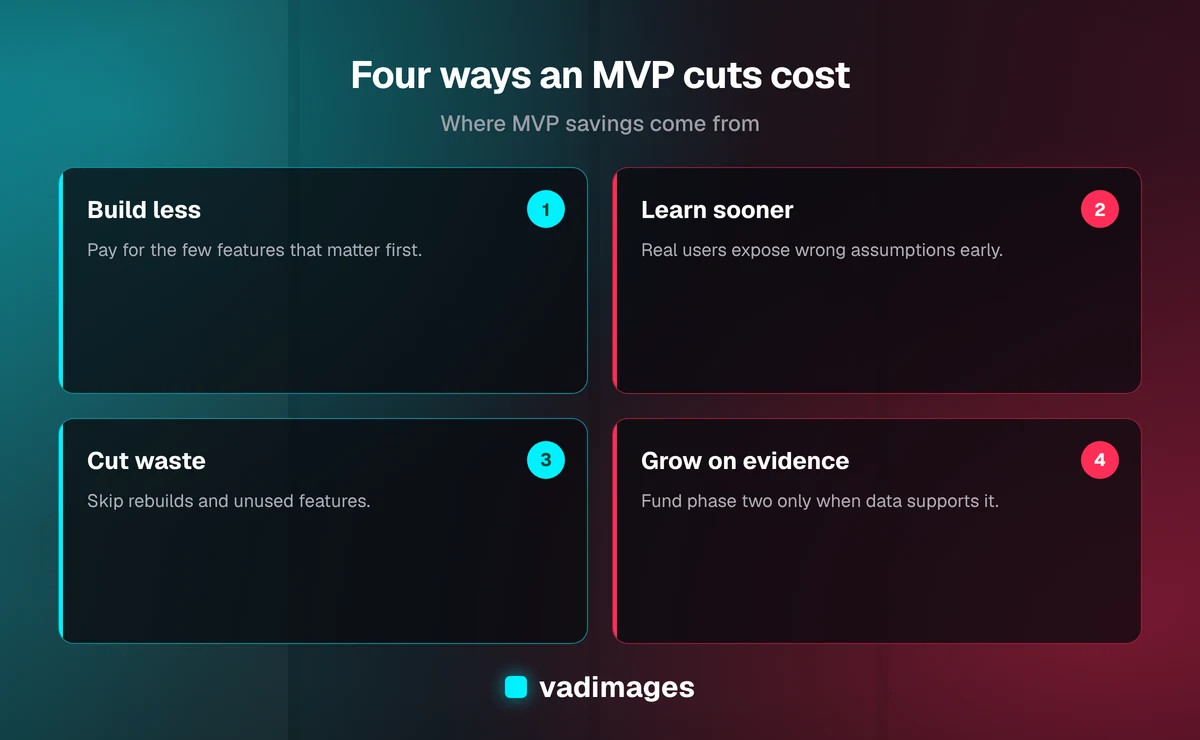
1. A smaller first invoice
The most obvious saving is the simplest: you pay for a narrower scope. If the full vision has twelve modules and the MVP has three, you commit budget to three. The other nine stay as options you can fund later, if and when the evidence supports them. That keeps cash available and lowers the risk of the first decision.
2. Fewer expensive rebuilds
Changing a plan is cheap. Changing finished software is not. When users test a small product early, wrong assumptions surface while the codebase is still small and flexible. Fixing a workflow that touches one screen costs far less than reworking a system where twenty screens depend on it.
3. Faster payback
A live MVP starts working for you sooner. An internal tool that removes manual data entry for one team begins saving hours as soon as that team uses it, even if reporting and admin screens come later. A customer-facing product can begin collecting feedback, and in some cases revenue, while the rest is still being planned.
4. Decisions based on evidence, not opinions
Meetings about what users want tend to be won by the loudest person in the room. Usage data and direct feedback settle those debates. Instead of arguing about whether a feature is needed, you watch whether people reach for it. That saves money by redirecting budget toward things that matter.
5. Less ongoing maintenance
Smaller software has a smaller surface for bugs, security updates, and support requests. Every feature you do not build is one you never have to maintain. Over several years, that adds up even if the savings are hard to see on any single invoice.
What an MVP typically costs in 2026
Costs vary by scope, so treat these as ranges rather than quotes. Vadimages publishes its typical budgets for each type of work. As of 2026:
- Internal tools typically run $30,000 to $75,000, with more for multiple user roles, complex workflows, and integrations.
- SaaS MVPs typically run $50,000 to $150,000, with multi-tenant platforms that include billing and admin tools at the higher end.
- System integrations typically run $15,000 to $60,000, depending on how many systems are connected and how complex the data transformation is.
- Business websites typically run $8,000 to $35,000, depending on page count, design depth, and integrations.
Those figures are for the scoped MVP, not for the entire long-term roadmap. The point of an MVP is that you choose the smallest slice that tests your idea, and you can see the price of that slice before you commit. Our pricing page explains how we estimate, and our solutions pages show typical budgets by project type.
A simple example of the math
Here is a hypothetical illustration, not a client result. Suppose a distribution company wants a custom system to manage quotes, orders, inventory, customer portals, and reporting. Built all at once, it is a large project. Now suppose the team realizes that the most painful problem is quote creation, which currently happens in spreadsheets and email.
The MVP is a quoting tool with a clean form, saved customer records, and a PDF output. It goes live to the sales team in a fraction of the time. Within weeks, the team learns which fields they actually fill in, which they skip, and that the real bottleneck is approving discounts. That insight reshapes the next phase. Had the full system been built first, the discount approval workflow might have been built wrong, and the company would have paid to fix it.
The saving is not a percentage you can promise in advance. It is the avoided cost of building the wrong things, and it depends on how many of your assumptions turn out to be incorrect. Because some early assumptions are almost always wrong, starting small is the lower-risk path.
When an MVP does not save money
An MVP is not automatically cheaper in every situation. Be honest about these cases:
- The scope is already well proven. If you are replacing a system whose workflows are fully understood and stable, a phased rollout may matter more than an MVP mindset.
- Regulation sets the minimum. In healthcare or finance, compliance requirements define a floor you cannot cut below. The MVP can still be narrow in features, but security and compliance work is not optional.
- The MVP keeps growing. If every stakeholder adds just one more must-have, the minimum stops being minimal. Scope discipline is what makes the savings real.
- There is no plan for what comes next. An MVP built with no architecture for growth can force a rebuild later. Good foundations are part of the cost.
How to scope an MVP that actually saves money
- Name the one problem. Write a single sentence describing who the product helps and what job it does for them. If you need three sentences, the scope is too wide.
- List every feature, then cut. Sort the list into must-have for launch, useful later, and nice to have. Only the first group goes into the MVP.
- Define what you will measure. Decide in advance what success looks like: hours saved, tasks completed, sign-ups, or repeat use. Without a measure, you cannot learn anything.
- Pick real users to test with. A handful of actual staff or customers beats a large group of hypothetical ones.
- Plan the next phase before you build. Keep a short roadmap of what you would add if the MVP works, so the foundation can support it.
- Set a review date. Schedule a decision point after launch to decide what to build, change, or drop.
Our process is built around this staged approach: a clear scope, a working first release, and a decision point before further spend. If you want to see how staged projects look in practice, browse our case studies, and if your industry has specific constraints, our industries pages cover them.
Common mistakes that erase the savings
- Treating the MVP as a throwaway. If it is built carelessly, you pay twice. Build it to be extended.
- Skipping user feedback. Launching a small product and not talking to its users wastes the main benefit.
- Confusing small with cheap. The goal is the best value for the smallest risk, not the lowest possible price.
- Ignoring integrations. If the product has to talk to your accounting or inventory system to be useful, that connection belongs in the MVP.
- Waiting for perfect. Polishing every detail before launch pushes back the learning that makes an MVP worthwhile.
How an MVP fits into custom software
A common worry is that an MVP means settling for an off-the-shelf tool. It does not. A custom software MVP is built around your workflow from day one, but it limits itself to the part of the workflow that matters most right now. As the product proves itself, you add the next piece. You end up with software that fits your business, built in steps you can afford and verify.
Frequently asked questions
What does MVP stand for?
MVP stands for minimum viable product. It is the smallest working version of a product that delivers real value to users and gives you evidence about what to build next.
How much does an MVP cost?
It depends on the type of product. As of 2026, Vadimages typically scopes internal tools at $30,000 to $75,000, integrations at $15,000 to $60,000, and SaaS MVPs at $50,000 to $150,000. The right number comes from a defined scope, not from a template.
Is an MVP lower quality than a full product?
No. An MVP should be reliable, secure, and well built. What it lacks is breadth, not quality. It does fewer things, but the things it does should work properly.
How long does it take to build an MVP?
Timelines depend on scope, integrations, and how quickly decisions get made. A narrow MVP reaches real users much sooner than a full build, which is a large part of its value. We give a timeline estimate once the scope is defined.
Can an MVP grow into the full product?
Yes, if it is built with growth in mind. A well-structured MVP becomes the foundation of the full product, with new features added in later phases as the evidence supports them.
Start with the smallest version that proves the idea
An MVP saves money by turning a large, uncertain bet into a series of small, informed ones. If you are weighing a software project and want to know what the smallest useful first release would look like for your business, contact us for a free scoping conversation. We will tell you plainly what is worth building first, what can wait, and what it should cost.