
SW Washington business software is the set of custom tools, integrations and automations that a growing company in Vancouver, Camas, Battle Ground, Ridgefield and the rest of Clark County uses to run daily operations without outgrowing spreadsheets, off-the-shelf apps and manual hand-offs. For most local owners, the goal is simple: fewer repeated tasks, one trusted source of truth, and systems that keep working as the team grows from 10 people to 40.
This guide is written for owners and operations leads across the Vancouver–Portland metro. It explains where growing businesses in SW Washington usually hit software limits, what to fix first, how much it typically costs as of 2026, and how to choose a partner. We are a Vancouver, WA team, so the examples lean local, but nothing here depends on any one industry.
Why growth in SW Washington creates software problems
Clark County companies often grow in a particular way. A business starts with a founder, a few employees and a handful of tools. It wins repeat customers, adds a second crew or location, and starts working with clients on both sides of the Columbia River. Each step adds people, orders, jobs and exceptions. The tools that worked at five people start to creak at fifteen.
The symptoms are familiar and rarely dramatic. Someone re-types the same customer details into three systems. A quote lives in an email thread that only one person can find. The weekly report takes half a day to assemble from exports. A new hire needs a month before they know which spreadsheet is the real one. None of these shows up as a single big failure, which is why they persist for years.
Working across the state line adds its own wrinkles. Many local businesses serve customers in both Washington and Oregon, which can mean different tax handling, different paperwork and different delivery zones. Software cannot replace advice from your accountant or attorney on those rules, but it can make sure your team applies your own rules the same way every time.
The five places growing local businesses feel it first
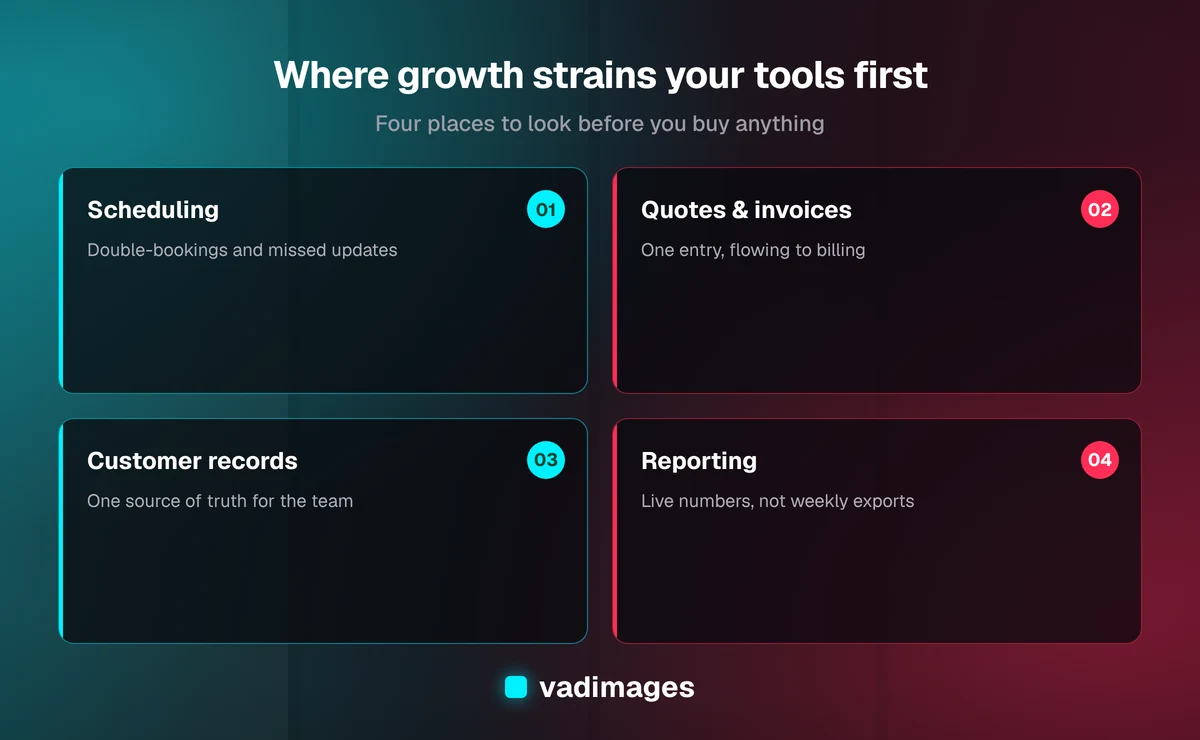
1. Scheduling and dispatch
Service, trades, logistics and healthcare-adjacent businesses often schedule through a shared calendar, text messages and memory. That works until two people book the same crew, or a job changes and the customer is never told. A scheduling tool built around how you actually dispatch work, with automatic confirmations and a clear daily view for each person, removes a surprising amount of daily friction.
2. Quotes, orders and invoicing
When quoting is manual, every quote is slightly different, takes longer than it should and depends on whoever remembers the pricing rules. A quoting workflow that pulls from your real price list, applies your rules and flows straight into the order and the invoice means fewer errors and faster responses to prospects, which matters when a competitor across the river is also bidding.
3. Customer and job records
Growing teams need one place where anyone can see the customer, the history, the open work and the notes. Generic CRMs help, but many local businesses find they are paying for features they never use while still keeping the important details in side spreadsheets. A focused internal tool can show exactly the fields your team uses.
4. Reporting
Owners want to know what is booked, what is late, what is profitable and what is waiting on a customer. If answering that means rebuilding a report by hand, decisions get made on old numbers. Connecting your accounting, scheduling and customer data into one live view usually beats adding yet another dashboard subscription.
5. Handoffs between tools
Most small companies run on five to ten software products that do not talk to each other. The cost is hidden in the copying and pasting between them. Integrations that move data automatically are often the cheapest, fastest win, and they are the first thing we look for on any engagement.
Off-the-shelf, custom, or a mix?
Custom software is not always the answer, and we will tell you when it is not. A sensible rule is to buy standard software for standard problems such as payroll, email and basic accounting, and to build custom software only where your process is a real advantage or where no product fits without painful workarounds.
- Buy when the problem is common, a product fits at least 80 percent of your needs, and the monthly fee is lower than the cost of building.
- Integrate when you already own good tools that just do not share data. Connecting them is usually the cheapest improvement.
- Automate when staff repeat the same steps every day: intake, reminders, status updates, report assembly.
- Build when your workflow is unusual, when you pay for many licenses to use a few features, or when the spreadsheet has become a critical system nobody dares touch.
Many of our projects are a blend. A company might keep its accounting package, add an integration that feeds it, and build one internal tool for the part of the business that no product handles well. You can read more about the kinds of projects we take on on our solutions page and our custom software overview.
What it typically costs in 2026
Pricing should be transparent before you talk to anyone, so here are the ranges we publish, as of 2026. Your actual number depends on scope, and we give a fixed estimate after a short discovery conversation.
- Integrations between your existing systems: about $15,000 to $60,000 as of 2026, depending on the number of systems, data volume and transformation logic.
- Workflow and process automation: about $25,000 to $100,000 as of 2026, depending on how many processes are automated and what they connect to.
- Internal tools (scheduling, quoting, job tracking, dashboards): about $30,000 to $75,000 as of 2026, more for multiple user roles and complex workflows.
- Business websites and customer portals: about $8,000 to $35,000 as of 2026, depending on pages, design depth and integrations.
Full details are on our pricing page. These are ranges for typical projects, not quotes, and larger replacements of older systems cost more. The point is that you should be able to judge whether an investment makes sense before spending hours in sales meetings.
How to decide what to fix first
A growing business usually has more problems than budget, so ordering matters. We suggest scoring each candidate on three questions, in plain terms.
- How often does it happen? A task done fifty times a week deserves attention before one done twice a month.
- What does a mistake cost? A wrong quote, a missed appointment or a double-booked crew has a real price in money and trust.
- Who is the bottleneck? If one person is the only one who knows how something works, that is a risk to the business, not just an inconvenience.
Write down your top five candidates, estimate hours lost per week for each, and compare them with the price ranges above. If a repeating task costs ten staff hours a week, you can reason about payback with your own numbers instead of a vendor's promise. We avoid quoting universal savings figures because every business is different; we would rather help you measure your own.
A representative example
This is a composite scenario for illustration, not a specific client. Imagine a 20-person home-services company in Clark County. Jobs are booked by phone, scheduled on a shared calendar, quoted in spreadsheets and invoiced from accounting software. The office manager spends much of each morning reconciling who is going where and what has been promised to whom.
A sensible first phase would not rebuild everything. It would connect booking, scheduling and invoicing so that a job entered once flows through to the crew's daily list and then to the invoice. A second phase might add customer reminders and a simple owner dashboard. Each phase is useful on its own, can be scoped and priced separately, and leaves the team's remaining tools untouched.
Choosing a software partner in the Vancouver–Portland area
You have options: freelancers, large agencies in Portland, offshore shops and local studios. None is wrong for every case, but a few questions separate good partners from risky ones.
- Do they explain things in plain English? If you cannot follow the proposal, you cannot judge it.
- Is pricing clear up front? Look for ranges, fixed estimates and a written scope rather than open-ended hourly billing.
- Do you own the work? You should own the code and the data, with documentation, so you are never locked in.
- Can you reach the people doing the work? Same-time-zone, same-region teams make quick calls and in-person workshops easy.
- Do they ship in phases? Small, working releases reduce risk and let you see value early.
You can see how we approach engagements on our how we work page, and browse examples on case studies. If your industry has specific needs, our industries page shows where we have experience.
What to do this month
You do not need a big project to start. This week, list the five most repeated manual tasks in your company and note who does them and how long they take. Next, list the software you already pay for and which of it exchanges data automatically. Those two lists usually point at the best first project, and they make any conversation with a partner far more productive.
If you would like a second opinion, we offer a no-pressure conversation about your systems. We will tell you honestly whether custom work makes sense or whether an existing product will do. Contact us to talk through your situation.
Frequently asked questions
What does business software cost for a small company in SW Washington?
As of 2026, typical Vadimages projects range from about $8,000 for a business website to $15,000–$60,000 for integrations and $30,000–$75,000 for internal tools. Larger or more complex systems cost more, and we give a fixed estimate after discovery.
Do I need custom software, or will an off-the-shelf product work?
If a standard product fits most of your process, use it. Custom software makes sense when your workflow is distinctive, when workarounds are costing staff time, or when you are paying for many licenses to use a small set of features. Integrations are often the best first step.
Do you work with businesses outside Vancouver, WA?
Yes. We are based in Vancouver, Washington and work with companies across Clark County, the Portland metro and beyond. Being local simply makes in-person workshops and quick calls easier.
How long does a typical project take?
It depends on scope. Smaller integrations and automations can be delivered in weeks, while larger internal tools are released in phases over a few months. We agree on a schedule in the written scope before work begins.