
The European Accessibility Act (EAA) has moved from a looming deadline to a live obligation. The directive’s rules took effect on 28 June 2025, and through 2026 national market-surveillance authorities are scaling up audits and complaints handling. On 4 June 2026, the European standards bodies CEN, CENELEC and ETSI published revised guidance tying the EAA and the Web Accessibility Directive to the harmonised standard EN 301 549 — the clearest signal yet of how regulators expect digital storefronts to be measured. For any retailer that sells to EU consumers, accessibility is no longer a nice-to-have backlog item; it is a condition of staying on the market.
What the EAA actually requires
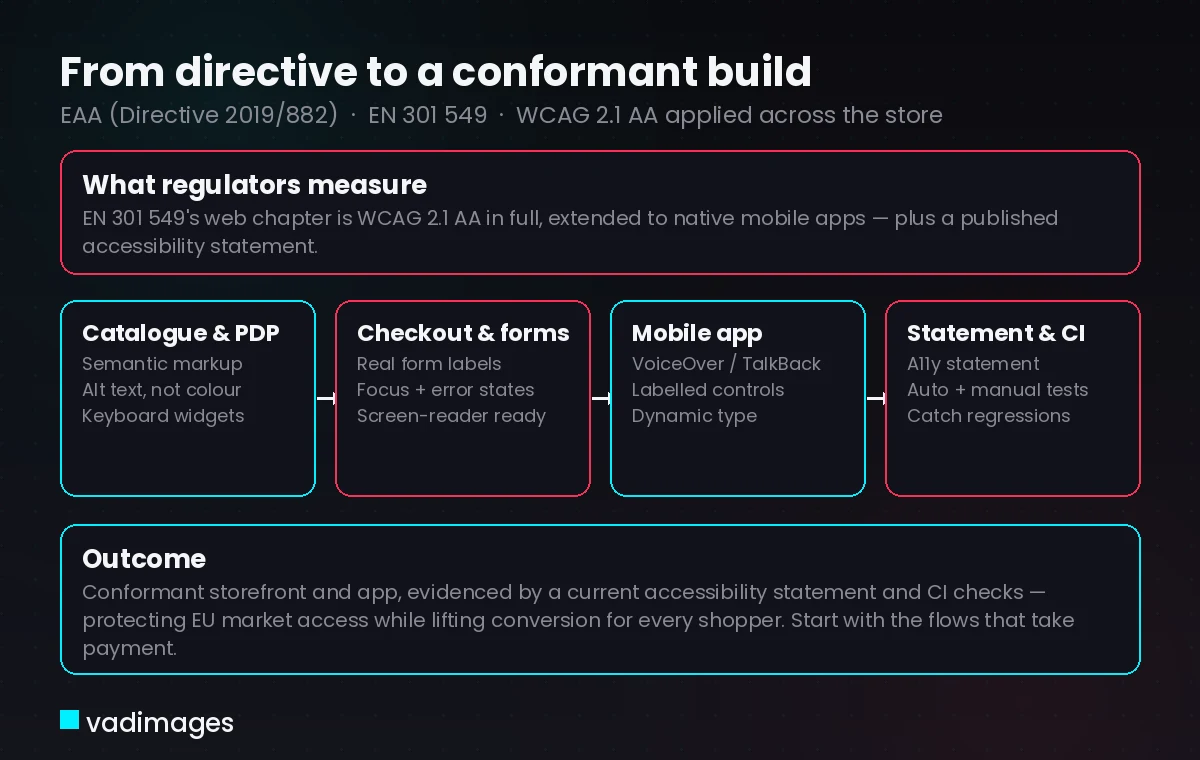
The EAA (Directive (EU) 2019/882) sets a single, EU-wide baseline for the accessibility of key products and services. E-commerce is explicitly named, alongside banking services, e-books, ticketing machines, smartphones and computers. For a web shop or shopping app, the practical reference point is EN 301 549, whose web chapter incorporates the WCAG 2.1 Level AA success criteria in full and extends comparable requirements to native mobile applications. In plain terms, your storefront, checkout and account flows must be perceivable, operable, understandable and robust for people who rely on screen readers, keyboard navigation, magnification or alternative input.
Scope is broad but not unlimited. The obligations generally apply to businesses offering covered services in the EU, with a carve-out for microenterprises — broadly, those with fewer than 10 staff and under €2 million turnover — that provide services. If you run a growing online store that ships into the EU, the safe assumption is that you are in scope and need to demonstrate it.
Why this matters for ecommerce now
Two things changed the risk picture in 2026. First, the transition cushion is narrower than many teams assume: while service contracts and self-service terminals already in use can run under a transition period to 28 June 2030, new and materially updated digital services are expected to conform now. A redesign or replatform you ship this year is judged against today’s rules, not 2030’s. Second, enforcement is becoming concrete — member states have designated authorities that can investigate, order corrective action and impose penalties that vary by country but reach into the tens of thousands of euros for serious or repeated non-conformity.
There is also a commercial case that has nothing to do with fines. Accessibility barriers quietly suppress conversion: inputs that screen readers cannot label, checkout steps that trap keyboard users, colour contrast that fails in daylight on a phone. Roughly one in four adults in the EU lives with some form of disability, and accessible patterns — clear focus states, real form labels, captions, resilient layouts — tend to improve usability for everyone, including older shoppers and anyone on a small screen.
The accessibility statement is part of the deliverable
The EAA does not only ask you to be accessible; it asks you to say how. Covered services must publish accessibility information that explains how the service meets the requirements, in clear language, and keep it current. That makes the accessibility statement a first-class artefact of the build rather than a legal afterthought. Treating it as a living document — updated when you change checkout, add a payment method or ship a new app version — is the difference between a defensible position and a box-ticking exercise that goes stale within a quarter.
Where online stores most often fail
In practice, the same handful of issues account for most conformance gaps on commerce sites:
- Checkout and forms without programmatic labels, error messages or focus management, so assistive technology cannot complete a purchase.
- Custom dropdowns, carousels, modals and “add to cart” widgets built without keyboard support or ARIA roles.
- Insufficient colour contrast on buttons, price badges and promotional banners, especially on mobile.
- Images and icons missing meaningful alternative text, and product galleries that convey information by colour alone.
- Mobile apps that ignore the platform accessibility APIs, breaking VoiceOver and TalkBack on the most important screens.
How Vadimages helps
Vadimages builds and remediates the web and mobile software this directive actually touches. On the storefront side, we audit existing e-commerce sites against WCAG 2.1 AA and EN 301 549, then rebuild the high-risk flows — product listing, product detail, cart, checkout and account management — with semantic markup, proper form labelling, keyboard and focus handling, and contrast that holds up on real devices. For teams replatforming or launching, we design accessible component libraries so new features ship conformant by default rather than being retrofitted later.
For mobile, we build native and cross-platform shopping apps that respect VoiceOver and TalkBack, with accessible navigation, labelled controls and dynamic-type support across the screens that drive revenue. We also wire up the integration layer — connecting your storefront and checkout to payment, tax and order-management APIs — so an accessibility rebuild does not disrupt the systems behind it. And because the EAA expects a published, current accessibility statement, we deliver an accessibility statement page wired into your CMS, plus automated and manual accessibility checks in your CI pipeline so regressions are caught before they reach shoppers. We build the software and the conformance evidence; we do not provide legal advice on your specific obligations.
Bottom line
The EAA is enforced, e-commerce is in scope, and 2026 is the year audits get real. New and updated digital storefronts are measured against EN 301 549 and WCAG 2.1 AA today, with a published accessibility statement to back it up. The work — accessible checkout, keyboard-friendly components, conformant mobile apps and CI checks that keep it that way — is exactly the kind of web and mobile build that protects both compliance and conversion. Start with the flows that take payment, and make accessibility a default in everything you ship next.
This article is general information, not legal advice; confirm your specific EAA obligations with qualified counsel.