
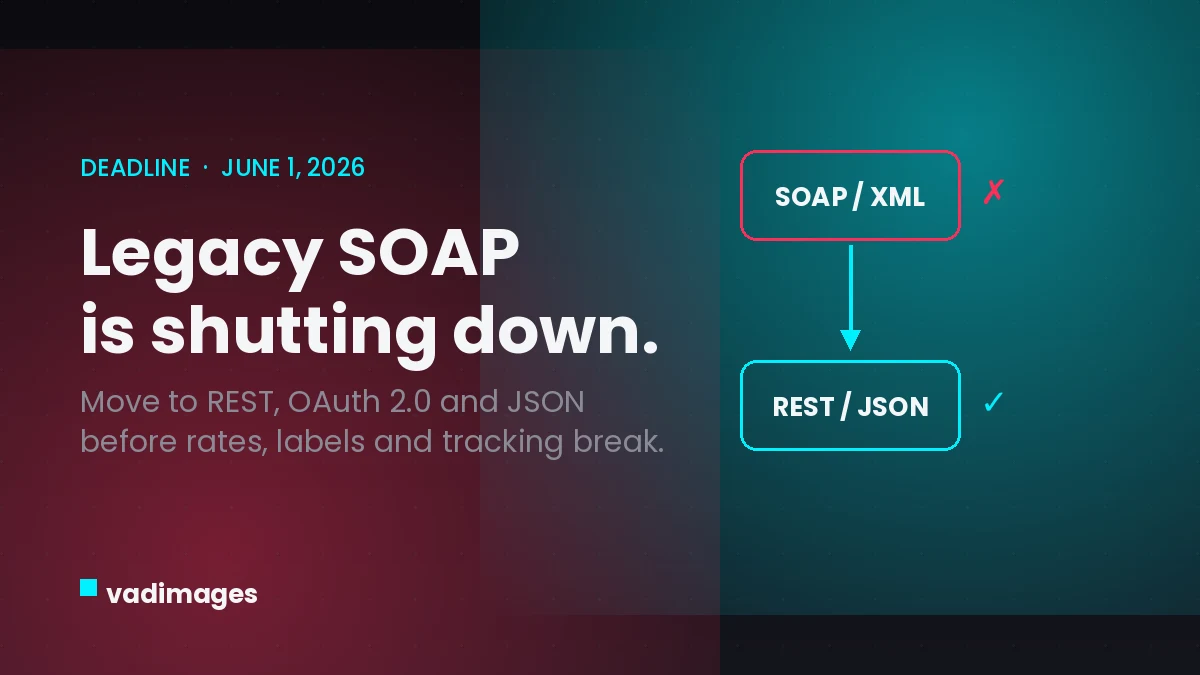
For US online retailers and logistics teams, a quiet piece of plumbing is about to become a loud problem. In June 2026, FedEx finishes retiring its legacy SOAP-based Web Services — the XML APIs that have powered shipping rate quotes, label printing, and package tracking on countless storefronts and internal tools for more than a decade. Once the remaining endpoints are switched off, any integration still calling them simply stops returning data. And the failure shows up exactly where it hurts most: at checkout, in the warehouse, and on the tracking page your customers refresh every day.
What FedEx is actually changing
FedEx is moving from its old SOAP/XML Web Services, accessed through WSDL endpoints, to modern REST APIs that use JSON payloads and OAuth 2.0 token-based authentication. The new platform returns more precise rates, cleaner error handling, and access to newer services the legacy interface never supported. The catch is that it is a different integration — not a drop-in upgrade.
The timeline has two tiers that US teams need to map to their own setup:
- March 31, 2026 – the deadline for “compatible providers,” meaning the TMS and shipping platforms that connect to FedEx on behalf of thousands of merchants.
- June 1, 2026 – the deadline for customers who maintain their own direct FedEx integration.
- March 1, 2026 – new FedEx accounts created through shipping platforms have already required multi-factor authentication and the REST API.
After the June cutover, the remaining SOAP endpoints are fully retired. There is no grace period that brings them back: integrations must use FedEx REST to access rates, labels, tracking, and any future service updates.
It is the last step of a broader carrier shift
FedEx is not acting alone. UPS sunset its legacy access-key authorization in the summer of 2025 in favor of OAuth 2.0, and USPS retired its older Web Tools APIs and switched off the last Web Tools (Version 3) endpoints in January 2026. With FedEx completing its move this June, all three of the major US carriers will have left the old key-based, XML world behind in roughly twelve months.
The drivers are consistent across carriers: tighter security to fight label fraud, tracking-data scraping, and shipment rerouting; more accurate, real-time rate and delivery data; and support for dynamic pricing that adjusts to demand and capacity. The upside is real once you are on the new APIs — but only teams that migrate cleanly get to enjoy it.
Why a US business should treat this as urgent
When a SOAP integration goes dark, the symptoms are immediate and customer-facing. Checkout can stop showing live shipping options or throw errors at the rate step, which is one of the fastest ways to abandon a cart. The warehouse cannot generate FedEx labels, so orders that were paid for cannot ship. Tracking updates stop flowing into your order-status pages, driving a wave of “where is my order” support tickets. For an ecommerce brand or a logistics operation, that is lost revenue, stalled fulfillment, and a support backlog all at once — the kind of outage that is far more expensive to fix under pressure than to prevent on a schedule.
What “migrate to REST” really involves
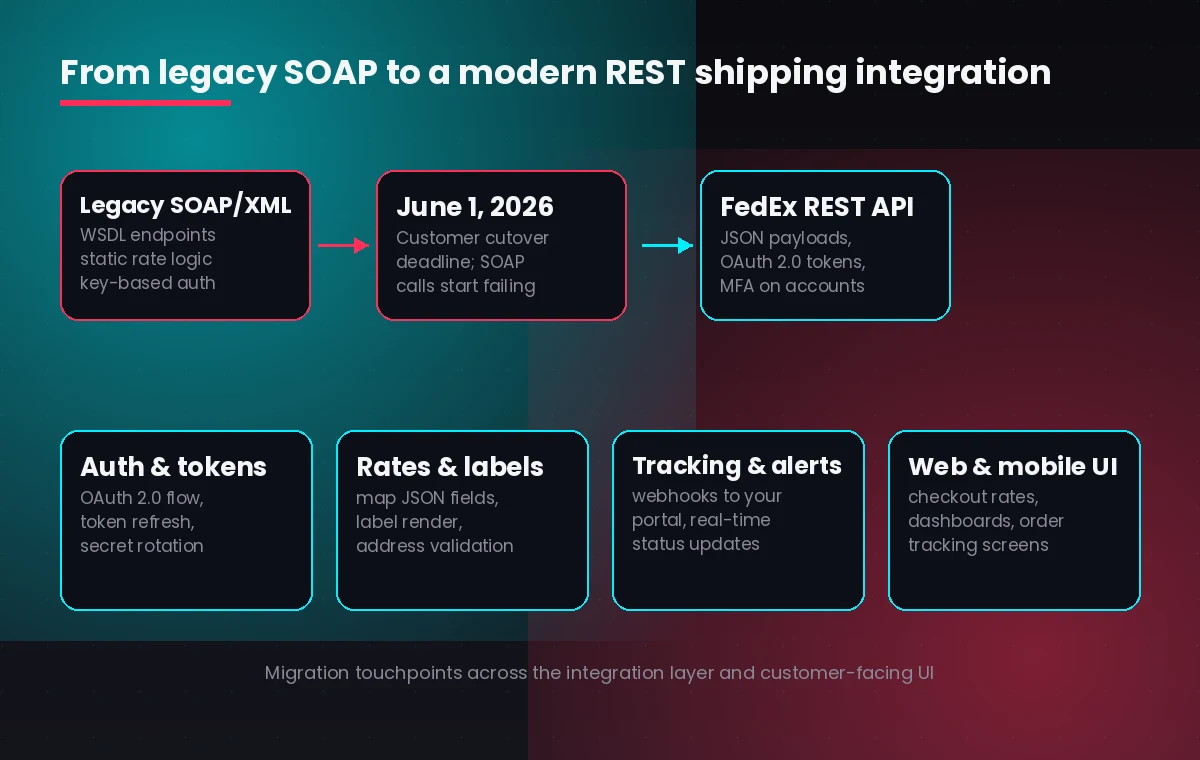
Swapping SOAP for REST is more than changing a URL. A complete migration touches several layers of the integration:
- Authentication: implement the OAuth 2.0 token flow, handle token refresh, and rotate client secrets securely instead of embedding static keys.
- Rates, ship, and track endpoints: re-map every request and response field from XML structures to the new JSON schema, because the shapes and naming differ.
- Account readiness: complete the multi-factor enrollment FedEx now requires before REST credentials are issued.
- Address validation and labels: rebuild validation and label-rendering logic against the new responses so warehouse output is byte-for-byte correct.
- Tracking updates: wire real-time status into your portal or order pages, ideally via webhooks rather than constant polling.
- Testing: run regression tests across quoting, shipping, and tracking so nothing silently breaks at peak.
How Vadimages helps
This is squarely web and mobile development work, and it is exactly what we build. Vadimages can replace the FedEx carrier integration inside your website or web app — the rate, label, and tracking calls — against the REST API and OAuth 2.0, with proper token handling and secret rotation. Rather than hard-wiring FedEx, we put a clean integration layer in front of it so carriers are swappable: FedEx, UPS, and USPS sit behind one internal API, and the next carrier change becomes a configuration update instead of another emergency rebuild.
On the customer-facing side, we build the checkout shipping-rate experience for Shopify, Adobe Commerce/Magento, or a custom storefront, with graceful fallbacks so a momentary carrier hiccup never leaves a shopper staring at a dead end. We develop branded order-tracking portals and status pages, an operations dashboard so your team can see quotes, labels, and exceptions in one place, and native or cross-platform mobile screens for warehouse and field staff who scan, print, and track on the move. We also add monitoring and automated tests around the integration so you find out about a problem before your customers do.
Bottom line
The FedEx SOAP shutdown is not a maintenance footnote — it is a hard deadline that determines whether your store can quote, ship, and track FedEx packages this summer. The work is real but bounded: audit everywhere your code still calls the legacy API, migrate to REST and OAuth, and wrap it all behind an integration layer that keeps you flexible the next time a carrier changes the rules. Handle it deliberately now, or scramble after something breaks at checkout. If you want a second set of hands on the migration and the customer-facing pieces around it, that is the kind of build we do.