
If your store charges customers on a recurring basis — subscriptions, memberships, auto-replenishment, or free trials that convert to paid — the rules of the road in the United States are tightening again. In March 2026 the Federal Trade Commission opened an Advance Notice of Proposed Rulemaking to revive its “Click-to-Cancel” rule, less than a year after a federal appeals court struck the 2024 version down on procedural grounds. The headline for US merchants is simple: even without a formal rule on the books today, regulators are actively policing how you sign people up and how easily you let them leave.
What the FTC actually revived
The original 2024 rule, formally the Rule Concerning Subscriptions and Other Negative Option Plans, required sellers to disclose material terms clearly, get express informed consent before charging, and make canceling at least as easy as signing up. On July 8, 2025, the U.S. Court of Appeals for the Eighth Circuit vacated the rule in full — not because the ideas were wrong, but because the FTC skipped a required economic analysis. On January 30, 2026, the agency submitted a draft notice to the Office of Information and Regulatory Affairs, and in March 2026 it formally announced the rulemaking. Comments were due April 13, 2026, and roughly 100 were filed. A new federal rule is now moving through a process that historically takes years — but the direction is unmistakable.
Enforcement never paused
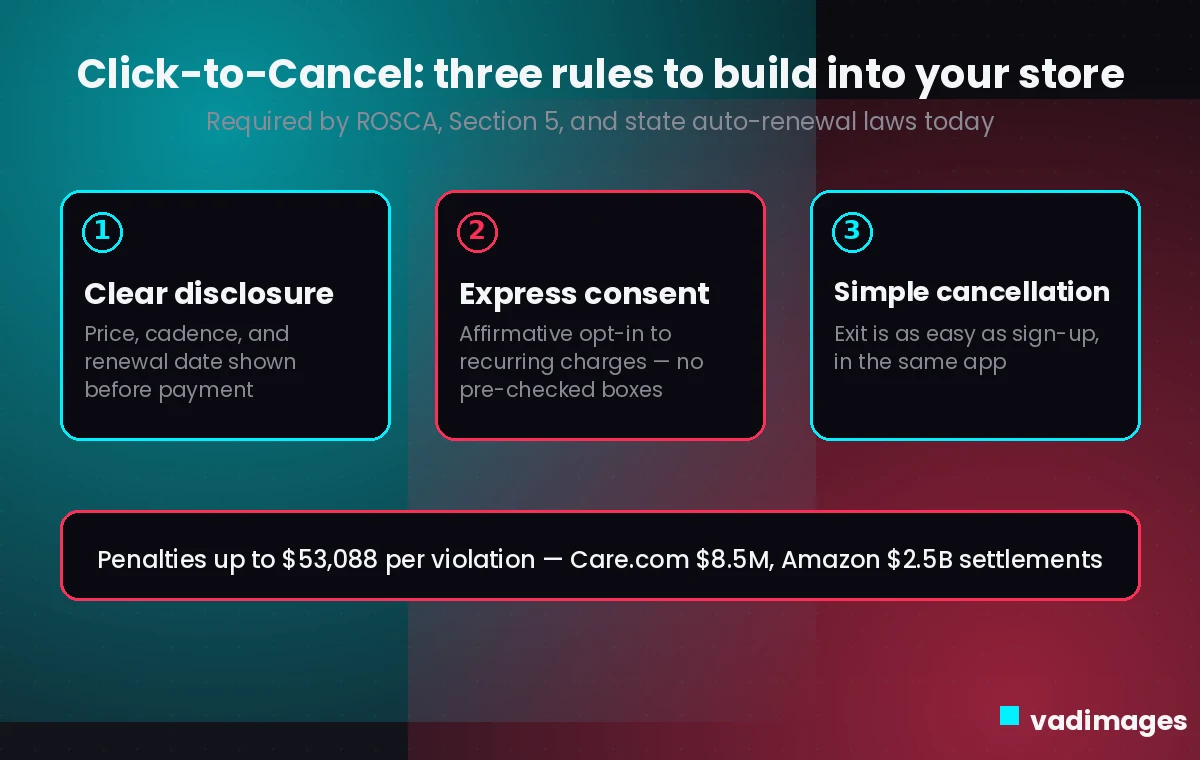
Here is the part US businesses miss: the vacated rule did not hand anyone a holiday. The FTC has kept bringing cases under Section 5 of the FTC Act and the Restore Online Shoppers’ Confidence Act (ROSCA) of 2010. In the Care.com matter it secured an $8.5 million settlement over hidden terms and hard-to-cancel plans. It later reached a record $2.5 billion settlement with Amazon over Prime enrollment and cancellation practices. In its NextMed complaint the FTC essentially re-applied the three Click-to-Cancel principles as standalone Section 5 violations. With 2026 civil penalties reaching up to $53,088 per violation, the math gets serious fast for a business that enrolls thousands of customers a month.
The three requirements that define compliance
Whether the obligation comes from a future federal rule, ROSCA, or a state statute, the same three pillars keep reappearing — and each is a concrete product decision rather than a legal abstraction:
- Clear and conspicuous disclosure. Price, billing cadence, renewal date, and what happens after a trial must be visible and understandable before the customer hands over payment details — not buried in a footer or a terms link.
- Express informed consent. The shopper has to affirmatively agree to the recurring charge. Pre-checked boxes, silent trial-to-paid conversions, and consent bundled with unrelated terms are exactly what regulators target.
- Simple cancellation. Ending a subscription must be no harder than starting it. If a customer signed up in two clicks online, forcing a phone call or a retention maze to cancel is the precise pattern the FTC has been fining.
The state patchwork already raises the floor
Federal action is only half the picture. Around 30 states now have their own automatic-renewal or negative-option laws, several of which already match or exceed the vacated federal rule. California’s Automatic Renewal Law, for example, requires businesses on auto-renewing plans to send customers an annual reminder spelling out the upcoming renewal, the price, and how to cancel. For any US merchant selling across state lines, a compliance-by-design approach pegged to the strictest state is far more practical than reacting jurisdiction by jurisdiction — and it has to live in the application, not be bolted on later.
How Vadimages helps
This is fundamentally a front-end and integration problem, and it sits squarely in our lane as a web and mobile app development studio. We build the customer-facing flows and the back-office tooling that turn these requirements into shipping software:
- Compliant checkout and consent UIs for your storefront — clear-terms summaries at the point of payment, explicit opt-in for recurring charges, and trial-end disclosures rendered where shoppers actually see them.
- Self-service cancellation flows in the same web or mobile app where customers subscribed, so “cancel” is genuinely as easy as “subscribe,” with each step logged for your records.
- Subscription management portals and dashboards that let customers pause, downgrade, or cancel, and give your team an audit trail of consent and cancellation events.
- Automated renewal-reminder emails and notifications wired into your commerce platform to satisfy state requirements like California’s annual notice.
- API integrations with Stripe, Shopify, Recurly, or your billing provider so consent records, cancellation timestamps, and disclosures stay in sync across systems.
Whether you run on Shopify, a headless storefront, or a fully custom web app, we adapt the build to your stack rather than forcing a rebuild.
Bottom line
The Click-to-Cancel rule is in limbo, but the obligations behind it are not. Section 5, ROSCA, and a growing list of state laws already require honest sign-ups, real consent, and easy exits — and the FTC is enforcing them with eight- and ten-figure settlements. US subscription and ecommerce businesses that treat compliant sign-up and cancellation as a core product feature, designed into their web and mobile apps now, will skip the scramble when a new federal rule lands.
This article is for general information only and is not legal advice; consult qualified counsel about your specific obligations.