
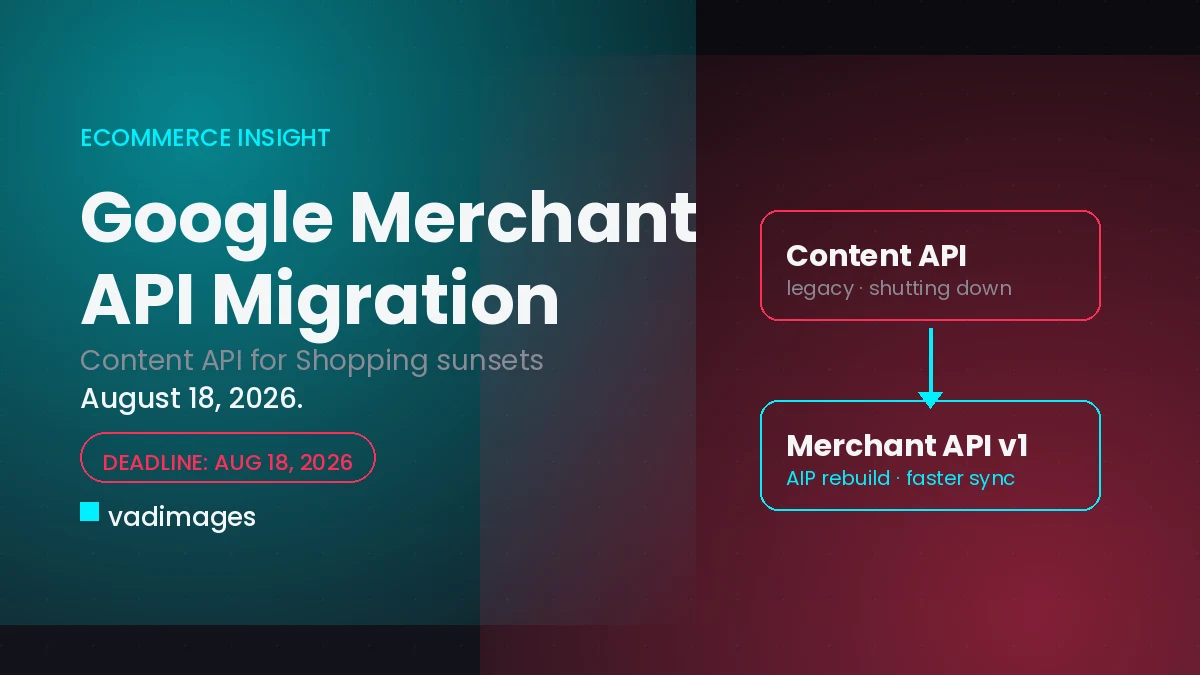
If your online store pushes product data to Google through code, a hard deadline is bearing down on you. Google is permanently shutting down the Content API for Shopping on August 18, 2026, and replacing it with a rebuilt service called the Merchant API. Any storefront, feed pipeline, or reporting dashboard still talking to the old endpoint stops syncing that day — which means your products quietly drop out of Google Shopping and your Performance Max campaigns stop serving. For US ecommerce brands heading into the Q4 selling season, this is a small-sounding integration change with outsized revenue consequences if it slips.
The deadline that does not move
Google announced the sunset alongside the launch of the Merchant API, which has been generally available since 2025. There are two cutover dates worth knowing. The first has already passed: the early v1beta of the Merchant API was retired on February 28, 2026. The second is the one that matters for most stores — on August 18, 2026, the Content API for Shopping is switched off entirely. Google has been emailing account-level warnings to affected Merchant Center accounts since January 2026. Importantly, this only affects programmatic connections. If you upload your catalog exclusively through manual file uploads, scheduled fetch, or Google Sheets, you are not on this clock. If software talks to Google on your behalf, you almost certainly are.
Who actually needs to migrate
The migration touches every brand whose product data reaches Google Merchant Center through an API integration. In practice that means:
- Custom-built feed scripts and proprietary data pipelines that publish your catalog to Google.
- Third-party feed management tools and older platform plugins that connect over the Content API on the back end.
- Reporting dashboards — Looker Studio, Tableau, internal admin panels — that pull Shopping data directly from the old API.
Platform users are not automatically safe. Shopify stores on the native Google channel app are handled by Shopify, but merchants using third-party Google Shopping apps depend on each app developer hitting the deadline. The reliable way to check your own status is inside Merchant Center Next: open Settings, then Data Sources, and look at the Source column. If any source reads “Content API,” that connection has to be rebuilt before August 18. When in doubt, ask your platform or feed vendor for written confirmation that their integration runs on Merchant API v1.
What actually changes under the hood
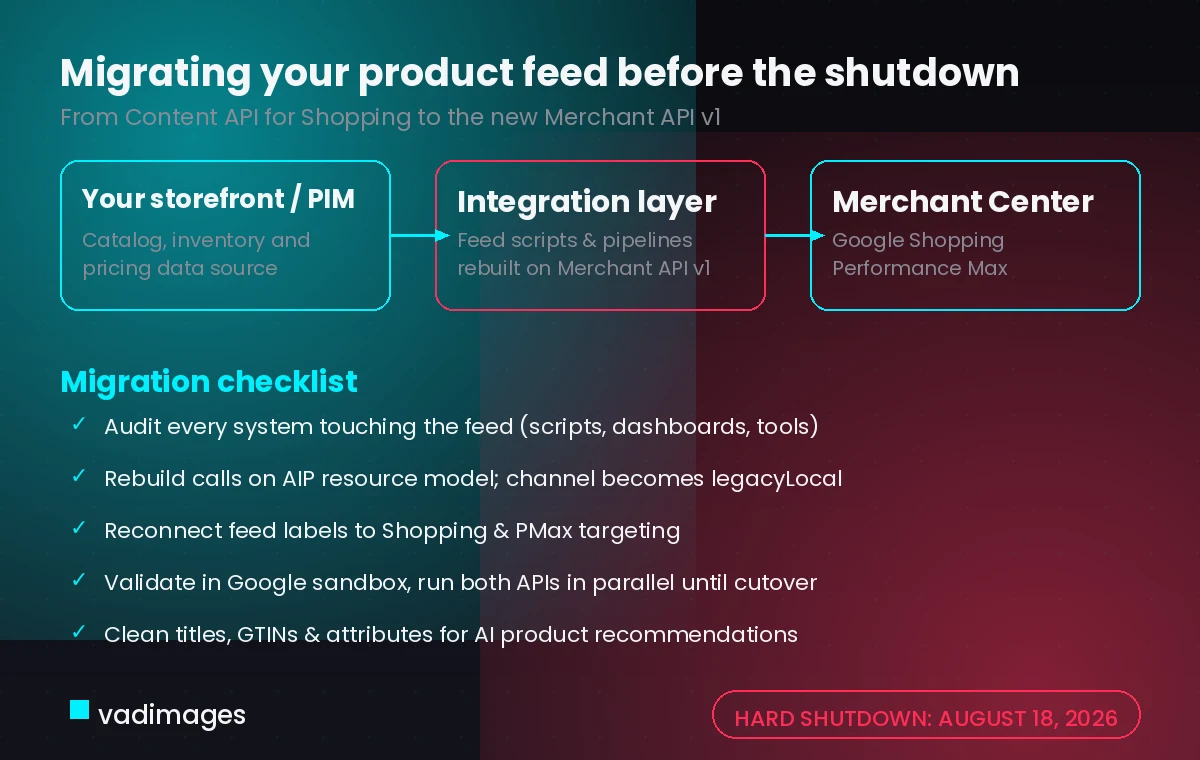
The Merchant API is not a renamed Content API. Google rebuilt it on its API Improvement Principles, so request structures, resource identifiers, and data formatting all changed — a find-and-replace on the host name will not get you there. Two operational details trip teams up most often. First, feed labels do not transfer automatically; if your Shopping or Performance Max campaigns target products by feed label, those labels must be manually reconnected after migration or the campaigns stop serving even when the feed itself succeeds. Second, the old channel field that distinguished online from local inventory is gone, replaced by a legacyLocal boolean for physical-store products; any integration that currently passes a channel value has to update that logic. The upside is real: the new API processes inventory and pricing updates faster, supports batch operations, and feeds Google’s AI-powered product optimization and recommendation surfaces.
Why this matters for US ecommerce businesses
Google Shopping and Performance Max are primary demand channels for most US online retailers, and a broken feed does not degrade gracefully — listings disappear and paid campaigns go dark within a day. The timing makes it sharper: a brand that discovers the problem in late summer is troubleshooting an untested integration during the run-up to the Q4 peak, exactly when downtime is most expensive. Complex setups with custom scripts and multiple reporting tools can take three to five months to migrate, test, and validate, so the practical window to start is now, not August. Treated well, the cutover is also an opportunity: cleaning up product titles, GTINs, and missing attributes during the migration improves both paid Shopping performance and eligibility for Google’s AI and agentic product recommendations going into the holidays.
How Vadimages helps
This is squarely a web-development problem: the integration layer between your storefront and Google needs to be rebuilt, and the systems around it kept healthy. As a custom web and mobile app development studio, Vadimages can:
- Audit every system that touches your product feed — custom scripts, data pipelines, dashboards, and plugins — and map exactly what still depends on the Content API.
- Re-architect the feed integration that pushes catalog, inventory, and pricing from your storefront, PIM, or database onto Merchant API v1, including the
legacyLocalchange and new resource model. - Build a feed-health web dashboard that surfaces sync status, rejected products, and attribute gaps across your data sources, so problems are visible before they cost impressions.
- Reconnect feed-label logic to your Shopping and Performance Max targeting and validate everything in Google’s sandbox, running the old and new APIs in parallel until a clean cutover.
- Clean and enrich the catalog feed at the storefront and data layer — titles, GTINs, attributes — to strengthen AI product-recommendation eligibility.
- Extend the same catalog and sync-status data into a lightweight mobile app so your merchandising team can monitor feed health on the go.
Bottom line
August 18, 2026 is a hard shutdown, not a soft deprecation. If any part of your Google Shopping setup runs on the Content API, the work is to audit it now, rebuild the integration onto Merchant API v1, reconnect your feed labels, and test in a sandbox well ahead of the date — and to use the migration as a reason to ship a cleaner, faster product feed into the Q4 season.