
On Thursday, June 18, 2026, the Node.js project shipped a coordinated security release across its 26.x, 24.x, and 22.x lines, fixing 12 vulnerabilities — two of them rated high. For US fintech and financial services companies, the headline issue is not a flashy remote-code exploit but something quieter and arguably more dangerous: a flaw that lets an attacker bypass TLS authentication, the very mechanism your payment APIs and partner integrations rely on to know who they are talking to. If your card-processing service, ledger, or open-banking connector runs on Node, this release deserves an emergency change window, not a backlog ticket.
What Node.js shipped on June 18
The fixes landed in Node.js v22.23.0, v24.17.0, and v26.3.1, and they also rolled in updated dependencies — OpenSSL 3.5.7, llhttp 9.4.2, nghttp2 1.69.0, and refreshed undici builds. Of the dozen CVEs, two carry a high severity rating; the rest range from medium to low and cluster around TLS hostname handling, HTTP/2 resource exhaustion, and the experimental permission model. One detail US teams routinely forget: end-of-life Node versions are always considered affected when a security release ships, and they never receive the patch. Running Node 20 or older means the only fix is to move forward to a supported line.
The two high-severity flaws, in plain terms
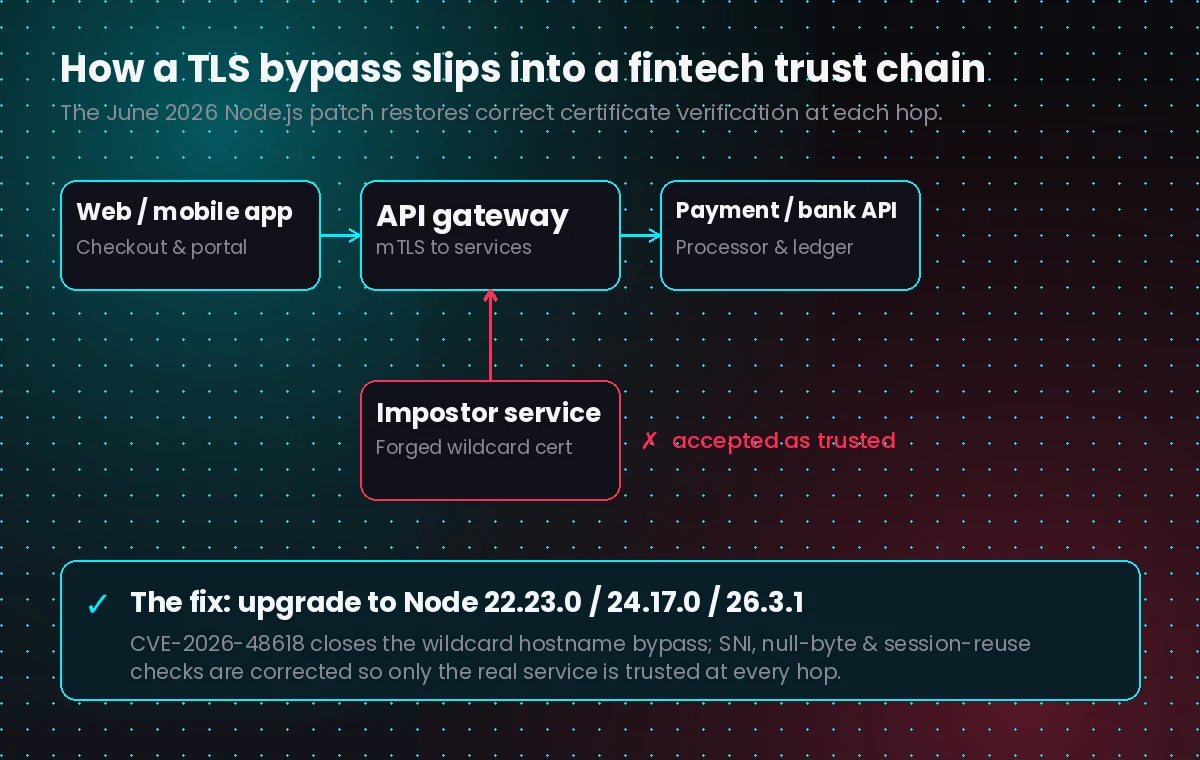
The first high-severity issue, CVE-2026-48618, is a TLS wildcard-depth authentication bypass. A mismatch between how Node’s resolver and its certificate verifier normalize Unicode “dot” separators in hostnames means a certificate can be accepted for a host it should never have matched. In practice, that can let a malicious endpoint impersonate a service your application trusts, undermining the confidentiality of the connection. The second, CVE-2026-48933, is a denial-of-service bug in Node’s WebCrypto layer: an integer overflow when subtle.encrypt() receives input that is a multiple of 2 GiB can abort the process outright, taking the service down.
Several of the medium-rated CVEs compound the trust problem. CVE-2026-48928 lets an uppercase Server Name Indication value slip past case-sensitive matching and bypass authorization in multi-context mTLS setups. CVE-2026-48930 uses an embedded null byte in a hostname to silently rebind to a different authority. CVE-2026-48934 allows a TLS session to be reused with a different server name, defeating host identity verification. Read together, this release is overwhelmingly about one theme: the assumptions your code makes about who is on the other end of an encrypted connection.
Why TLS and mTLS bypasses hit fintech hardest
Financial software is built on chains of trusted machine-to-machine calls. A checkout posts to a payment service provider; a reconciliation job pulls settlement files; an open-banking aggregator calls a bank’s data API; internal microservices authenticate to each other with mutual TLS. Every one of those hops depends on certificate validation working exactly as intended. A wildcard or mTLS bypass is, in effect, a way to slip into that chain as an impostor — the kind of exposure that turns a routine integration into a path for data interception or fraudulent transactions.
For US companies, the stakes are also regulatory. PCI DSS 4.0.1 requires strong cryptography for cardholder data in transit and explicit management of the systems that handle it; GLBA Safeguards and state financial regulators expect timely patching of known vulnerabilities. A documented TLS authentication weakness sitting unpatched is exactly the sort of finding that surfaces in an assessment or, worse, after an incident. Treating this release as a compliance event — with a change record, a test plan, and an attestation that production is on a fixed version — is the defensible posture.
Building an upgrade and verification plan
Patching Node sounds simple, but in a real financial stack the runtime is everywhere: API servers, background workers, build pipelines, serverless functions, and container base images. A credible plan inventories every place Node runs, maps each to its current version, and prioritizes anything that terminates or initiates TLS with an outside party. From there, the work is concrete:
- Upgrade all services to v22.23.0, v24.17.0, or v26.3.1 (or newer) and retire any end-of-life Node lines that can never be patched.
- Rebuild and redeploy container images so the fixed runtime and updated OpenSSL actually ship — a
package.jsonbump alone does not cover a pinned base image. - Re-test certificate validation paths: wildcard certificates, mTLS between internal services, and any custom SNI or hostname-matching logic.
- Audit error handling so proxy credentials and connection details never leak into logs (CVE-2026-48615), a real concern for systems under audit.
- Add HTTP/2 client and server limits to blunt the ORIGIN-frame and GOAWAY resource-exhaustion issues.
How Vadimages helps
Vadimages builds and maintains the web and mobile applications that sit on top of these runtimes — payment and checkout flows, reconciliation and settlement dashboards, customer-facing financial portals, and the API integration layers that connect them to processors, banks, and data aggregators. When a release like this lands, we update the Node runtime and dependencies across the application and its services, rebuild the deployment images, and run the regression suite so nothing breaks in checkout or reporting. On the integration layer we own, we re-verify TLS and mTLS configuration, tighten hostname and certificate handling, and add the HTTP/2 and logging safeguards above, so the trust boundaries between your app and its partners hold. For teams modernizing off older stacks, we plan and execute the migration from end-of-life Node onto a supported line as part of the same engagement. The deliverable is always software we build and ship for you — not hardware, managed infrastructure, or advisory services.
Bottom line
The June 18, 2026 Node.js release is a trust-boundary release. For US fintech teams, a TLS authentication bypass is not an abstract bug — it is a direct threat to the integrity of payment and data flows and a clear compliance exposure. Inventory where Node runs, upgrade to a patched version, rebuild your images, and re-test certificate validation across every external connection. The faster that change window opens, the smaller the window of risk.
This article is for general information only and is not legal, security, or compliance advice; consult your own qualified professionals about your specific obligations.