
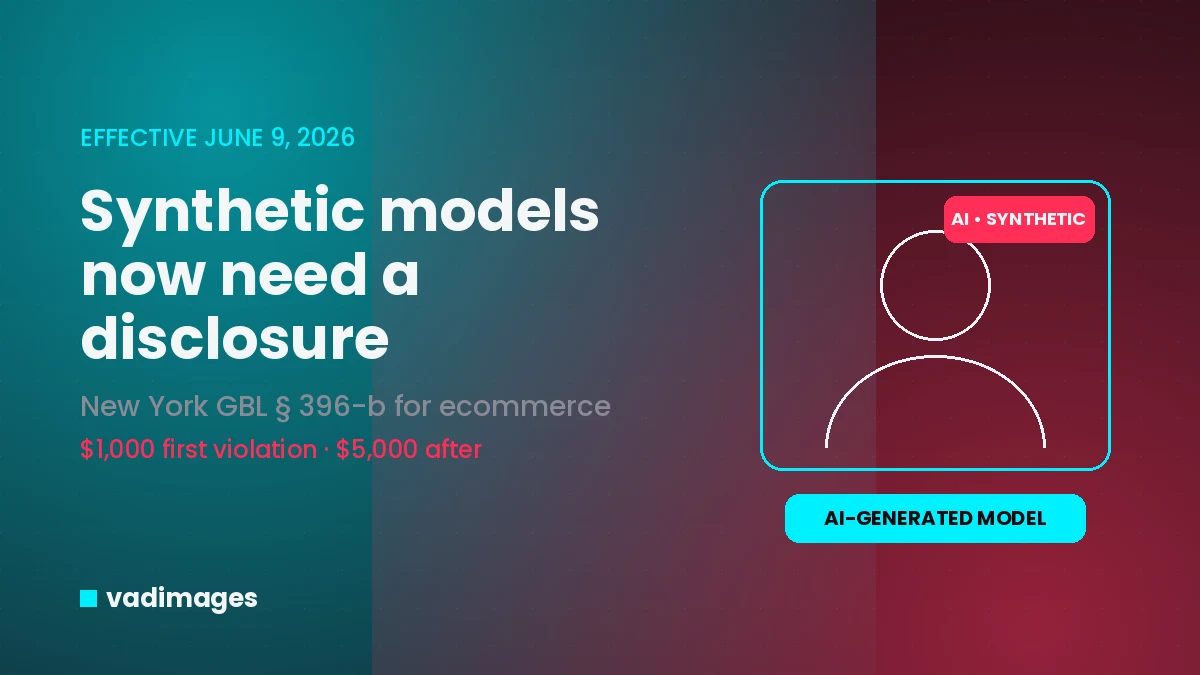
If your online store uses AI-generated models — the polished, photo-real “people” wearing your products in lifestyle shots — a new New York law now affects how you display them. On December 11, 2025, Governor Kathy Hochul signed S.8420-A/A.8887-B, a first-in-the-nation “synthetic performer” disclosure law that amends New York General Business Law § 396-b. It took effect on June 9, 2026. Any business that advertises property or services to a New York audience must now conspicuously disclose when an advertisement contains an AI-generated synthetic performer — and for ecommerce brands, that obligation reaches straight into the product imagery on your storefront.
What the law actually requires
The trigger is narrow but important. The disclosure obligation is not set off by “using AI” in general; it is set off by the inclusion of a “synthetic performer.” New York defines that as a digitally created asset — created, reproduced, or modified by computer using generative AI or a software algorithm — that is intended to create the impression of a human performance by someone who is not recognizable as any identifiable real person. In plain terms: a fabricated, photo-real human that looks like a real model but is no one in particular. A business that produces or creates an advertisement for a commercial purpose must “conspicuously disclose” that a synthetic performer appears in it, where the business has actual knowledge of that fact.
Two details matter for retailers. First, the law is technology-agnostic: even a digital human built with traditional, non-AI visual-effects software can qualify as a synthetic performer. Second, the statute does not define “conspicuous,” which leaves the content, placement, and formatting of the disclosure to market practice and enforcement — so the safe path is a clear, visible label, not fine print buried in a footer. Civil penalties run $1,000 for a first violation and $5,000 for each subsequent violation.
Why ecommerce is squarely in scope
Over the past two years, AI-generated lifestyle models have become a cheap alternative to traditional photo shoots. Brands and marketplace sellers now spin up an entire “cast” of synthetic people modeling apparel, accessories, and home goods on demand, with no studio, no booking, and no usage fees. That efficiency is exactly what puts ecommerce in the crosshairs: product detail pages, category banners, email creative, and paid social ads that feature these fabricated models are advertisements distributed to a New York audience, and the disclosure rule applies to them.
There are real carve-outs. The law exempts audio-only ads, situations where AI is used solely to translate a human performer’s language, and promotional material for expressive works such as films and video games when the synthetic character is used consistently with the underlying work. It also does not target the publishers or platforms that merely distribute an ad. But none of those exceptions help a typical retailer showing a synthetic model wearing a jacket on a product page. If you have actual knowledge that the “model” is fabricated, you need a conspicuous disclosure.
The operational problem this creates
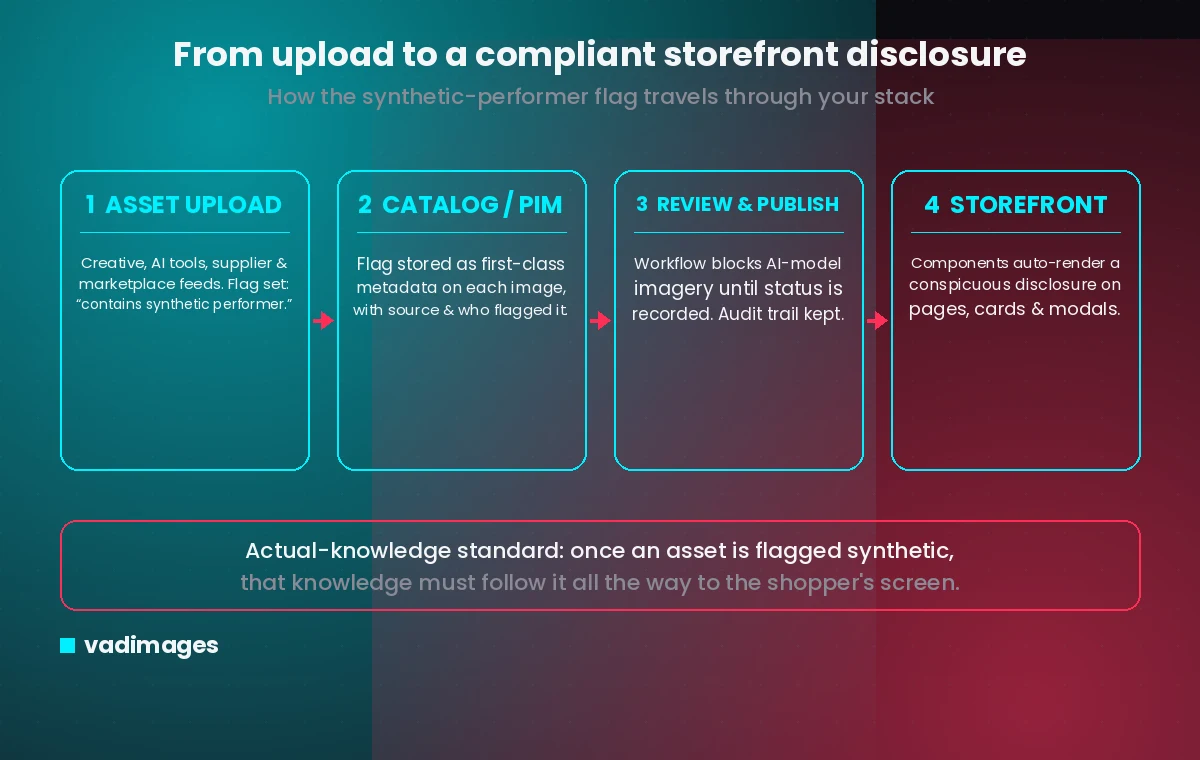
For most stores, the hard part is not adding one label — it is knowing, reliably and at scale, which of thousands of images contain a synthetic performer in the first place. Catalog imagery flows in from many sources: in-house creative, agencies, AI image tools, dropship suppliers, and third-party marketplace sellers. The “actual knowledge” standard cuts both ways: it limits liability where you genuinely don’t know, but the moment your team or your vendors flag an asset as synthetic, that knowledge has to travel with the image all the way to the customer-facing page.
That is a data and software problem, not a legal-copy problem. It calls for asset-level provenance tracking, a place to record whether each image contains a synthetic performer, and storefront logic that renders the disclosure automatically wherever that image appears — product page, listing card, hero banner, or quick-view modal — without relying on a person to remember.
What a compliant storefront looks like
Practically, an ecommerce build can carry this end to end. The cleanest approach treats “contains a synthetic performer” as a first-class attribute on every media asset, captured at the moment of upload and preserved through publication. Key building blocks include:
- A media metadata field in your CMS, PIM, or DAM that marks each image or video as containing a synthetic performer, plus the source and who flagged it.
- Intake checks at upload — a required prompt for creative teams and an API field for supplier and marketplace feeds — so the flag is set before an asset ever reaches the catalog.
- Storefront components that read the flag and render a conspicuous, accessible disclosure badge on product pages, listing cards, banners, and modals automatically.
- A review-and-publish workflow that blocks AI-model imagery from going live until its synthetic-performer status is recorded.
- An admin dashboard to inventory every asset and campaign featuring synthetic performers, so audits and proof of compliance take minutes rather than a manual image-by-image hunt.
Because the rule keys on a New York audience, many teams will choose to show the disclosure to all US shoppers for simplicity rather than geofencing — a product decision your front end should make easy to toggle either way.
How Vadimages helps
Vadimages builds the web and mobile software that makes this practical. For ecommerce clients, we design and develop storefronts, product-detail and checkout interfaces, and the admin tools behind them — including the media-metadata model that records synthetic-performer status and the storefront components that surface a conspicuous disclosure wherever a flagged asset renders. We build the upload and intake flows, the integration layer that pulls provenance fields from your DAM, PIM, supplier feeds, and marketplace APIs, and the admin dashboard that lets your team inventory and audit AI-model imagery across the catalog. On the mobile side, we extend the same disclosure logic into native and cross-platform shopping apps so the experience stays consistent. Whether you are on a headless stack, a platform like Shopify, or a custom build, we add this disclosure layer to your existing storefront rather than forcing a rebuild.
Bottom line
New York’s synthetic performer law is live as of June 9, 2026, and AI-generated models in product imagery are exactly the use case it reaches. The compliant move is to treat “contains a synthetic performer” as structured data that follows each asset from upload to the shopper’s screen, with the disclosure rendered automatically and an audit trail behind it. Get that plumbing right once and the label takes care of itself across your whole catalog.
This article is for general information only and is not legal advice; consult qualified counsel about how this law applies to your business.