
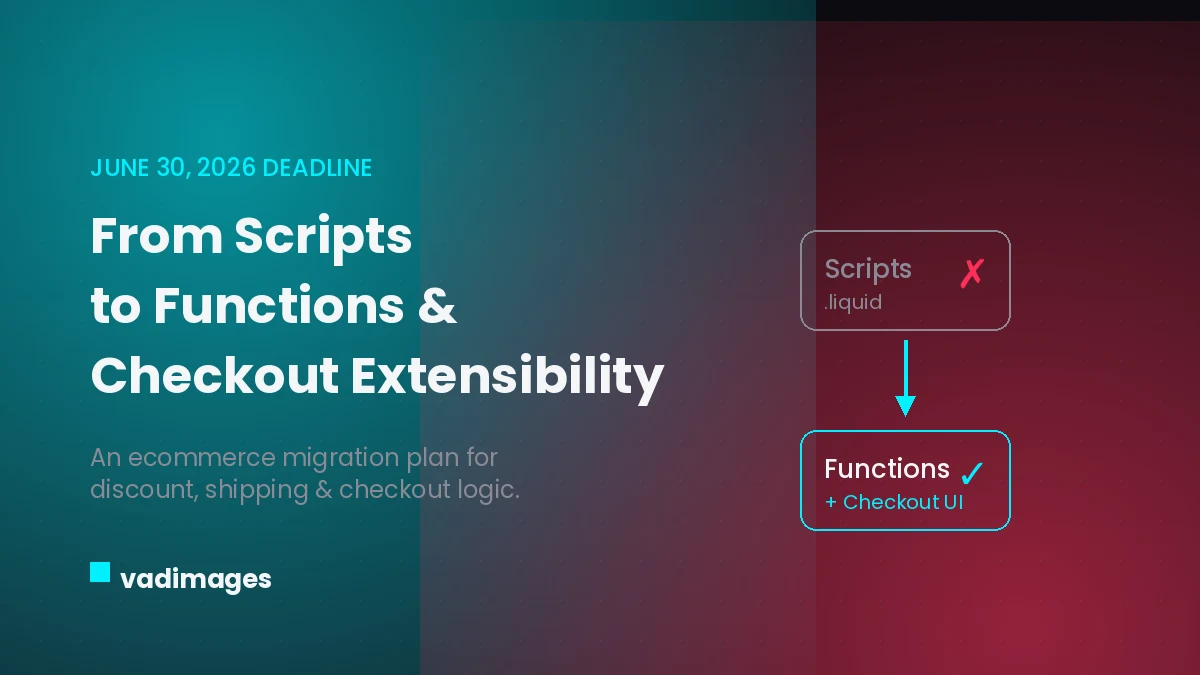
If your Shopify store quietly relies on a few lines of code to apply a tiered discount, hide a payment method, or surcharge a remote postcode at checkout, the clock is running out. Shopify Scripts — the legacy engine behind that logic — stops executing entirely on 30 June 2026. After that date, any discount, shipping, or payment rule still running through Scripts simply disappears, and the checkout falls back to default behaviour. With editing already frozen since 15 April, the window to plan, build, and test a replacement is now measured in days, not months. Here is what is changing, why it matters for revenue, and how to migrate without breaking your storefront.
What is actually being switched off
Two pieces of legacy Shopify technology are reaching end of life on the same trajectory. The first is Shopify Scripts, the Ruby-based system that let merchants customise discounts, shipping rates, and payment options at checkout through the Script Editor. The second is the older checkout.liquid customisation layer, where custom fields, banners, trust badges, and third-party integrations used to live. Both are being retired in favour of a modern, sandboxed architecture. The headline date is 30 June 2026, when Scripts stop running. A milestone has already passed: as of 15 April 2026, you can no longer create, edit, or publish Scripts — existing ones still run, but they are frozen exactly as they were.
The practical risk is that this logic is often invisible until it fails. A store can look perfectly healthy in the admin while a Script silently applies a wholesale discount or suppresses cash-on-delivery for certain regions. When that Script stops firing, nothing throws an error — customers simply see the wrong prices, the wrong shipping options, or payment methods that should have been hidden. The failure mode is lost margin and confused buyers, not a red banner telling you what broke.
The two deadlines that matter
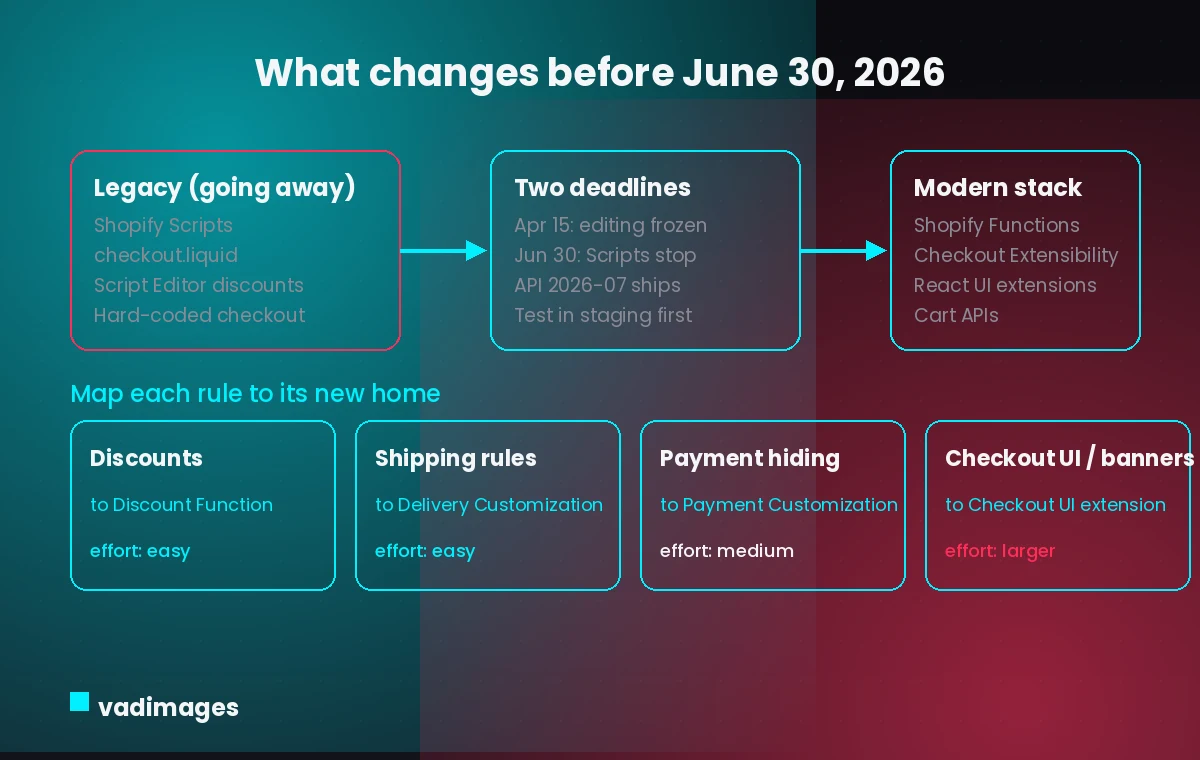
It helps to treat this as two dates rather than one. The 15 April 2026 freeze means your current Scripts are now a fixed snapshot — you cannot tweak them, so any change to discount or shipping logic between now and the cutoff must already be built on the new system. The 30 June 2026 shutoff is the hard stop: after it, the Scripts engine is gone. Shopify has also been shipping the replacement APIs on a rolling schedule, with new capabilities landing in the 2026-07 API version, so building against current, supported endpoints matters for anything you implement now.
For most merchants the honest assessment is that the easy migrations are genuinely easy, and the hard ones are real projects. Anything that touches the legacy checkout layer — custom checkout UI, multi-step logic, deep third-party integrations — is best planned as a three-to-five week effort including testing, not a weekend patch.
Functions and Checkout Extensibility, explained
The replacement comes in two parts. Shopify Functions are small, fast, sandboxed programs that run on Shopify’s infrastructure and handle back-end logic: discount calculations, delivery customisations, and payment customisations. They execute quickly and predictably, which is part of why Shopify is forcing the move. Checkout Extensibility is the front-end half — a component-based system where custom UI, banners, custom fields, and integrations now live as checkout UI extensions instead of edits to checkout.liquid.
The migration is really an exercise in mapping each old behaviour to its new home. A Script that applied a buy-more-save-more discount becomes a Discount Function. A Script that adjusted or renamed shipping options becomes a Delivery Customization. One that hid a payment method for certain carts becomes a Payment Customization. The banners and custom fields from the old checkout become UI extensions. The figure below shows that mapping at a glance.
Why this is an ecommerce problem, not just an IT chore
Checkout is where revenue is decided, so anything that degrades it has a direct line to the bottom line. The risks of doing nothing are concrete:
- Promotions stop applying — tiered, volume, or wholesale discounts vanish, so customers either overpay and abandon, or you honour prices manually and bleed margin.
- Shipping logic resets to defaults — surcharges, free-shipping thresholds, and region rules disappear, exposing you to unprofitable orders.
- Payment rules fail open — methods you deliberately hid for fraud or cost reasons reappear at checkout.
- Checkout customisations break — trust badges, delivery-date pickers, gift options, and B2B fields silently stop rendering.
Because none of these throw visible errors, the safest path is to rebuild and verify each rule in a staging environment, confirm parity against the live behaviour, and only then cut over — well before 30 June rather than on the day.
How Vadimages helps
This is squarely web-development work, and it is what we do. Vadimages builds and migrates Shopify storefronts, checkout experiences, and the web app logic behind them. For this deadline specifically, we start with an audit of your existing Scripts and checkout.liquid customisations, then rebuild each one on the supported stack:
- Re-implementing discount, shipping, and payment logic as Shopify Functions that match your current rules exactly.
- Rebuilding custom checkout UI — banners, custom fields, trust signals, B2B and delivery options — as Checkout Extensibility UI extensions.
- Reconnecting third-party tools (loyalty, tax, subscriptions, ERP, marketing) through supported APIs and the modern Cart APIs instead of brittle checkout edits.
- Standing up a staging store to test parity, then handling the cutover and post-launch monitoring.
- Extending the same logic into your storefront and any companion mobile app so promotions and pricing stay consistent across every channel.
The goal is a checkout that behaves identically to today — only now it runs on the architecture Shopify will keep supporting, with cleaner code you can actually change again after 15 April.
Bottom line
Shopify Scripts stop executing on 30 June 2026, and the editing freeze is already in effect. The discount and shipping migrations are quick; the checkout-UI work is a real project. Map every rule to its Function or UI-extension equivalent, rebuild and test in staging, and cut over before the deadline — not on it. If your checkout quietly depends on Scripts, now is the moment to find out and fix it.