

On June 17, 2026, Shopify shipped its Spring ’26 Edition — a twice-yearly bundle of more than 150 platform updates — and the headline is not a new theme or a faster checkout. It is that Shopify has thrown open the doors to agentic commerce. Building on Shopify’s AI-agent layer used to require an approval process. That requirement is gone. Any developer can now register an agent profile and call a public endpoint to build experiences that search products, build carts, and complete checkout across millions of merchants. For online retailers, this quietly redraws the map of how customers will find and buy products.
What Shopify actually shipped
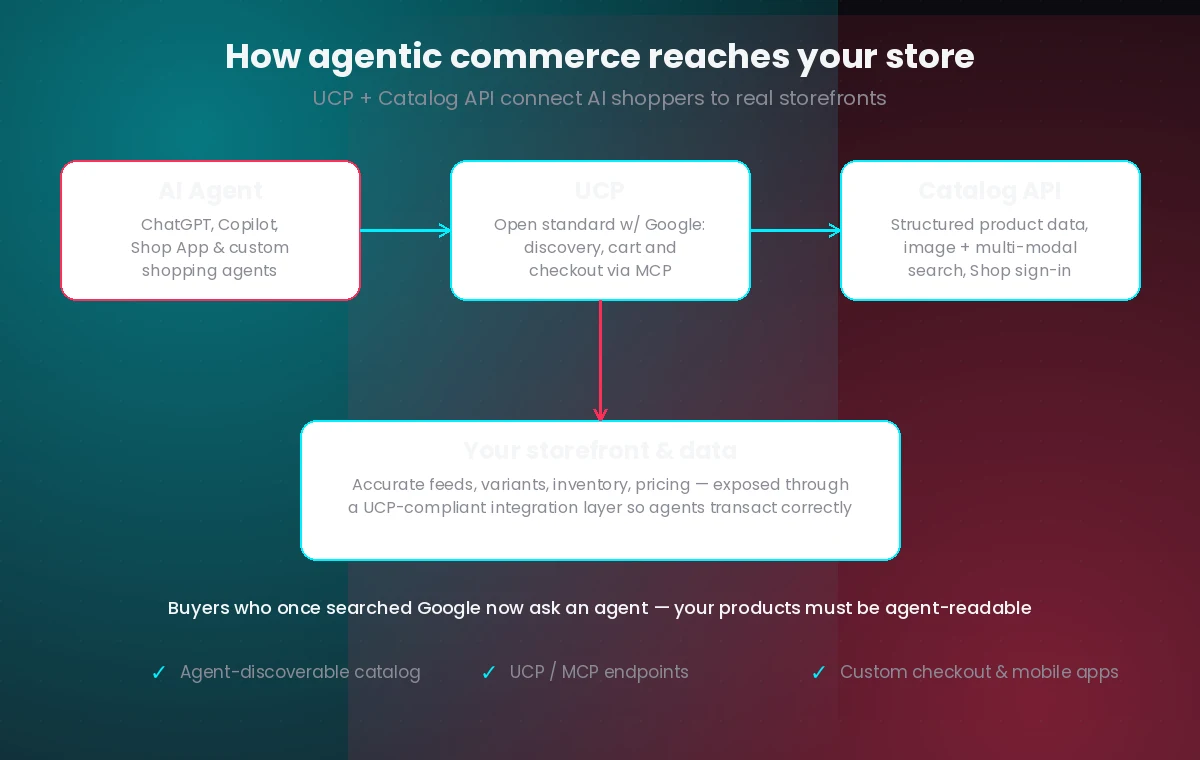
The center of the announcement is the Universal Commerce Protocol (UCP) — an open standard Shopify co-developed with Google that defines how AI agents transact with merchants across the full journey from discovery to cart to checkout. In the previous Edition, Shopify rebuilt its developer platform around AI but kept access gated. Spring ’26 makes that infrastructure self-serve: developers register an agent profile in the Developer Dashboard, call the public Model Context Protocol (MCP) endpoint, and build end to end without applying for permission. Shopify reports broad industry backing for UCP from Amazon, Meta, Microsoft, Salesforce, Stripe, Etsy, Target, and Wayfair — a sign this is being positioned as a shared standard rather than a Shopify-only feature.
Why “agentic commerce” matters for online stores
For two decades, the discovery battle was fought on search engines and social feeds: rank well, run ads, win the click. Agentic commerce changes the surface. A growing share of shoppers now begin with an AI assistant — asking ChatGPT, Copilot, or a shopping agent to find, compare, and even buy on their behalf. If your catalog is not legible to those agents, your products simply do not appear in the answer, no matter how good your storefront looks to a human. The shift is less about a flashy new feature and more about a new distribution channel that rewards structured, accurate, machine-readable product data.
That is the strategic weight behind Shopify’s move. By making UCP self-serve and pairing it with a discovery layer, Shopify is trying to ensure its merchants show up wherever buying decisions now happen — inside assistants and agents, not just on Google’s results page.
Inside UCP and the Catalog API
Two pieces do the work. UCP defines the shape of the conversation between an agent and a store, and it is deliberately transport-flexible — it works over REST, GraphQL, JSON-RPC, MCP, and agent-to-agent (A2A) channels. It does not try to own everything: it plugs into the Agent Payments Protocol (AP2) for payment authorization, MCP for tool access, and A2A for delegating across agents. The Catalog API is UCP’s discovery layer, turning products from millions of merchants into structured, queryable data that agents can read accurately.
Several details matter for retailers planning a build:
- Catalog access now takes only an API key — no approval — and powers visible surfaces like ChatGPT, Copilot, and the Shop app today.
- It adds image search, multi-modal (text plus image) search, and a lookup endpoint that resolves product URLs into real catalog matches.
- It supports Sign in with Shop, so a build can reuse a trusted buyer identity instead of forcing a new login.
- Shopify states that AI searches powered by its Catalog convert at twice the rate of those using scraped data — underscoring why accurate, first-party feeds beat guesswork.
What this means for store owners
The practical takeaway is that being “on Shopify” is no longer enough to be found by an agent — your product data has to be complete, current, and structured the way the protocol expects. Variants, inventory, pricing, sizes, colors, and delivery estimates all become signals an agent uses to present (or skip) your items. Stores running on headless or custom front ends need a deliberate integration layer so an agent sees the same accurate truth a shopper would. And because agents can now carry a buyer from a question straight through checkout, the checkout and post-purchase experience need to behave correctly when the “customer” is software acting on a person’s behalf.
None of this requires abandoning your existing storefront. It does mean treating agent-readability as a first-class requirement alongside SEO and page speed — a new channel to instrument, test, and maintain.
How Vadimages helps
Vadimages builds the web and mobile software that makes a store ready for this shift. On the storefront side, we develop custom and headless commerce front ends, product-detail and search experiences, and checkout flows that hold up whether the buyer is a person or an agent. On the data side, we build the integration layer that keeps your catalog, variants, inventory, and pricing accurate and structured — the feed that determines whether an agent represents your products correctly. We implement and expose UCP- and MCP-compatible endpoints, connect your store to the Catalog API and other commerce APIs, and wire in trusted sign-in so identity carries across experiences. And when discovery moves to phones and assistants, we build the native and cross-platform mobile shopping apps and dashboards that let you watch this new channel and act on it. Our scope is squarely web and mobile development — storefronts, portals, dashboards, API integration layers, and apps — not the payment networks or AI models themselves.
Bottom line
Shopify opening agentic commerce to every developer is a signal, not a niche. The next wave of shoppers will increasingly ask an agent to find and buy, and the stores that win will be the ones whose product data and checkout are built to be read and acted on by software. Getting your storefront, catalog feed, and integration layer ready now is the difference between showing up in the answer and being invisible to it. Treat agent-readability as the new front door — and build for it deliberately.