
If you run a business in the Portland metro and you have decided it is time to build custom software, your next problem is not code. It is trust. You are about to hand a team money, deadlines, and a piece of how your company runs, and you need to know before you sign that they can deliver. The hard part is that almost every software developer in Portland, Oregon will tell you they are experienced, reliable, and reasonably priced. Your job is to figure out which ones actually are.
At Vadimages we build custom software for small and mid-sized businesses across the Pacific Northwest from just across the river in Vancouver, Washington. We compete for Portland projects every week, and we lose some of them to good teams and win others from teams that overpromised. This guide is what we would tell a friend who asked us how to choose. It is not a sales pitch for one agency. It is a practical list of what separates a developer who will make your life easier from one who will quietly become your biggest headache.
Read it before your first discovery call. The goal is simple: by the end of a 45-minute conversation, you should be able to tell whether a team understands your business, will tell you the truth, and can ship working software at a price you can predict.
Why "local" still means something in Portland
Software can be written from anywhere, so it is fair to ask whether hiring a Portland-area developer buys you anything a cheaper remote shop does not. In our experience it buys you three concrete things. The first is time zone. When your developer works Pacific hours, a question you send at 9am gets answered before lunch, not overnight. Over a six-month build, that difference compounds into weeks of saved calendar time. The second is the option to meet in person. Most projects never need it, but the ones that go sideways almost always get fixed faster in a room than on a screen. The third is accountability that has a face and an address. A local team you can look up, whose past clients you can call, and who will still be around Portland next year is a very different bet than an account you found on a marketplace.
None of that means local is automatically better. It means proximity is a real advantage you should weigh honestly against price, and you should make a developer earn the premium by being genuinely easier to work with. The rest of this guide is how you test for that.
Start with proof, not promises
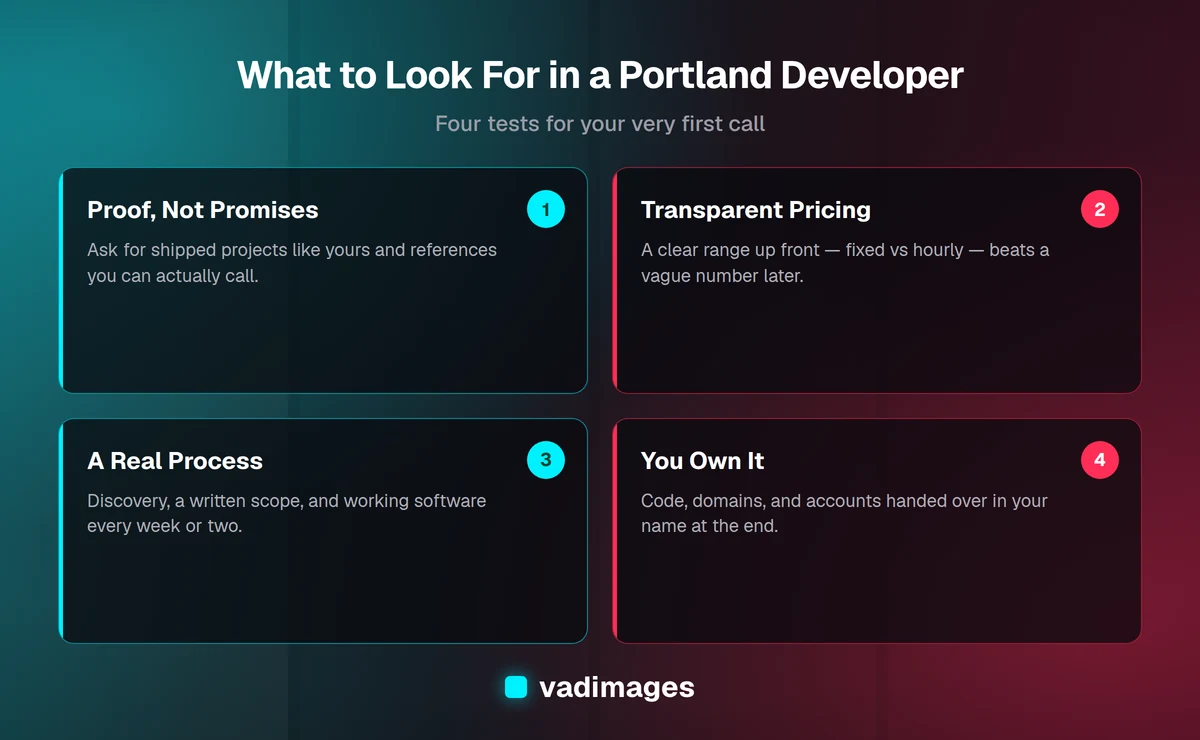
Anyone can describe great work. Fewer can show it. The single most reliable signal in the whole hiring process is a portfolio of shipped software you can actually look at or, better yet, use. Ask each developer to walk you through two or three real projects that resemble yours in size and complexity. You are listening for specifics: what the business needed, what they built, what went wrong along the way, and what the client got out of it. A team that only speaks in adjectives — "robust," "scalable," "cutting-edge" — and cannot tell you a concrete story is waving a flag.
Then go one step further and check the story. Ask for references and call them. A short conversation with a past client tells you things no proposal will: whether the team hit their dates, how they handled the inevitable surprise, and whether the person would hire them again. Our own case studies exist for exactly this reason — so a prospective client can see the before-and-after of a real business, not a stock illustration. When you evaluate any Portland developer, treat "show me" as your default and be politely suspicious of anyone who cannot.
Insist on transparent, predictable pricing
Pricing is where good and bad developers separate most clearly, and it is the area where local teams should have the least to hide. The warning sign is not a high number or a low one — it is vagueness. A developer who will not put a range on paper until you are deep into the relationship is protecting their flexibility at the expense of yours. You want a team that will tell you early, in plain terms, roughly what a project like yours costs and what drives that number up or down.
We publish our pricing openly and start custom projects at $5,000 and up, because we would rather lose a deal on the first call than surprise a client on the last invoice. When you compare Portland developers, ask each of them the same direct questions. What is your estimate for this scope? What is fixed and what is hourly? What happens to the price if we change our minds halfway through? How do you handle work that turns out harder than expected? The answers matter less than the willingness to answer. A team comfortable talking about money is usually a team comfortable telling you the truth about everything else.
Look for a real process, not just talented people
Skill matters, but process is what turns skill into a finished product on a schedule. Ask any developer to describe, step by step, what the first ninety days of working together would look like. A strong answer sounds like a sequence you could follow on a calendar: discovery and scoping, a written plan you approve, short build cycles with something to see every week or two, testing, and a launch with a plan for what comes after. A weak answer is a shrug and "we will figure it out as we go."
The reason this matters so much is that how a team works determines whether you will ever be surprised in a bad way. Regular demos mean you catch a misunderstanding in week three instead of month three. A written scope means the definition of "done" is not a moving target. Clear cycles mean you always know what is being worked on and what is next. When you interview Portland developers, favor the ones who can hand you a map of the road ahead over the ones who are simply confident they will find their way.
Communication built for a business owner
You are not hiring an engineer to impress you with jargon. You are hiring a partner who can translate between your business and the technology that serves it. The best developers explain trade-offs in language you can act on: this feature adds two weeks, that one saves your team an hour a day, this shortcut will cost us later. Watch how a team communicates during the sales process, because it only gets more honest, never less, once the contract is signed. If they are hard to reach, slow to reply, or condescending before you have paid them a dollar, believe it.
Ask who your day-to-day contact will be and whether that person changes after the deal closes. A common trap is a polished salesperson up front and an anonymous queue afterward. With a good local team, the people who scope your project are close to the people who build it, and you always know exactly who to call. That continuity is one of the quiet reasons proximity still pays off.
Make sure you own what you pay for
This is the question business owners forget to ask and later regret. When the project is done, who owns the code, the design files, the domain, and the accounts everything runs on? The right answer is that you do. You are commissioning software, not renting it, and a trustworthy developer hands over the keys — source code in a repository you control, documentation, and administrative access to every service in your name. Some shops build on proprietary platforms or keep your credentials so you cannot leave without them. That is a cage, and it is worth walking away over.
Ask directly, early, and get the answer in writing: at the end of this engagement, what exactly do we own and how is it transferred to us? A developer who has done right by their clients will have a clean, practiced answer. One who hesitates is telling you how the relationship ends before it begins.
Plan for the day after launch
Software is never truly finished. Browsers update, business changes, users find edges you never imagined, and something always needs a fix or an addition. The developers worth hiring plan for that from the start and are candid about what ongoing support costs. Ask what happens after launch. Is there a maintenance plan? What is the response time when something breaks? How are new features scoped and priced once the first version is live?
A team that only wants the big upfront build and disappears afterward leaves you stranded the first time something goes wrong. A team that expects a long relationship prices the build fairly because they are not trying to make all their money in one shot. When you look at Portland developers, treat post-launch support as part of the product, not an afterthought — because a year from now it will feel like the most important part.
Portland versus offshore: the honest math
Almost every business we talk to has, at some point, gotten a quote from an overseas team at a fraction of a local price, and it is fair to take that seriously. Sometimes offshore is the right call, especially for a very well-defined, self-contained piece of work. But the sticker price is not the real price. Factor in the overnight communication lag, the time you personally spend clarifying requirements across a language and culture gap, the rework when something is built to the letter of a spec but not its intent, and the difficulty of holding anyone accountable when things go wrong. Those costs are real; they just do not appear on the invoice.
A capable Portland-area team costs more per hour and usually less per outcome, because more of those hidden hours are theirs instead of yours. The way to decide is not ideology, it is a clear-eyed comparison for your specific project. If your work needs close collaboration, evolving requirements, or someone who understands the industry you operate in, local tends to win once you count everything. If it is a small, frozen spec, offshore may be fine. Do the honest math rather than the flattering one.
A short checklist for your first call
Bring these to every developer conversation and compare the answers side by side:
- Can you show me two or three shipped projects like mine, and give me references I can call?
- What is your rough price range for this scope, and what is fixed versus hourly?
- Walk me through the first ninety days — how often will I see working software?
- Who is my point of contact, and does that change after we sign?
- At the end, what do I own, and how do you transfer the code and accounts to me?
- What does support and maintenance look like once we launch?
If a team answers all six clearly and without flinching, you have found someone worth trusting with your project. If they dodge even two of them, keep looking. The right developer will be relieved you asked, because prepared clients make for better software and both sides know it.
How Vadimages fits
We are a Pacific Northwest software team based in Vancouver, Washington, minutes from Portland, and we built our whole practice around the standards above. We show our work, we publish our prices, we hand over every line of code, and we plan for the long relationship rather than the quick build. If you are weighing your options and want a straight answer about what your project would take and cost, get in touch — even if you decide to go another way, you will leave the conversation knowing exactly what to look for. And if you want to see the kind of software we build for businesses like yours, our solutions and case studies are the best place to start.