
If your business runs on software that is starting to feel more like a liability than an asset, you have probably already accepted that something needs to change. The harder question is how. "Modernize the legacy system" is not a single action — it is a menu of very different strategies, each with its own cost, timeline, and level of risk. Choosing the wrong one is how modernization projects blow their budgets, drag on for a year, and still leave you with software nobody trusts.
At Vadimages we build and modernize custom software for small and mid-sized businesses across the Pacific Northwest, from just across the river in Vancouver, Washington. We have watched companies pour money into a full rewrite they never needed, and we have watched others limp along with a quick patch that solved nothing. This guide compares the main legacy modernization strategies in plain English — what each one is, when it fits, what it tends to cost in money and risk — so you can walk into the decision knowing which path actually matches your situation.
What a "legacy modernization strategy" really means
A legacy modernization strategy is simply the approach you choose for bringing an aging system up to date. The reason it matters so much is that the strategies are not interchangeable. Wrapping an old system in a modern interface and rewriting it from scratch both count as "modernization," but one is a few weeks of low-risk work and the other is a multi-month project that can reshape your whole operation. The goal is never to use the newest technology for its own sake. It is to spend the least money and take the least risk to get the business outcome you actually need — lower maintenance costs, better security, faster feature delivery, or the ability to integrate and scale.
Industry practitioners often talk about the "R's" of modernization: retain, encapsulate, rehost, replatform, refactor, rebuild, and replace. That vocabulary is useful, but for most SMB decisions it collapses into a handful of practical choices. Below we compare the strategies that matter most, ordered roughly from lightest-touch to most involved.
Strategy 1: Encapsulate — wrap the old system in a modern layer
Encapsulation leaves the legacy system running exactly as it is and puts a modern access layer — usually an API — in front of it. You do not change the old code; you make it reachable and reusable by newer tools. This is the cheapest and lowest-risk strategy, and it is often the first move in a longer plan.
When it fits: the system still does its job and you cannot afford downtime, but it is isolated and hard to connect to anything. Encapsulation buys you integration — a clean way to feed data into a new CRM, analytics platform, or customer portal — without touching the fragile core. The trade-off: you have modernized the edges, not the system. The old maintenance, security, and hiring problems are still in there. Encapsulation is a bridge, not a destination.
Strategy 2: Rehost — lift and shift to modern infrastructure
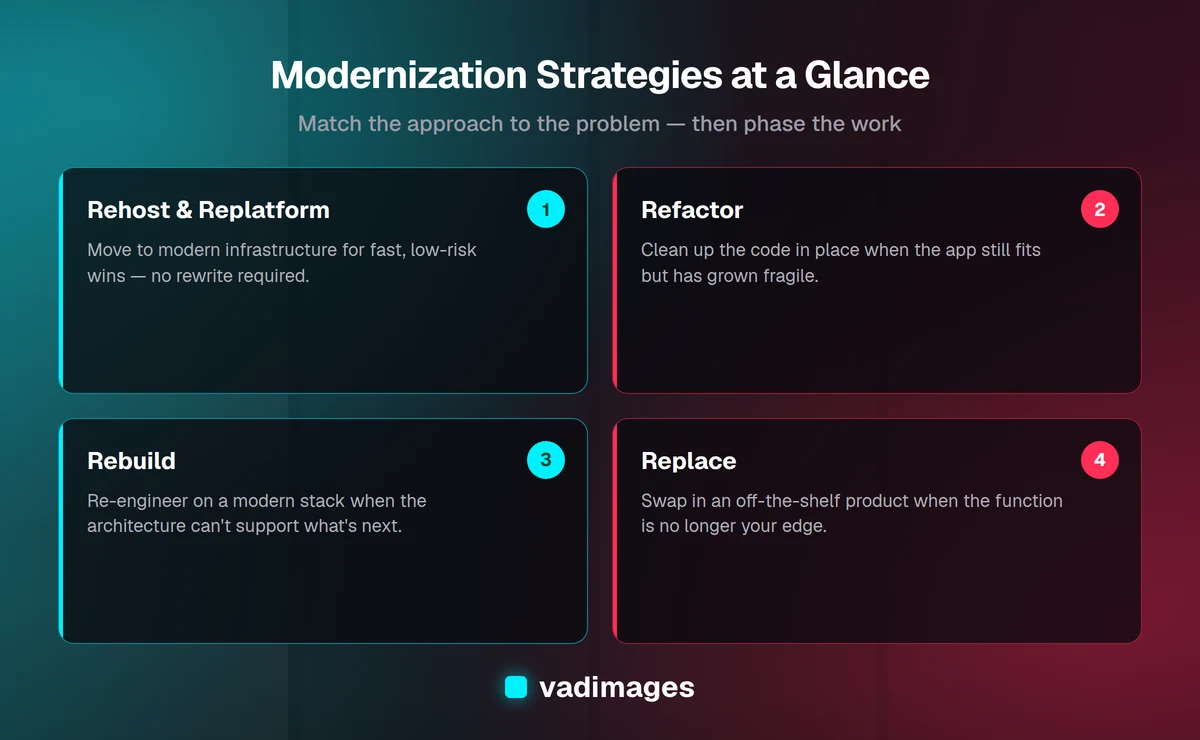
Rehosting, often called "lift and shift," moves the application to new infrastructure — typically from an aging on-premise server to the cloud — with little or no change to the code itself. You get better reliability, easier scaling, and modern hosting security without rebuilding anything.
When it fits: the software is fundamentally sound but the hardware or data center underneath it is the risk — old servers, an expiring lease, or a machine only one person knows how to keep alive. Rehosting is fast and comparatively low-risk. The trade-off: moving old code to a shiny new server does not fix old code. If the application is slow or hard to change, it will be exactly as slow and hard to change in the cloud. Rehosting solves an infrastructure problem, not a software problem.
Strategy 3: Replatform — modernize the surroundings without a rewrite
Replatforming sits one step beyond rehosting. You still avoid a full rewrite, but you make targeted upgrades to the parts around the application — moving to a managed, current database version, swapping a self-managed component for a cloud service, or updating a runtime that is past end-of-life. The core logic stays largely intact; its foundation gets meaningfully more modern.
When it fits: the application is worth keeping but depends on something that is becoming a liability — an unsupported database, an outdated framework version, brittle infrastructure. Replatforming captures real gains in security and maintainability for a fraction of a rebuild's cost. The trade-off: it takes more care and testing than a straight rehost, and it still leaves the application's fundamental design unchanged. If the architecture itself is the problem, replatforming will not reach it.
Strategy 4: Refactor — improve the code in place
Refactoring changes the software's internal structure without changing what it does from the outside. You clean up tangled code, upgrade the framework, break a monolith into more manageable pieces, and pay down the technical debt that makes every change slow and scary. From a user's perspective nothing changes; under the hood, the system becomes safer and faster to work with.
When it fits: the application still does what the business needs, but it has grown fragile — small changes break unexpected things, onboarding a new developer takes months, and everyone is afraid to touch certain files. Refactoring restores your ability to move quickly. The trade-off: it is more involved than the infrastructure-level strategies, and because the payoff is internal, it can be a harder investment to justify to non-technical stakeholders. Done well, though, it often delivers the best value-to-risk ratio of any strategy.
Strategy 5: Rebuild — re-engineer on a modern stack
Rebuilding means rewriting the system on modern technology while preserving the parts of its design that still make sense. This is the strategy most people picture when they hear "modernization," and it is the most powerful — you are no longer constrained by yesterday's decisions. It is also the most expensive and the riskiest, which is exactly why it should not be the default.
When it fits: the current architecture genuinely cannot support where the business is going, and no amount of refactoring will get it there. A rebuild is justified when the ceiling is real, not just uncomfortable. The trade-off: "big bang" rewrites are notorious for running over budget, missing requirements the old system quietly handled for years, and stumbling at cutover. If you rebuild, do it incrementally rather than all at once — more on that below. Reach for this strategy deliberately, with clear eyes about the commitment.
Strategy 6: Replace — retire the custom system for an off-the-shelf product
Sometimes the best modernization strategy is to stop maintaining custom software altogether. Replacement retires the legacy system and adopts a mature commercial product in its place. Not everything needs to be bespoke, and a well-supported off-the-shelf tool can be cheaper and better than a custom system you are struggling to keep alive.
When it fits: the system handles a commodity function — accounting, scheduling, basic inventory — that is no longer a competitive differentiator, and the market now offers a solid product that does it well. The trade-off: you give up the exact fit and full ownership that custom software provides, and you take on data migration plus the risk of bending your process to match someone else's tool. Where the software is your differentiator, replacement is the wrong call — that is precisely the software worth investing in. Our work across different industries and solutions is usually about the opposite case: building or modernizing the systems that give a business its edge.
How the strategies compare on cost, risk, and time
Laid side by side, the strategies form a clear spectrum. As you move from encapsulation toward a full rebuild, the potential payoff grows — but so do the cost, the timeline, and the risk. Here is the shape of the trade-offs:
- Encapsulate: lowest cost, lowest risk, fastest. Unlocks integration but leaves the core untouched.
- Rehost: low cost, low risk, fast. Fixes the infrastructure; does nothing for the code.
- Replatform: moderate cost, moderate risk. Modernizes the foundation without redesigning the app.
- Refactor: moderate to higher cost, controllable risk. Restores speed and safety of change; often the best value.
- Rebuild: highest cost, highest risk, longest timeline. The most transformative — and the one to phase, never big-bang.
- Replace: variable cost, migration risk. Removes maintenance entirely for commodity functions you should not be building yourself.
The most important thing to understand is that these are not mutually exclusive. A real modernization plan almost always mixes them. You might replatform the database, refactor the two modules that change most often, encapsulate the stable core behind an API, and replace the reporting piece with an off-the-shelf tool — all as one coordinated program. Matching the approach to each part of the system, rather than applying one strategy to everything, is what separates a smart plan from an expensive one.
How to choose the right strategy
The choice is a business decision as much as a technical one, and it comes down to a few honest questions. Answer them for each significant part of your system, not just the system as a whole.
- Does this part still do what the business needs? If yes, lean toward the lighter strategies — encapsulate, rehost, replatform, or refactor. If it fundamentally cannot, that is where rebuild or replace earn their cost.
- Is the problem the infrastructure, the code, or the design? Infrastructure points to rehost or replatform. Fragile-but-sound code points to refactor. A design that has hit its ceiling points to rebuild.
- Is this software a competitive differentiator? If it is what makes you better than the alternative, invest in it — refactor or rebuild. If it is a commodity, replacing it frees your team to focus on what matters.
- How much risk and downtime can the business absorb right now? Tight tolerance favors incremental, lower-risk moves you can stop or reverse. More headroom makes a larger rebuild feasible.
A good partner helps you run this assessment objectively, without the sunk-cost attachment that makes it hard to judge your own system fairly. That is exactly the kind of work we scope in how we work — starting from what the system costs you today and what the business needs next, then recommending the lightest strategy that gets you there.
Why phasing beats a big-bang, whatever strategy you pick
Whichever strategies you choose, how you sequence the work matters as much as the strategies themselves. The single most reliable way to modernize without betting the company is the strangler pattern: instead of replacing everything at once, you build new capability around the edges of the old system and gradually route work to it, until the legacy pieces can be switched off one at a time. Every step delivers value on its own, and you are never one risky cutover away from disaster.
In practice this usually means putting a modern layer in front of the old system — that encapsulation step from earlier — and then refactoring, replatforming, rebuilding, or replacing one capability at a time behind it. A reporting module this quarter, a customer-facing workflow the next. The business keeps running throughout, and you learn as you go instead of discovering problems at a single high-stakes launch. For most SMBs, incremental modernization is not just safer; it is the version that actually finishes. You can see the shape of this in our case studies, where the wins come from staged, low-risk transitions rather than dramatic rip-and-replace projects.
What it costs and how to start
Cost tracks the strategy. An encapsulation or a first replatforming slice is a modest commitment; a full rebuild is a much larger one — which is the strongest argument for starting light and phasing the rest. The useful reframe is to compare any modernization spend against what the legacy system already costs you in maintenance, downtime, security exposure, and missed opportunities. You are paying for the old system either way; modernization redirects that money toward something that pays you back.
At Vadimages, engagements start at $5,000 and up, and we scope them transparently so you know what you are paying for and what it will deliver before any work begins — you can see our ranges on the pricing page. The right first step is rarely to pick a technology. It is to take an honest inventory of what you have, quantify what it costs, and identify the one or two pieces that are most expensive, most fragile, or most limiting. That assessment tells you which strategy fits where, and it turns "modernize the whole thing someday" into a plan you can start on this quarter.
Frequently asked questions
Which modernization strategy is best? There is no single best strategy — the right one depends on whether your problem is the infrastructure, the code, or the design, and on whether the software is a differentiator or a commodity. Most successful plans combine several strategies, matching each to a different part of the system.
Do we have to rebuild from scratch? Usually not. A full rebuild is the most expensive and highest-risk path, and lighter strategies — encapsulate, rehost, replatform, refactor, or replace — often deliver what you need for far less. Reserve a rebuild for when the architecture genuinely cannot support where the business is going.
Can we modernize without disrupting daily operations? Yes. The strangler pattern lets you replace or upgrade one piece at a time while the business keeps running, avoiding a high-stakes all-at-once cutover.
What if only one person understands our current system? Treat that as an urgent signal. Key-person risk is one of the most common ways a manageable situation becomes an emergency. Start documenting the system now and begin an incremental modernization before that knowledge walks out the door.
The bottom line
Modernizing a legacy system is not one decision; it is a series of choices about how much to change and in what order. Encapsulate and rehost when you need speed and safety. Replatform and refactor when the foundation or the code is holding you back. Rebuild when the design has truly hit its ceiling, and replace when a function is no longer worth building yourself. Then phase the work so the business never rides on a single risky launch. Get an honest read on which strategy fits where, and modernization stops being a gamble and becomes a plan. If you want that read on your own system and a practical, low-risk path forward, reach out through our contact page. We build for humans and optimize for growth.